3D Imaging to help plan plastic surgery
Medically reviewed by Shervin Naderi, MD, FACS, double board-certified facial plastic surgeon
20+ Years of Facial Plastic Surgery
100,000+ Procedures Performed
4.9★ from 1,100+ Google Reviews

See Your Best Self, 3D Imaging Benefits
Canfield 3D imaging lets you see a simulation of a possible result before you decide on a face or neck procedure. It takes much of the guesswork out of planning and gives you and your doctor the same picture to discuss.
Precision Planning
3D imaging helps plan your treatment around your goals and shows what is realistic for your face.
Informed Decisions
Seeing a simulated outcome makes it easier to decide what you want, and what you don't.
Enhanced Consultation
You and your doctor look at the same simulated result, which makes the consultation a real two-way conversation.
Board Certified & Recognized





Canfield 3D Imaging: Vectra H2 for Facial Plastic Surgery Imaging
Vectra H2 face and neck system simultaneously takes a number of photos of the patient from different points of view. It does this through multiple cameras. Once the photos are taken, a special Sculptor 3D software constructs an extremely accurate three-dimensional image of the patient’s face and neck.
Dr. Naderi can then use the Sculptor software to change the dimensions and volumes of the face and simulate a realistic surgical result. These changes can be viewed from virtually any angle and compared to the original image.
This lets us sit down with patients, make sure they have a realistic picture of what to expect, and agree clearly on the goals of the procedure.
We will bring the experience.
Simulation technology used for a variety of surgical procedures
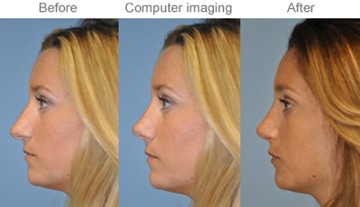
Here at The Naderi Center, we use the Vectra H2 system for a variety of face and neck procedures such as facelift, neck lift, chin augmentation, and rhinoplasty. You can look at a simulated rhinoplasty result from many angles, or see how a larger chin would strengthen your profile and balance your features.
Dr. Naderi and his patients have found simulation technology to be a very useful tool during the consultation and preoperative phases. Dr. Shervin Naderi remarks that, “The technology provided to us by Canfield allows for more productive dialogue between me and the patient, as well as better visualization of realistic surgical expectations”.
Offering patients latest imaging technology is one of the many ways that The Naderi Center differentiates itself from the typical plastic surgery practice
How does the Vectra H2 system plastic surgery simulation work?
When we decide to use the Vectra H2 system, we’ll ask a patient to stand in front of the device. Once turned on, it will snap six 2 dimensional photographs with six sophisticated cameras simultaneously. It will also take accurate measurements to instantly produce a 3D image of the patient’s face and neck. The image is detailed enough that, zoomed in, Dr. Naderi can see pores, freckles and pigmented spots on the face or neck.
2D imaging is used to predict after cosmetic surgery results
The Mirror suite is Canfield’s 2D imaging software. It includes PhotoFile, PhotoTools, Rejuvenation and 2D simulation tools, and we use it to manage patient photos, explain findings visually and simulate aesthetic changes.
Imaging technology: PhotoFile feature
PhotoFile keeps all of a patient’s photos organized and accessible in a HIPAA-compliant way, and it includes several tools we use during consultations.
The loupe tool lets us look closely at the skin to find problem areas and recommend the right treatment. With the side by side view, we can track a patient’s treatment progress while demonstrating their results.
PhotoFile can also export images into a PowerPoint presentation for the patient to keep, and its iPad consultation app makes it easy to walk patients through their photos during a visit.

PhotoFile also connects to a secure, password-protected portal where patients can log in from home to see their photos, treatment recommendations and progress.
Offering patients latest imaging technology is one of the many ways that The Naderi Center differentiates itself from the typical plastic surgery practice
Imaging Software: PhotoTools feature
Skin Rejuvenation procedures analyzed with high-tech imaging program
The rejuvenation tool provides us with an instant look at the types of results patients can expect after a variety of skin rejuvenation procedures.
It can simulate the effects of dermal fillers, microdermabrasion, lasers and other skin treatments, so patients can compare options before choosing one.
2D Simulation
2D simulation is a simple, effective way to show patients the kind of result they can expect. Seeing it helps them decide and often prompts good questions before they commit to a procedure. Dr. Naderi uses 2D simulation for a wide range of procedures, including facelift, rhinoplasty, chin augmentation, neck lift and neck liposuction.

Patient Financing
Pay Over Time with Cherry
Monthly payment plans for surgery and treatments, including 0% APR options for qualifying patients. Checking whether you qualify won’t affect your credit score.
See the Doctor
Questions about what you just read? Ask our doctors in person. Book a consultation in Reston or Chevy Chase, or start with a virtual consultation from home.
Book a ConsultationVirtual consultation
Call Reston (703) 481-0002 or Chevy Chase (301) 222-2020.
Canfield Imaging Systems FAQs
What is Canfield Scientific?
Canfield Scientific is one of the best-known makers of medical imaging systems. Its cameras and software are used in medicine, skin care, cosmetics, and pharmaceutical and biotechnology research.
The Naderi Center uses Canfield’s Vectra H2 3D system and Mirror software for patients from across the Washington, DC area.
Which one of my cosmetic surgery procedures can my surgeon perform before and after imaging?
We use Canfield imaging systems before a wide variety of facial plastic surgery procedures. Some of the most common ones include rhinoplasty, chin augmentation, facelift, brow lift and neck lift.
Why is before and after imaging an important part of a facial plastic surgery consultation?
Imaging lets patients see a realistic simulation and make better-informed decisions. It can’t be done for every procedure or every patient. In revision rhinoplasty, for example, scar tissue from earlier surgery can make it hard to predict whether a simulated result will be accurate. When imaging is reliable for a patient, Dr. Naderi uses it.
For rhinoplasty, Dr. Naderi performs the imaging himself rather than leaving it to a photographer, so the changes shown on the screen are ones that are surgically realistic. Simulation takes away much of the anxiety and hesitation patients feel about how their new profile will look.
Who is a good candidate for the Canfield plastic surgery imaging systems?
Almost any patient who is interested in facial plastic surgery can benefit from the Canfield imaging systems. They can help patients understand their options and set realistic expectations for their results.
Imaging is especially helpful for patients considering rhinoplasty, chin augmentation or facial rejuvenation who want to see how a change would affect the balance of their face.
Are before and after photos of other patients still shared?
Yes. Imaging shows a simulation of your own face, but we’re also happy to show you before and after photos of real patients. We only show photos of patients who have given written consent to use their images.
Canfield 3D Imaging
The Naderi Center uses imaging systems from Canfield Scientific, including Canfield 3D imaging, to plan face and neck procedures. Seeing a simulation before surgery sets realistic expectations, so patients understand their options and the limits of what a procedure can do.
