Anglo-Caucasian Rhinoplasty in the Washington DC Area: Reston, VA and Chevy Chase, MD

Anglo-Caucasian rhinoplasty in our Reston and Chevy Chase offices by double board-certified facial plastic surgeon Dr. Shervin Naderi.

2 hrsSurgery
1 weekOff work
5–10 daysCast off
$18,000+Surgeon’s fee

20+ Years with Strong Surgical Focus on Rhinoplasty
Thousands of Primary & Revision Rhinoplasties
Complex Cases Referred by ENTs & Plastic Surgeons

Board Certified & Recognized

  • American Academy of Facial Plastic and Reconstructive Surgery
  • American Board of Facial Plastic and Reconstructive Surgery
  • American Board of Otolaryngology Head and Neck Surgery
  • American College of Surgeons
  • RealSelf Top Contributor
Four years running

Dr. Shervin Naderi, named to Newsweek America’s Best Plastic Surgeons

  • 2023
  • 2024
  • 2025
  • 2026
Washingtonian Top Doctor 2026, Dr. Shervin NaderiNorthern Virginia Magazine Top Doctors, Dr. Shervin NaderiCastle Connolly Top Doctor 2027, Dr. Shervin NaderiBest of Bethesda award, Dr. Shervin NaderiPatients’ Choice Most Compassionate Doctor award (Vitals), Dr. Shervin NaderiBest in Medicine award, The Naderi CenterPeople Love Us on Yelp, The Naderi Center
As featured in

Dr. Naderi and The Naderi Center have been featured by WUSA9, NewsChannel 8, HuffPost, Le Point (France), Ynet (Israel), New Beauty Magazine, Beauty Seek and Your Health Magazine.
Browse Our Vast Gallery

Anglo-Caucasian Rhinoplasty Before and After Photos by Dr. Naderi

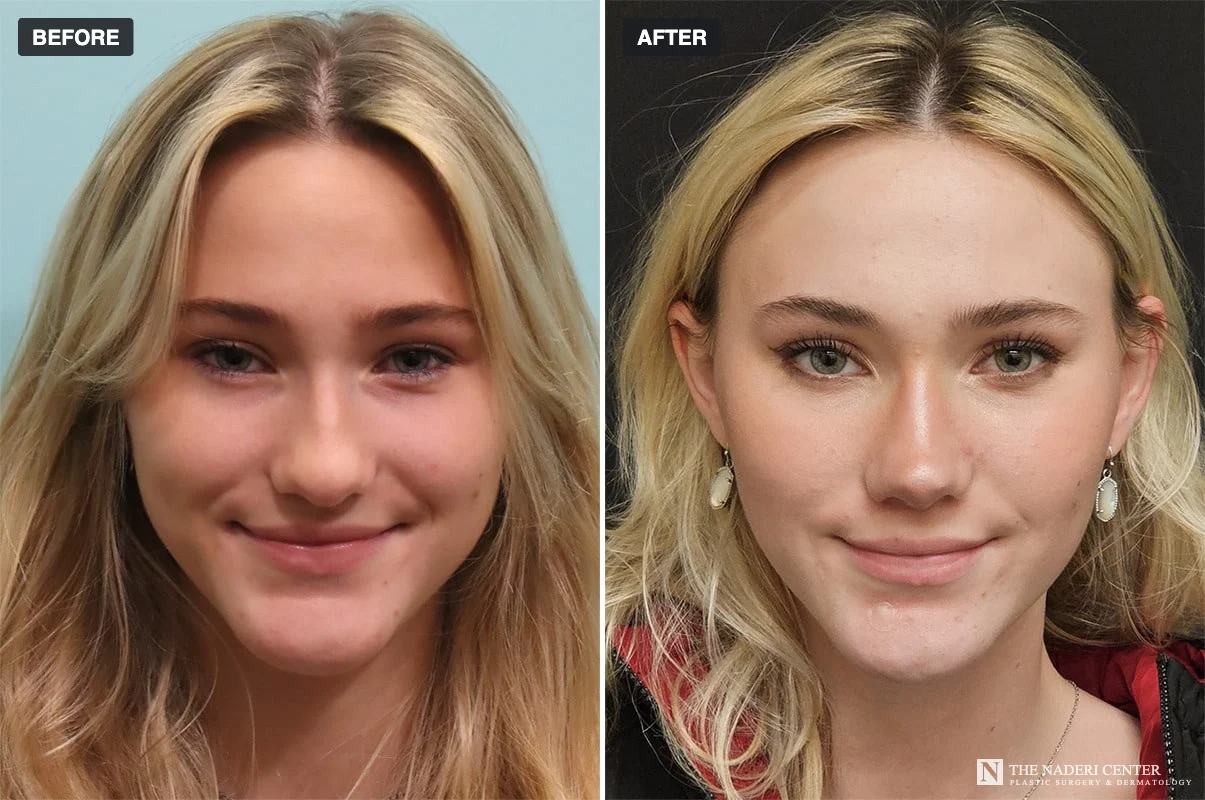
Anglo-Caucasian rhinoplasty before and after by Dr. Shervin Naderi: a straighter nose after an old break

Rhinoplasty by Dr. Naderi

After a broken nose

Dr. Naderi lowered the hump, repositioned the tip, narrowed the nasal bones and fixed a deviated septum after an old break. Shown one year after surgery.

See all views of this patient →
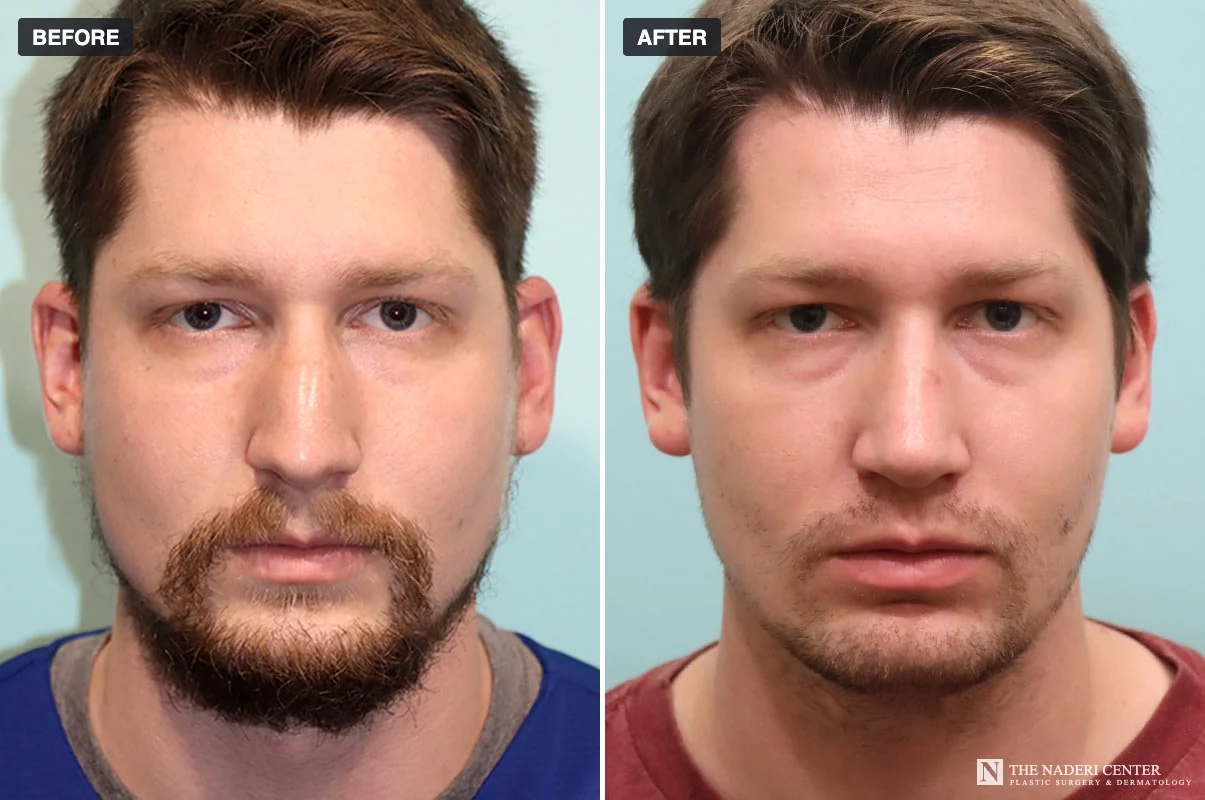
Anglo-Caucasian rhinoplasty before and after by Dr. Shervin Naderi: hump lowered and tip supported in a man

Rhinoplasty by Dr. Naderi

Hump down, tip supported

Dr. Naderi filed down the hump and added rotation and projection to the tip, so the nose stays balanced and masculine.

See all views of this patient →
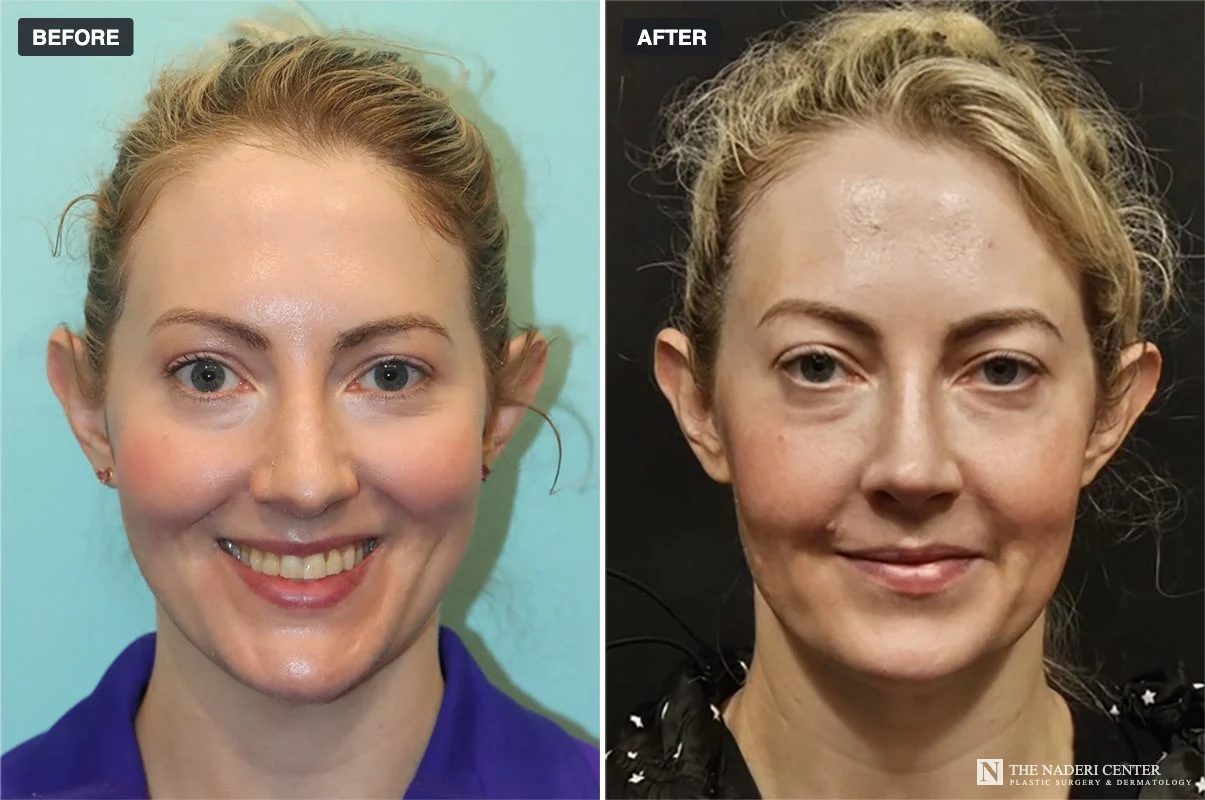
Anglo-Caucasian rhinoplasty before and after by Dr. Shervin Naderi: narrower bones, a lower bridge and a refined tip

Rhinoplasty by Dr. Naderi

One year later

Dr. Naderi narrowed wide nasal bones, lowered the bridge and reshaped the tip. Shown one year after surgery.

See all views of this patient →
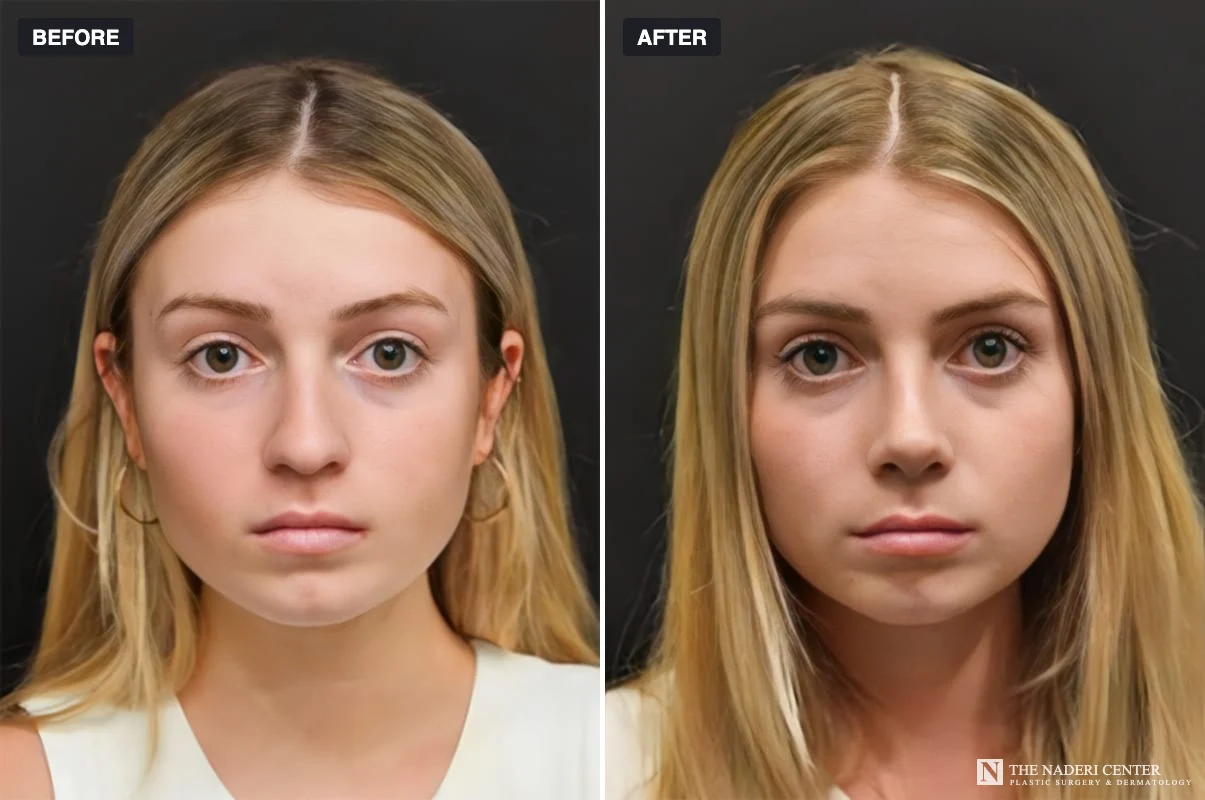
Anglo-Caucasian rhinoplasty before and after by Dr. Shervin Naderi: finesse rhinoplasty with a supported tip

Rhinoplasty by Dr. Naderi

Finesse rhinoplasty

Small, precise changes: Dr. Naderi reshaped and supported the tip, fixed the septum and lowered a small bump for a natural slope.

See all views of this patient →
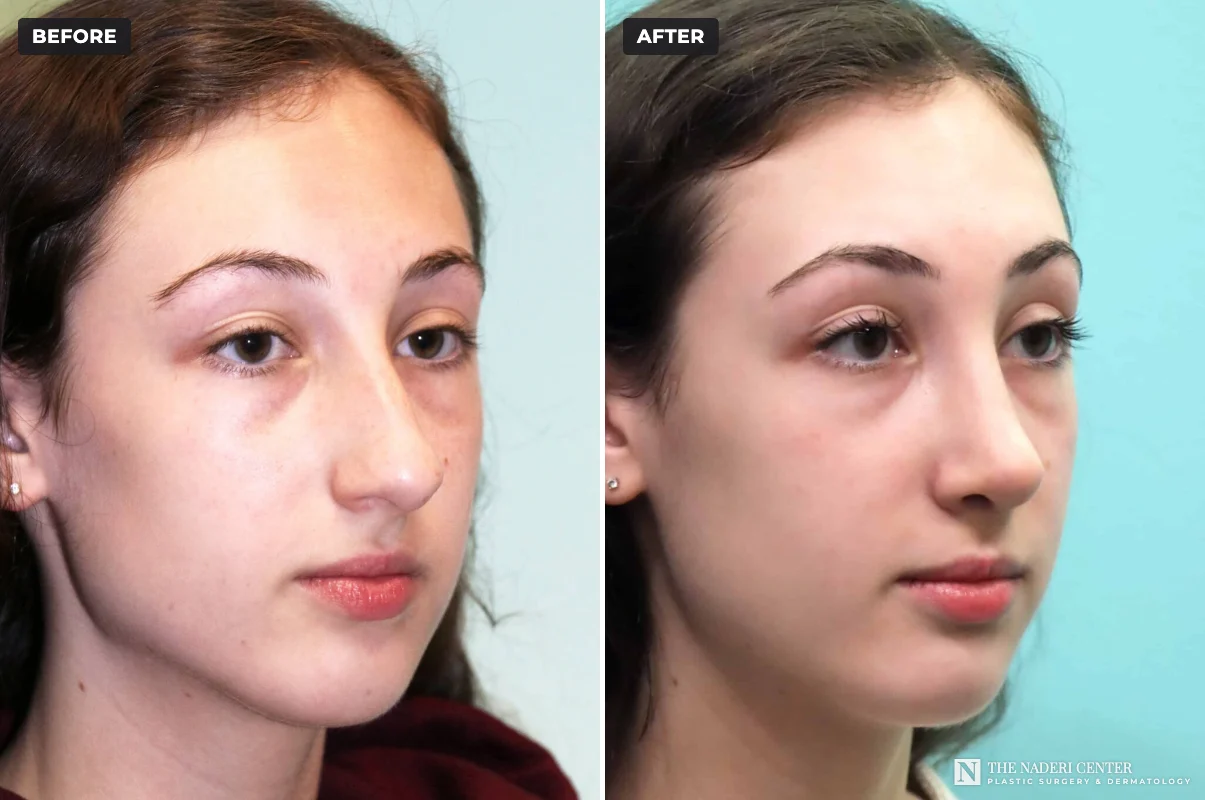
Anglo-Caucasian rhinoplasty before and after by Dr. Shervin Naderi: three-quarter view of a lower bridge and a lifted, shorter tip

Rhinoplasty by Dr. Naderi

Breathing and shape

Dr. Naderi lowered the bridge, straightened the septum for easier breathing, and lifted and shortened the tip so it no longer droops when she smiles.

See all views of this patient →
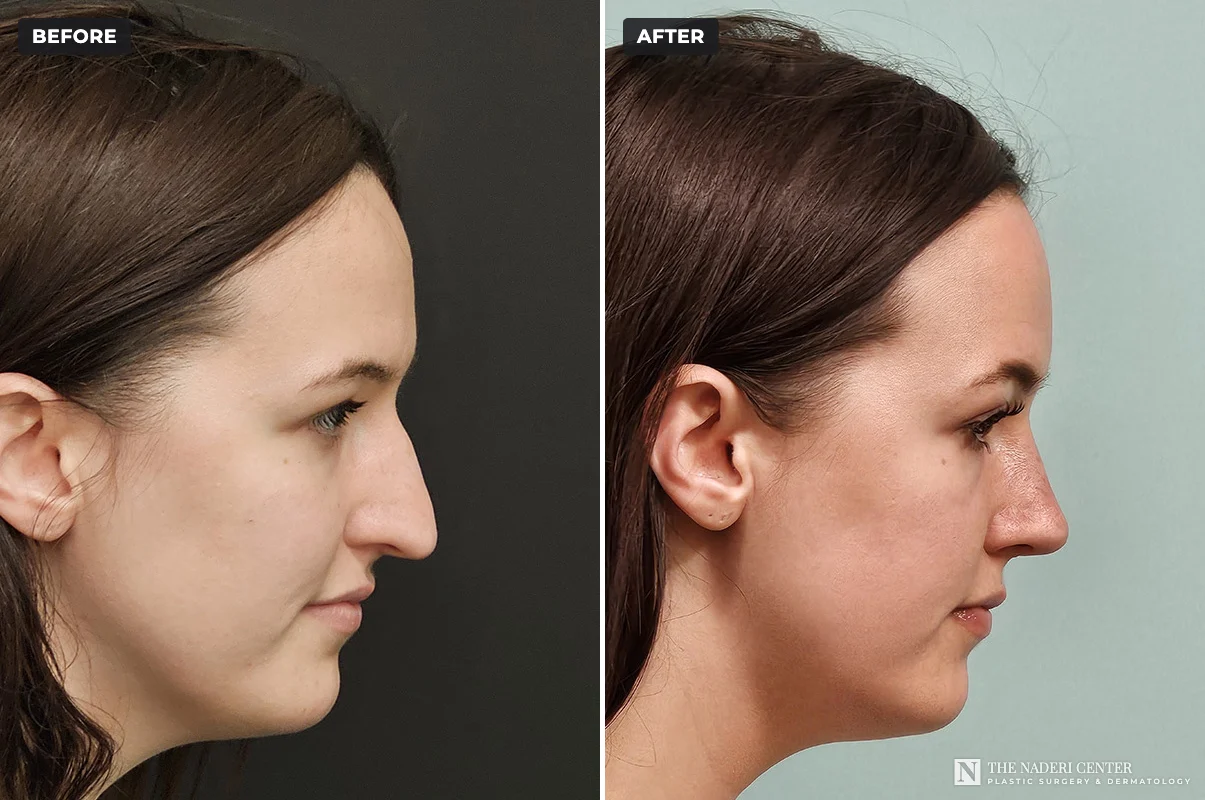
Anglo-Caucasian rhinoplasty before and after by Dr. Shervin Naderi: side view of a refined bridge and a lifted tip

Rhinoplasty by Dr. Naderi

Straighter, tip lifted

Dr. Naderi refined the bridge with a preservation approach, lifted and supported a drooping tip, and straightened a bent nose and septum. Shown one year after surgery.

See all views of this patient →
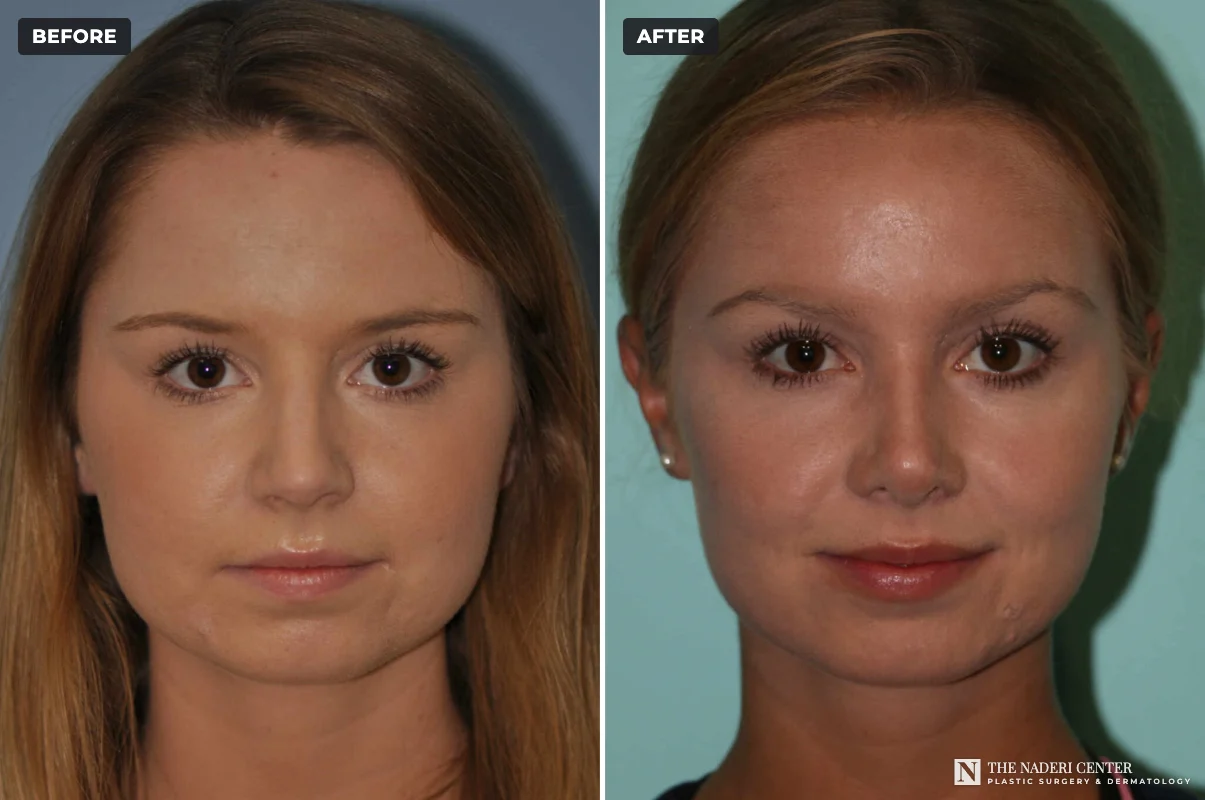
Anglo-Caucasian rhinoplasty before and after by Dr. Shervin Naderi: front view of a refined tip after the bridge bump was corrected

Rhinoplasty by Dr. Naderi

Bump corrected, tip refined

Dr. Naderi corrected the bump on the bridge and refined the tip, bringing the nose into balance with her features.

See all views of this patient →
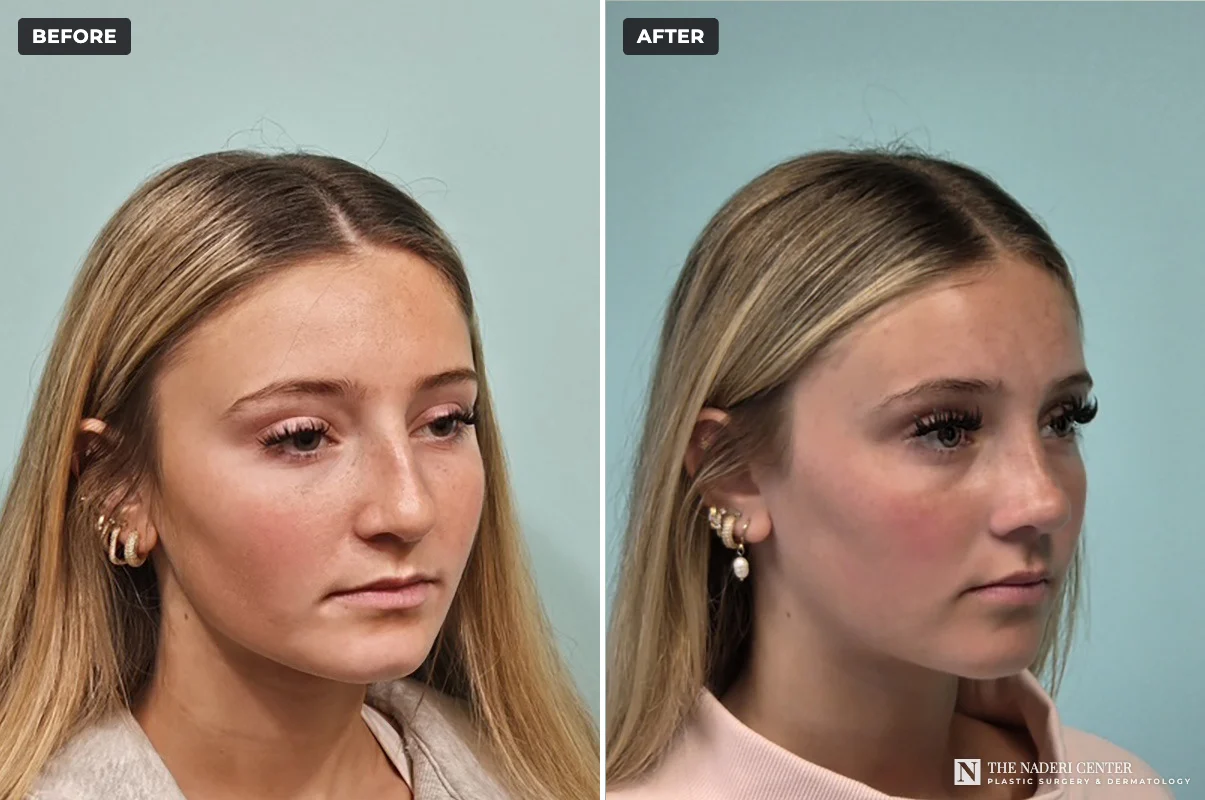
Anglo-Caucasian rhinoplasty before and after by Dr. Shervin Naderi: three-quarter view of a lower bridge and a lifted, refined tip

Rhinoplasty by Dr. Naderi

Lower bridge, lifted tip

Dr. Naderi lowered the bridge, narrowed the nasal bones, and refined, lifted and supported the tip, tailored to her thicker skin for a soft, natural result.

See all views of this patient →
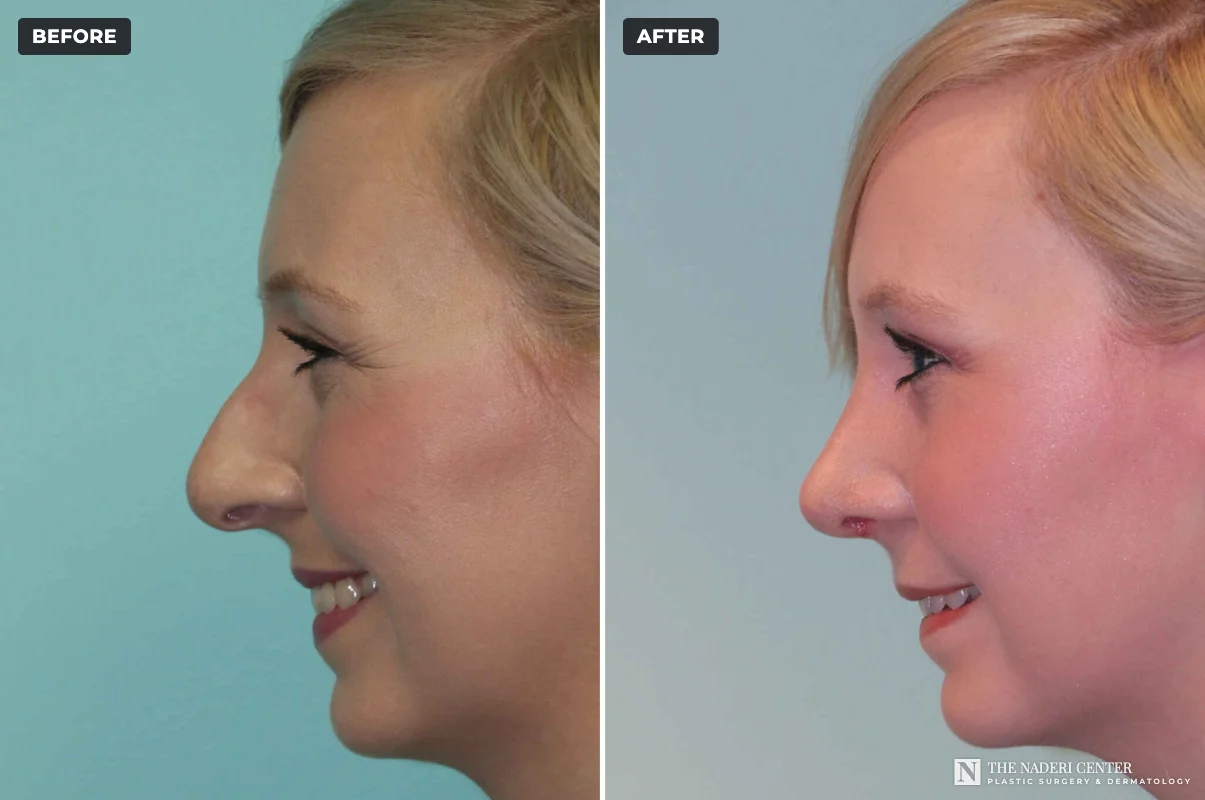
Anglo-Caucasian rhinoplasty before and after by Dr. Shervin Naderi: smiling side view of a smoother bridge and a tip that no longer drops

Rhinoplasty by Dr. Naderi

No more drooping tip

Dr. Naderi corrected the hump and lifted the tip, so it no longer drops when she smiles.

See all views of this patient →
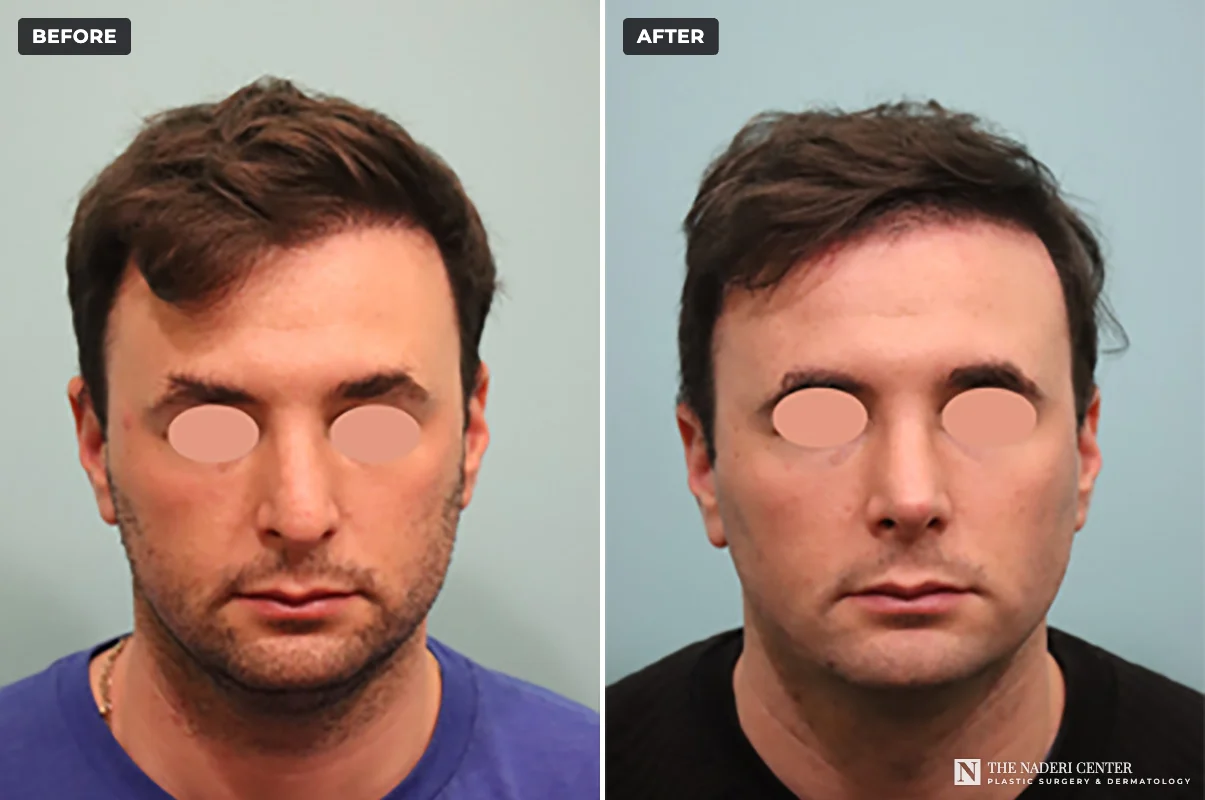
Anglo-Caucasian rhinoplasty before and after by Dr. Shervin Naderi: front view of a straighter nose in a man after wrestling injuries

Rhinoplasty by Dr. Naderi

After wrestling injuries

Dr. Naderi straightened the septum and nasal bones and used a septal extension graft to support and lift the tip, for easier breathing and better balance.

See all views of this patient →
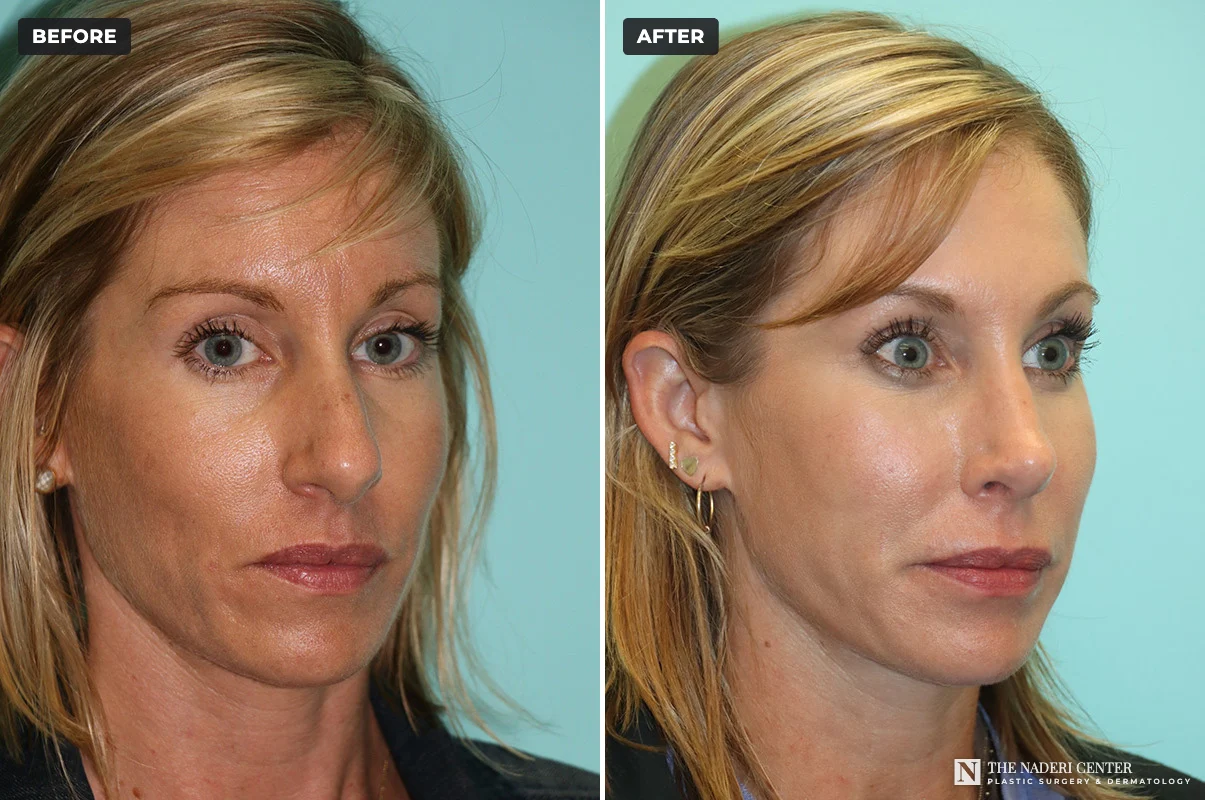
Anglo-Caucasian rhinoplasty before and after by Dr. Shervin Naderi: three-quarter view of a natural rhinoplasty result

Rhinoplasty by Dr. Naderi

A natural profile

A rhinoplasty by Dr. Naderi, shown in a three-quarter view. Her case page has every angle.

See all views of this patient →
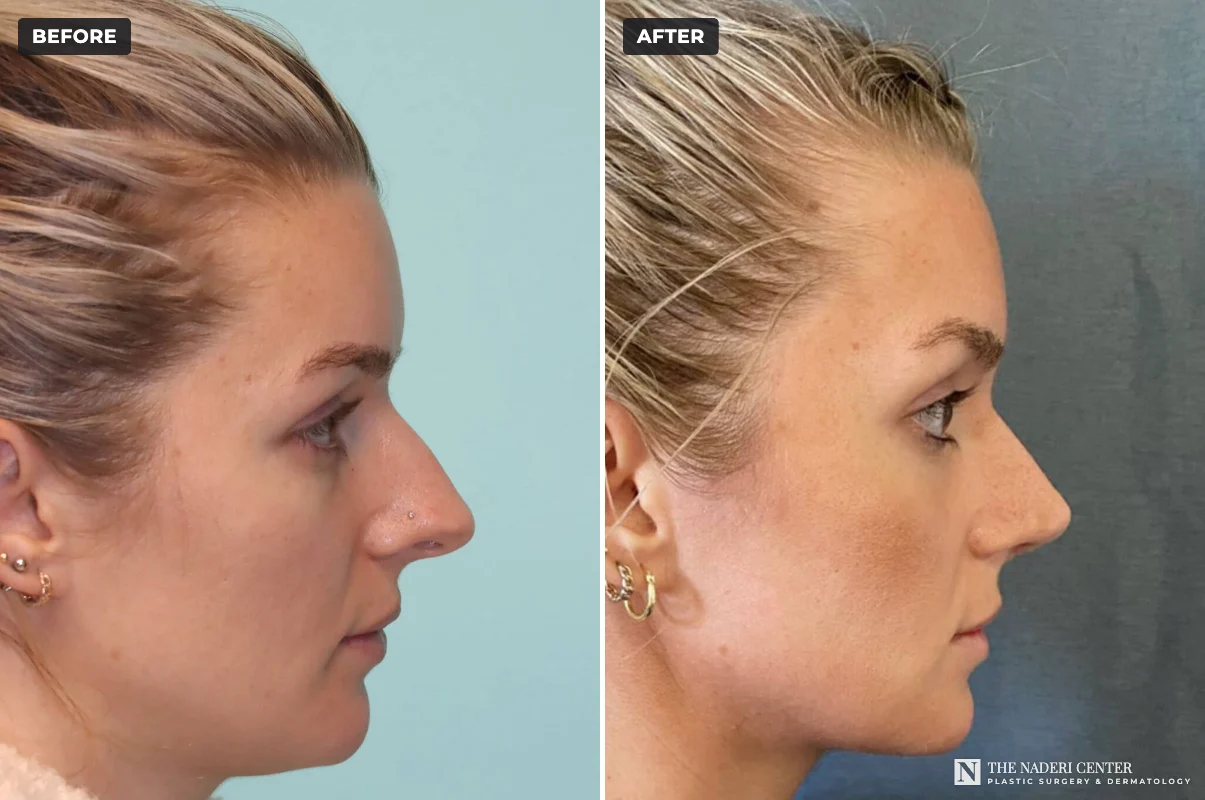
Anglo-Caucasian rhinoplasty before and after by Dr. Shervin Naderi: side view of a smaller hump and a less projected tip

Rhinoplasty by Dr. Naderi

Smaller hump, softer tip

Dr. Naderi reduced the hump and brought the tip back slightly (deprojected). Shown one month after surgery, with swelling still settling.

See all views of this patient →
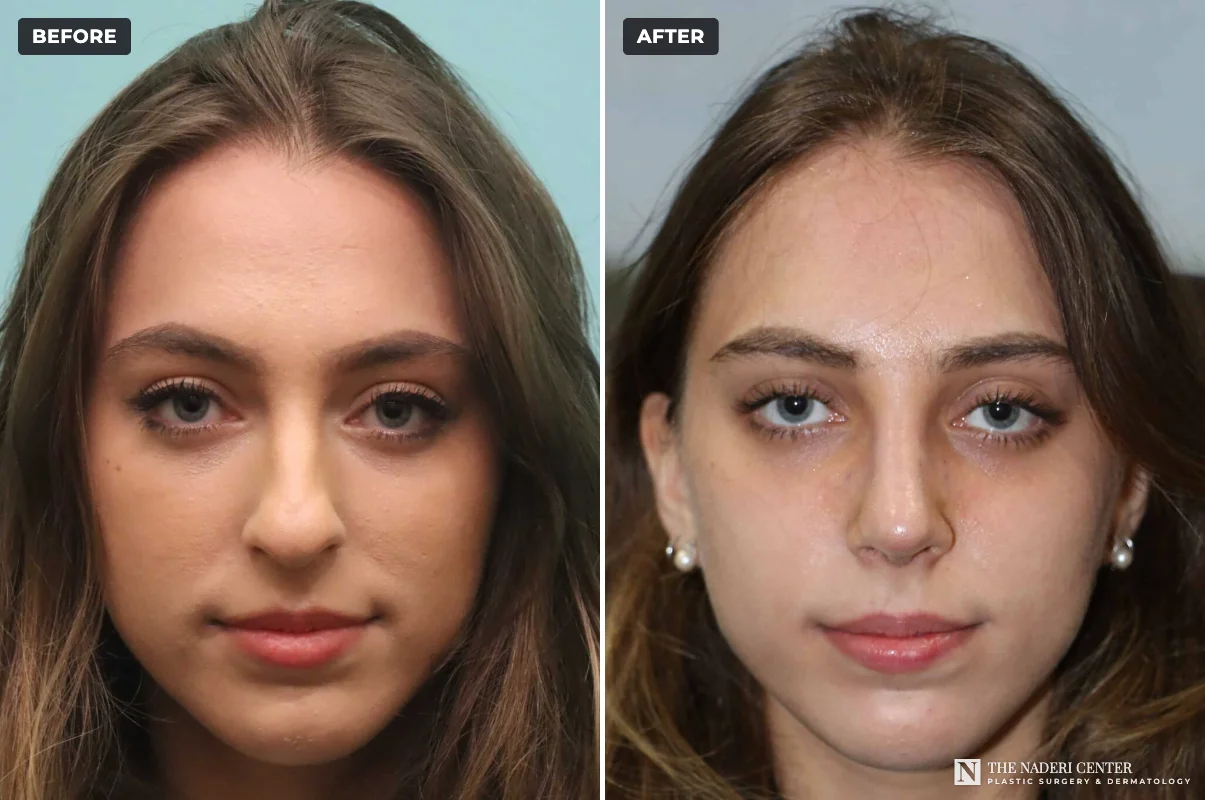
Anglo-Caucasian rhinoplasty before and after by Dr. Shervin Naderi: front view days after a structural and preservation rhinoplasty

Rhinoplasty by Dr. Naderi

Structure and preservation

Dr. Naderi combined structural and preservation techniques to lower the bridge, lift the tip and add projection. Shown just days after surgery.

See all views of this patient →
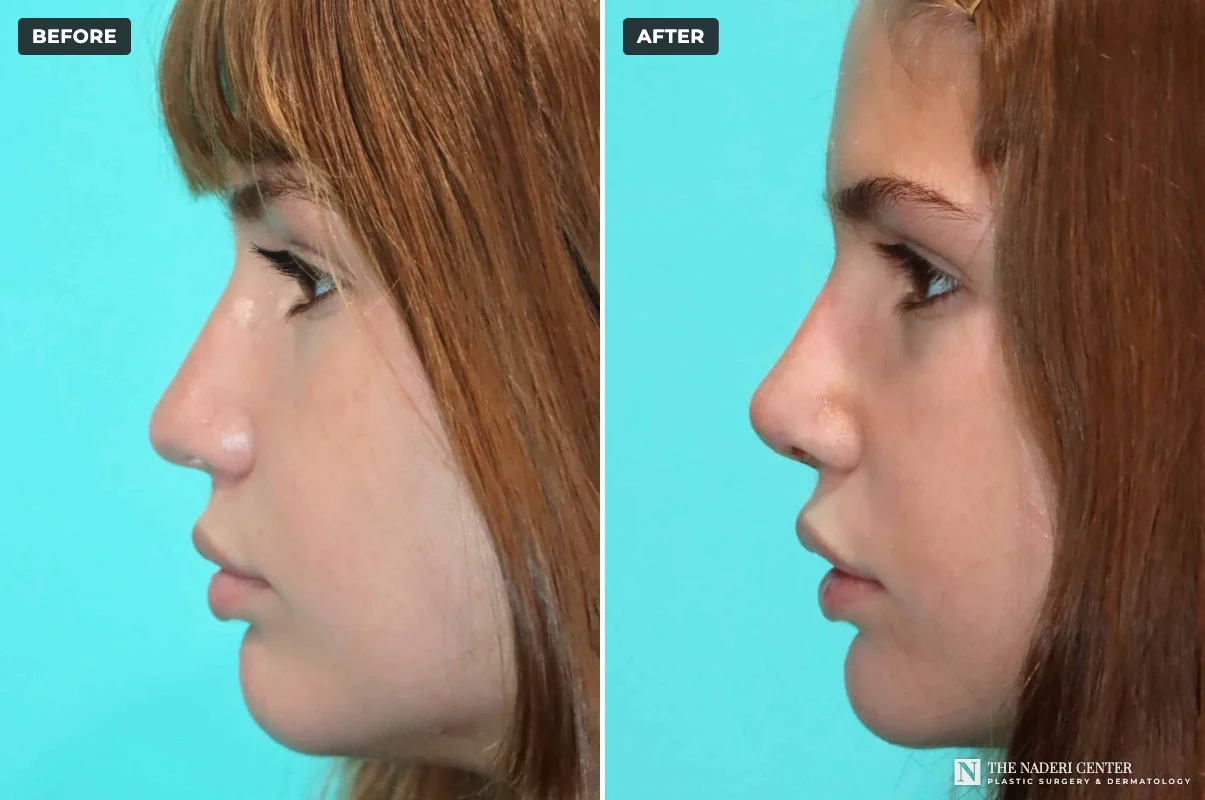
Anglo-Caucasian rhinoplasty before and after by Dr. Shervin Naderi: side view one week after surgery, the day the cast came off

Rhinoplasty by Dr. Naderi

One week after surgery

Taken the day the cast came off. Some swelling remains and settles over the coming months, yet the new shape already shows.

See all views of this patient →
‹1 / 14›

Real patients of Dr. Shervin Naderi. Each patient is unique and individual results vary.
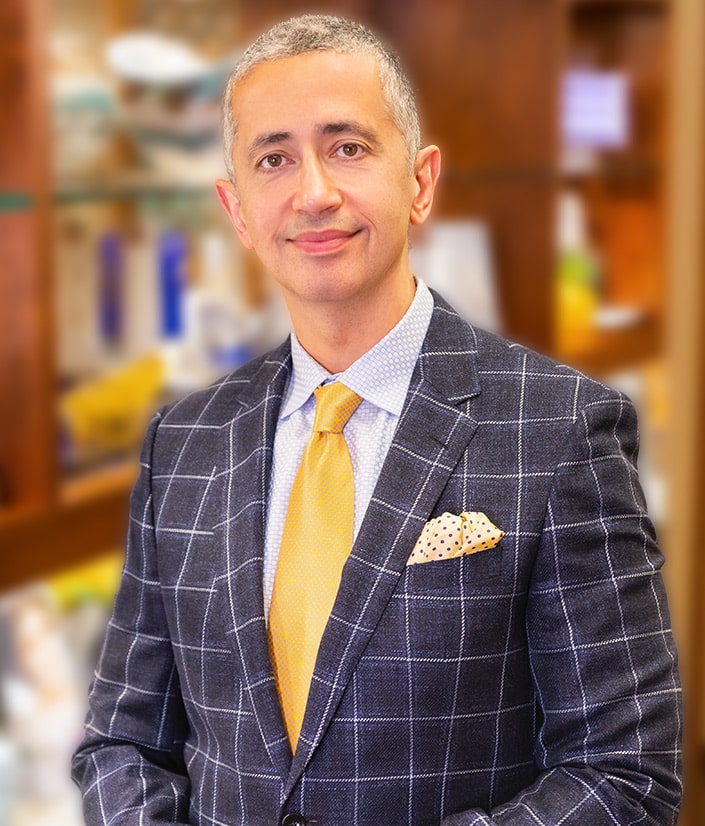
Dr. Shervin Naderi, double board-certified facial plastic surgeon and rhinoplasty specialist
Shervin Naderi, MD, FACSDouble Board-Certified Facial Plastic Surgeon

Your Rhinoplasty Surgeon

Why Choose Dr. Naderi for Anglo-Caucasian Rhinoplasty in the Washington DC Area?

Dr. Naderi has performed thousands of rhinoplasties, about 85% of them open and 15% closed. Many patients come to him for revision of a rhinoplasty done elsewhere, and many travel to him from other states and from abroad.

  • ThousandsOf rhinoplasties performed
  • 100,000+Procedures performed
  • 4 yearsNewsweek America’s Best Plastic Surgeons for Rhinoplasty, 2023 to 2026
  • A Destination for Revision RhinoplastyMany patients come to Dr. Naderi to correct a rhinoplasty done elsewhere. Plastic surgeons and ENT physicians in the Washington DC area refer their most difficult noses to him.
  • Thousands of RhinoplastiesDr. Naderi has performed thousands of rhinoplasties for patients of every background, from subtle refinements to complex revisions, using open, closed, preservation and ultrasonic techniques.
  • Textbook Author on Revision RhinoplastyCo-author of the rhinoplasty chapters in two surgical textbooks: Revision Rhinoplasty (Becker and Park) and Head and Neck Surgery: Otolaryngology (Bailey, Johnson and Newlands).
  • Double Board Certified, Fellowship TrainedCertified by the American Board of Facial Plastic and Reconstructive Surgery and the American Board of Otolaryngology-Head and Neck Surgery, and a Fellow of the American College of Surgeons. Fellowship trained under Dr. Stephen W. Perkins, past president of the American Academy of Facial Plastic and Reconstructive Surgery.
  • Board ExaminerHas served as an Oral Board Examiner for the American Board of Facial Plastic and Reconstructive Surgery and as Clinical Assistant Professor at Indiana University School of Medicine. Surgeons around the world use his online surgical videos for training.
  • Teacher of SurgeonsTaught the Georgetown University Hospital plastic surgery residents through lectures and grand rounds, with residents scrubbing in on his cases at Suburban Hospital. He has given talks at rhinoplasty meetings and has taught facial anatomy to nurses and physicians at an anatomy lab held at Inova Fairfax Hospital.

What patients can expect

  • Dr. Naderi does the computer imaging himself, so what you see on the screen is surgically realistic.
  • He advises against surgery when it is not in your best interest.
  • He does not routinely pack the nose after surgery.
  • He performs open, closed and preservation rhinoplasty, uses advanced grafting techniques, and shapes bone precisely with ultrasonic rhinoplasty and power rasping devices, choosing the right tools for each nose.
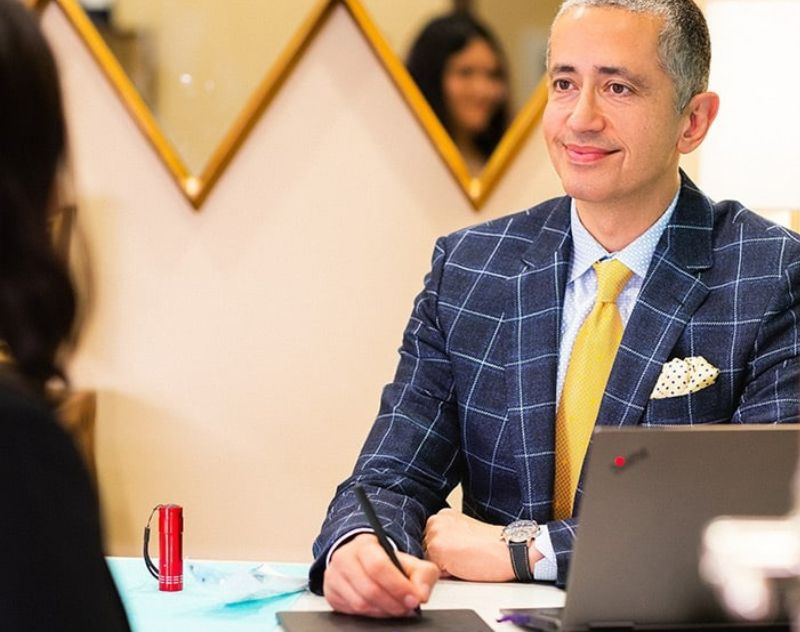
Dr. Naderi during a rhinoplasty consultation at The Naderi Center

“It’s important to me that as the surgeon, I perform all of the imaging rather than a photographer, making sure what I show on the computer screen is surgically plausible.”Dr. Shervin Naderi

Dr. Naderi’s Rhinoplasty Expertise

RealSelf Top Contributor, Dr. Shervin Naderi

RealSelf is where patients research cosmetic surgery and compare surgeons. Its video library features Dr. Naderi teaching patients about rhinoplasty, and his RealSelf patients rate him 4.9 out of 5 stars across more than 350 reviews. He is a RealSelf Top Contributor.

Dr. Naderi’s rhinoplasty videos featured on RealSelf:

  • Do Nose Jobs Require Plastic Implants?
  • Computer Imaging Previews Nose Job Results
  • Am I an Ideal Candidate for Rhinoplasty?

Dr. Naderi on Rhinoplasty in the Media

As featured inBeauty Seek“When Your Surgeon Says No”Video interview with Dr. Shervin Naderi, August 2026
As featured inBeauty Seek“Thin vs Thick Skin in Rhinoplasty”Video interview with Dr. Shervin Naderi, July 2026
As featured inNewBeauty“Can a Nose Job Really Fix ‘Webbing’?”Dr. Shervin Naderi quoted as a rhinoplasty expert, 2013
As published inYour Health Magazine“Choosing Open Rhinoplasty Versus Closed Rhinoplasty”Article written by Dr. Shervin Naderi, November 2009
As published inYour Health Magazine“Comparing Ethnic to Caucasian Rhinoplasty”Article written by Dr. Shervin Naderi, August 2009
As published inYour Health Magazine“Benefits of Rhinoplasty (Nose Surgery)”Article written by Dr. Shervin Naderi, March 2009


Rhinoplasty Patient Reviews

4.9 on Google from 1,100+ reviews

“Her confidence changed completely.”

“My daughter was nervous before college, but after the surgery, her confidence changed completely. Dr. Naderi made us feel seen and heard the entire way. She now has the cutest nose!”

★★★★★R.L.Bethesda, MD

“My only regret is not getting it done sooner!”

“I am eternally grateful to Dr. Naderi and his absolutely amazing staff for the top-notch care that I received before, after and during my rhinoplasty. … It is now two months since my rhinoplasty and I am absolutely in love with my new nose. My results are so cute and natural looking, and I am so glad I trusted Dr. Naderi’s expertise. He 100% changed my life and I could never thank him enough for the confidence he has given me. My only regret is not getting it done sooner!”

★★★★★E.F.Google review

“I have such a very long list of praises to sing.”

“I have such a very long list of praises to sing about my experience at the Naderi Center and, specifically, with Dr. Naderi himself that I almost don’t even know where to start with my review! … As there were no results throughout the globe (literally) that compared to the beautiful and natural results that I saw on Dr. Naderi’s website/Instagram, I reached out from Germany and easily scheduled an initial Skype consultation, where Dr. Naderi’s wisdom, in addition to his evident skill, immediately assured me that this was the surgeon for me.”

★★★★★B.B.RealSelf review

“Dr. Naderi has a great talent for making everything look natural and balanced.”

“Thank you to Dr. Naderi and his team! I’m three months post op and I absolutely love my new nose. I was nervous at first and didn’t know how I would feel after getting the surgery and how hard the recovery would be. I found it’s not too bad at all and I was given the best pre and post op care. I was nervous my new nose would look too unnatural but Dr. Naderi has a great talent for making everything look natural and balanced. Very thorough, very thoughtful, and very professional! I feel so confident. Highly recommend”

★★★★★K.A.Google review

“Best decision I ever made going with Dr. Naderi.”

“I had an incredible experience getting a preservation rhinoplasty (septoplasty) with Dr. Naderi. It is one month post-operation and I am so happy with the results. He did perfect work and gave me exactly what I had in mind. It looks completely natural! Swelling is very minimal due to keeping it wrapped consistently. Imaging and the surgery results one month out look the same, and I personally feel that it looks even better than the imaging. I am so happy I chose him as my surgeon. I would recommend him to friends and family. Thank you! Best decision I ever made going with Dr. Naderi.”

★★★★★S.M.RealSelf review

“This has truly been a life changing experience!”

“Its only been 6-weeks since my surgery and I love my new look already! I have to retrain myself not to hide from my right side profile like I used to. I can now wear my hair back and show my elegant nose at all angles. I now feel good about myself when walking by that department store mirror and catching a glimpse of the profile I tried so hard to contour with makeup and using my hair to shield its sharpness. This has truly been a life changing experience! Thank you Dr Naderi and staff!”

★★★★★L.V.Yelp review

“The functional results have been huge for me.”

“The functional results have been huge for me. My breathing opened up immediately, but what really surprised me was how much my sense of smell improved, and with it, my sense of taste. Food just tastes so much better now. The first time I really noticed it, I had to stop for a second because I hadn’t realized how much I’d been missing.

I also noticed that Dr. Naderi takes real pride in his work. You can see it when the cast comes off. He is genuinely invested in how it turned out, and he treats the result like something he personally stands behind.”

★★★★★J.Google review

“I love my new nose so much!”

“I love my new nose so much! Thank you so much Dr. Naderi and his team. I can also finally breath through both noses when I lay down to sleep! Also, two people have asked me for my surgeons information because they love my results (I’m only 3.5 week post op). If you’re contemplating on getting a septorhinoplasty/rhinoplasty then just DO IT.”

★★★★★K.J.Google review

“I live in NYC and the trip was so worth it.”

“Dr. Naderi was amazing! He made me feel very comfortable because he is so confident and knowledgeable. I live in NYC and the trip was so worth it. I will definitely be back!”

★★★★★T.M.Google review

“My daughter and I both had rhinoplasties at the Naderi Center.”

“I can’t say enough about Dr. Naderi and his entire staff! My daughter and I both had rhinoplasties at the Naderi Center and have recommended friends that had procedures completed and are happy as well.”

★★★★★L.H.Google review

Reviews posted by rhinoplasty patients on Google, Yelp and RealSelf. Some reviews are shortened. Each patient is unique and individual results may vary.

Five days after surgery. Watch a patient of Dr. Naderi five days after a preservation and structural hybrid rhinoplasty, with very little swelling and only mild bruising.

Begin with a Conversation
Bring us your questions.
We will bring the experience.

What Is Anglo-Caucasian Rhinoplasty?

Anglo-Caucasian rhinoplasty is not a separate operation. It is rhinoplasty planned for patients of Anglo, Northern European and other Caucasian backgrounds, where the goal is usually to refine rather than build up: a smoother bridge, narrower bones and a more defined tip, under skin that is often thin. Patients come to our Reston and Chevy Chase offices from McLean, Great Falls, Arlington, Alexandria, Bethesda, Potomac and Washington DC, and travel from across the country and abroad.

Woman with a refined, natural nose

What patients most often ask for

  • A smaller or smoother hump
  • Narrower nasal bones
  • A more defined tip
  • A tip that no longer droops
  • A straighter nose after an injury
  • Easier breathing
  • A correction of an earlier surgery (revision)

Dr. Naderi plans every nose around the patient’s own anatomy, skin and goals, never a template. A nose in balance with the rest of your face brings facial harmony and often more self-confidence.

Looks and breathing in one surgery

Many patients also have a deviated septum, enlarged turbinates, nasal valve collapse or chronic congestion. Dr. Naderi examines how your nose works as well as how it looks, and corrects breathing problems in the same operation. His septoplasty keeps supporting cartilage in place, so the septum does not collapse or deviate again.

“A successful nose surgery should always address both appearance and airway health. Breathing should feel better, not worse, after rhinoplasty.”

Dr. Shervin Naderi

Research on functional rhinoplasty shows a significant improvement in patients’ own breathing scores after surgery that corrects a deviated septum, nasal valve collapse or enlarged turbinates. Source: Most, Archives of Facial Plastic Surgery, 2006.

A smoother, balanced profileLowering a hump and refining the tip brings the nose into balance with your eyes, lips and chin.
Better breathingA deviated septum or narrow airway can be corrected in the same operation.
Still recognizably youDr. Naderi refines the nose rather than replacing it, so family and friends still see you.

What Does a Caucasian Nose Look Like?

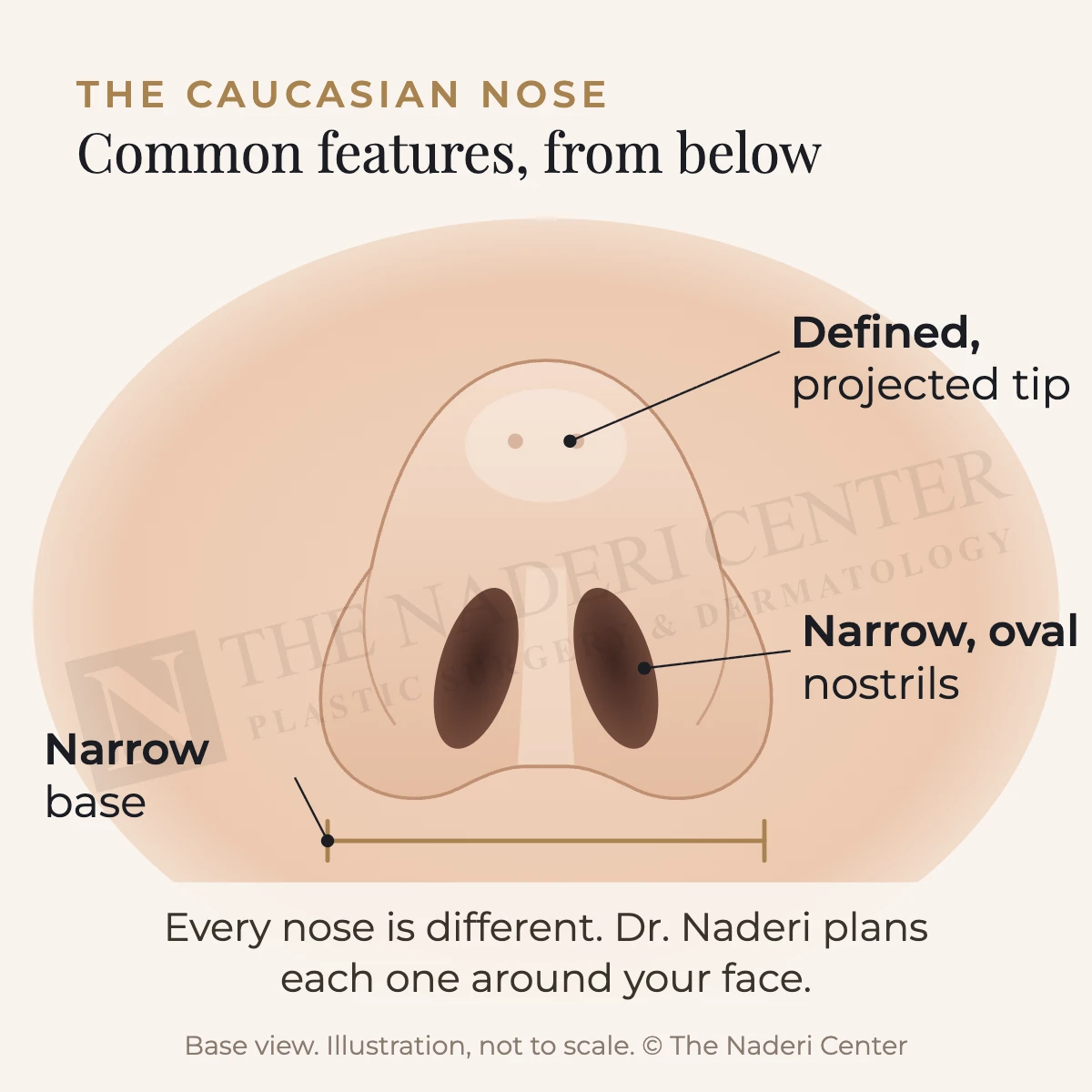
Every nose is different, but many Caucasian noses share a tall, narrow bridge, a hump where bone meets cartilage, firm tip cartilage, narrow oval nostrils and thin skin. Thin skin shows fine detail, so small, precise changes make the difference.
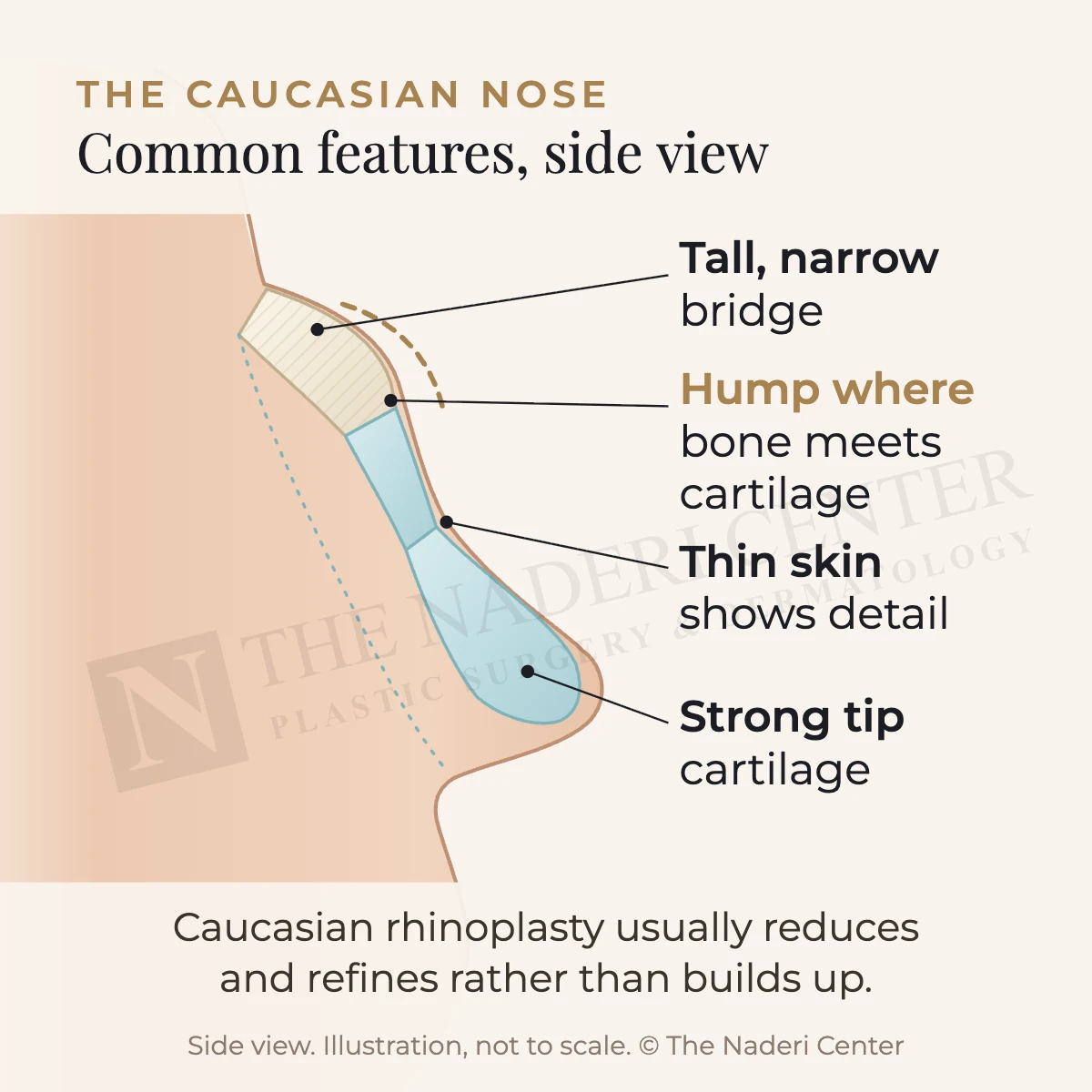
Caucasian nose anatomy diagram, side view: a tall, narrow bridge, a hump where bone meets cartilage, thin skin and strong tip cartilage
Caucasian nose diagram from below: a defined, projected tip, narrow oval nostrils and a narrow base

Refined, Never Overdone

Caucasian skin over the nose is usually thin. It shows fine detail, which helps a refined result, but it also shows the smallest bump, edge or asymmetry underneath. Dr. Naderi shapes the bone and cartilage precisely, smooths every edge and supports the tip with cartilage, so the nose stays smooth and natural as it heals.

Woman with fair, thin skin and a smooth, natural nose

Many patients worry about the overdone noses of past decades: a scooped bridge, a pinched or upturned tip, a nose too small for the face. Those results usually came from removing too much. Dr. Naderi reduces only what needs reducing and keeps the support that holds the shape, and computer imaging lets you and Dr. Naderi agree on the plan before surgery.

Who is a good candidate?

A good candidate is healthy, has a nose that has finished growing, and wants the change for himself or herself. Rhinoplasty is permanent, so Dr. Naderi takes the time to understand why you want surgery, and he is never quick to operate. Consultations are private, and you can decide at your own pace.

Not ready for surgery? Non-surgical rhinoplasty with filler can camouflage a small bump in a short office visit, though it cannot make a nose smaller.
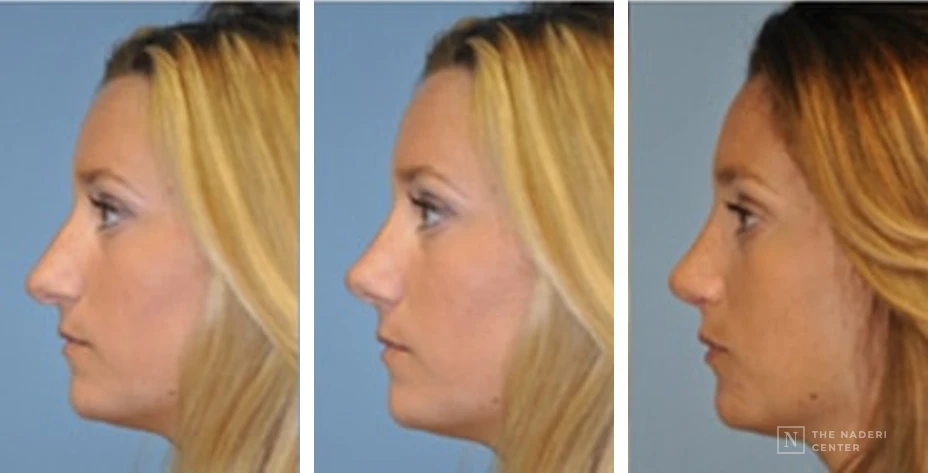

WomenOften want a smaller hump and a refined tip, with a profile that stays soft and feminine.
MenUsually want a straight, strong bridge with less tip rotation, so the nose stays masculine.
Teens to over 40The minimum age is 14, and maturity matters more than the number. About 1 in 5 of Dr. Naderi’s rhinoplasty patients are over 40. See rhinoplasty after 40.

Types of Rhinoplasty Dr. Naderi Performs

Ultrasonic rhinoplasty diagram: an ultrasonic tip shaping the nasal bone, side view ULTRASONIC (PIEZO) Shapes bone in fine, controlled steps Nasal bone Ultrasonic tip Cartilage Sculpts the nasal bones without traditional chisels. Used in select patients. Side view. Illustration, not to scale.
01

Ultrasonic Rhinoplasty

Read more

In an ultrasonic rhinoplasty, also known as a “piezo rhinoplasty”, the surgeon reshapes the nasal bones with an instrument that vibrates at ultrasonic frequency in place of traditional chisels and rasps. It lets the surgeon sculpt bone in fine, controlled steps. Dr. Naderi uses ultrasonic rhinoplasty in select patients, when it is the right tool for that nose.

Preservation rhinoplasty diagram: a strip of septum removed below so the bridge is lowered as one piece, side view PRESERVATION Keeps your bridge and lowers it Old hump Bridge lowered as one piece Strip of septum removed below Your natural bridge stays intact. Suits some noses, not all. Side view. Illustration, not to scale.
02

Preservation Rhinoplasty

Read more

Preservation rhinoplasty keeps your natural bridge and its support intact and lowers it from underneath, in place of removing a hump and rebuilding the bridge. It suits some noses and not others, so Dr. Naderi uses it in select patients. Read more about preservation rhinoplasty.

Revision rhinoplasty diagram: a cartilage graft rebuilding the bridge after an earlier surgery, side view REVISION Correcting a previous surgery Earlier result Cartilage graft rebuilds Rebuilds shape and support, often with your own cartilage. Side view. Illustration, not to scale.
03

Revision Rhinoplasty

Read more

Revision rhinoplasty corrects the result of a previous nose surgery, in appearance, in breathing or in both. It is more complex than a first rhinoplasty, and many patients come to Dr. Naderi for it after surgery elsewhere. Learn more about Revision Rhinoplasty.

Ethnic rhinoplasty diagram: the tip refined and the nostril base narrowed, seen from below the nose ETHNIC Refining while keeping your heritage Tip refined Nostril base narrowed The tip and nostrils are refined to look natural on your face. View from below the nose. Illustration, not to scale.
04

Ethnic Rhinoplasty

Read more

Dr. Naderi performs a high volume of ethnic rhinoplasty. The goal is a nose that looks natural on your face and stays true to your heritage. Common changes include refining the bridge, narrowing the nostrils and adjusting the angle of the tip. Learn more about Ethnic Rhinoplasty, including Persian, Asian, African American, Latin, Jewish and Anglo-Caucasian rhinoplasty.

Functional rhinoplasty diagram: the septum straightened and the turbinates reduced to open the airway, front cross-section FUNCTIONAL Opening the airway Septum straightened Old bend Turbinate reduced Airway opened Straightens the septum and reduces swollen turbinates so air flows freely. Front cross-section of the nose. Illustration, not to scale.
05

Functional Rhinoplasty

Read more

Functional problems, including a deviated septum as well as breathing impairments, are the most common functional nasal surgical repairs. Rhinoplasty opens nasal airway obstructions with septoplasty, vestibuloplasty, turbinate reduction, valvuloplasty, or osteotomies. Learn more about Functional Reparative Rhinoplasty. If an injury has broken or shifted your nose, see nasal fractures and surgical options.

Open rhinoplasty diagram: one small incision across the columella under the tip, seen from below the nose OPEN One small incision under the tip Incisions inside Tip cartilages Small incision Tip A full view of the tip cartilages. The small scar fades to nearly invisible. View from below the nose. Illustration, not to scale.
06

Open Rhinoplasty

Read more

In an open rhinoplasty, the surgeon adds one small incision on the skin between the nostrils to the incisions inside the nose. This gives a full view of the nasal structures and allows more structural work on the tip. Placed and closed properly, the small scar is nearly imperceptible once it heals.

Closed rhinoplasty diagram: the incisions are inside the nostrils, seen from below the nose CLOSED (ENDONASAL) Every incision is inside the nose Incisions inside Tip cartilages Tip Columella No visible scar. Usually less swelling at the tip. View from below the nose. Illustration, not to scale.
07

Closed (Endonasal) Rhinoplasty

Read more

In a closed rhinoplasty, also known as an “endonasal rhinoplasty”, all of the incisions are inside the nostrils and are not visible after surgery. It usually means less swelling and quicker healing at the tip. Dr. Naderi performs both closed and open rhinoplasty and chooses the approach for each nose. Learn more about scarless rhinoplasty.

Rhinoplasty Videos

Watch Dr. Naderi’s rhinoplasty patients before and after surgery, and hear him explain how a nose is shaped and cared for. Tap any video to play it.

Patient Before and After Reveals

A rhinoplasty reveal for a patient who first came in asking about a nonsurgical nose job.
A patient reveal for anyone who has put off rhinoplasty for years.
One month after rhinoplasty: a more defined tip for a patient who was bothered by her nasal tip.
One month after rhinoplasty: a small hump lowered, the tip reshaped and a weak, crooked septum supported.
Why the goal is a nose that suits your face, not a ‘perfect’ nose.
Five days after rhinoplasty: a lifted, supported tip, a smaller bump and easier breathing.
A rhinoplasty reveal with Dr. Naderi

Dr. Naderi on Rhinoplasty

Your rhinoplasty instructions, before and after surgery Read the instructions
The anti-bleeding, anti-bruising diet before surgery Read the instructions
What makes a rhinoplasty look natural Read the transcript
How accurate is computer imaging for rhinoplasty? Read the transcript
What questions should you ask before rhinoplasty? Read the transcript
Is everyone really staring at your nose? Read the transcript
How does skin thickness affect rhinoplasty? Read the transcript
How can a low or flat nasal bridge be raised? Read the transcript
Can septoplasty be done at the same time as rhinoplasty? Read the transcript
What is AlloDerm in rhinoplasty? Read the transcript
Do you really need a revision rhinoplasty? Read the transcript
How long before a wedding should you have rhinoplasty? Read the transcript
What is changing in rhinoplasty and facial rejuvenation? Read the transcript
Can filler straighten a nose with a bump? Read the transcript
Are you a candidate for a liquid nose job? Read the transcript
Does liquid rhinoplasty make the nose look wider? Read the transcript
The tip cartilages Dr. Naderi shapes during an open rhinoplasty
Dr. Naderi walks through an open rhinoplasty
What does a nose look like when the cast comes off? Read the transcript
What is rhinoplasty recovery really like? Read the transcript
How to tape your nose after rhinoplasty Read the transcript
How to clean your nose after rhinoplasty Read the transcript
Should you massage your nose after rhinoplasty? Read the transcript
When can you swim, dive or work out after rhinoplasty? Read the transcript
Can filler fine-tune a nose after rhinoplasty? Read the transcript

More rhinoplasty answers from Dr. Naderi in our video library

Computer Imaging: See Your New Nose Before Surgery

Computer imaging is the clearest way for you and your surgeon to agree on a plan. Dr. Naderi morphs your own photos on a large screen during the consultation, so you can see the proposed nose on your face and ask for changes before surgery, not after the cast comes off.

Take a dorsal hump as an example. Every surgeon will plan to remove it, but how much comes off decides whether the profile ends up straight, slightly curved or scooped. Imaging lets you choose.

Dr. Naderi does the imaging himself, because the surgeon doing the surgery is the one who knows what is surgically realistic. Imaging is not a guarantee of the outcome. It is the road map he follows in the operating room. You are welcome to bring your own edited photos to show what you like and what you fear. Learn more about our 3D imaging technology.

Rhinoplasty computer imaging at The Naderi Center: the patient before surgery, the computer imaging prediction, and the result after surgery, side profile
The same profile before surgery, in the computer imaging made at the consultation, and after rhinoplasty. Imaging lets you see the planned change before you decide.

How Much Does Anglo-Caucasian Rhinoplasty Cost in the Washington DC Area?

A plan designed for your nose. No two noses are alike, so no two surgical plans are alike. After your consultation and examination with Dr. Naderi, you receive a personalized proposal that reflects the surgery he has designed for you.

Insurance. Medical insurance does not pay for cosmetic rhinoplasty. When part of the surgery corrects a breathing problem, insurance may cover that part, but only with plans The Naderi Center is in network with.

Rhinoplasty prices at The Naderi Center
Primary rhinoplasty$18,000 to $27,000
Revision rhinoplastyFrom $45,000
Consultation, primary rhinoplasty$250
Consultation, revision rhinoplasty$500

Surgery prices are Dr. Naderi’s surgeon’s fee. Anesthesia and surgical facility fees are separate. Your consultation fee is applied to your surgery when you schedule within three months of your consultation.

Included in your price

  • Dr. Naderi’s surgeon’s fee
  • Follow-up visits at The Naderi Center

Not included

  • Anesthesia fee
  • Surgical facility fee
  • Pre-surgical medical clearance and lab tests, usually covered by your medical insurance
  • Prescription medications, usually covered by your medical insurance
Cherry

Patient Financing

Pay Over Time with Cherry

Monthly payment plans for surgery and treatments, including 0% APR options for qualifying patients. Checking whether you qualify won’t affect your credit score.
How to Prepare for Rhinoplasty

  • Stop smoking at least two weeks before surgery. Smoking impairs your circulation and slows healing.
  • Review your medications with us, including over-the-counter products, vitamins and herbal supplements.
  • Avoid aspirin and ibuprofen, and products that contain them, before and after surgery. They interfere with clotting and can cause bleeding.
  • Use Tylenol (acetaminophen) if you need a pain reliever or fever reducer.
  • Read your instructions. Go over our rhinoplasty pre- and post-operative instructions before surgery day.

How Rhinoplasty Is Performed

Rhinoplasty takes about two hours under general anesthesia. Dr. Naderi works through incisions inside the nose (closed rhinoplasty) or adds one small incision between the nostrils (open rhinoplasty) to reach the cartilage and bone that give the nose its shape.

He then reshapes that framework. Depending on your nose, he may reduce a hump, narrow the nasal bones, or lift, shorten, refine or support the tip. To make a nose smaller he removes cartilage or bone. To build or support it he adds cartilage grafts.

When there is enough of it, Dr. Naderi prefers to use your own septal cartilage, taken from the nasal septum, the wall that divides the two air passages. When more cartilage is needed, he typically uses donor rib cartilage, and your own rib only as a last resort. He does not use ear cartilage or implants.

When the framework is finished, the skin is laid back over it and takes on the new shape. A small splint supports the nose while it heals. Dr. Naderi does not routinely use nasal packing.

Anesthesia for Rhinoplasty

Dr. Naderi performs rhinoplasty under general anesthesia. You are fully asleep, comfortable and still for the whole operation, which matters in a surgery measured in millimeters.

Related Information:

Rhinoplasty Recovery, Week by Week

Plan on one week off work or school. A small cast stays on your nose for 5 to 10 days, and exercise waits for one month.

Tap a stage to see what to expect

Stage 1 of 6

Day of surgery

About 2 hours under general anesthesia. Dr. Naderi does not routinely pack the nose, so many patients need little or no pain medication.

  • About 2 hours
  • General anesthesia
  • Usually no nasal packing

Stage 2 of 6

First week

A small cast stays on the nose. Expect bruising and swelling around the nose and eyes. Cold compresses help. Take the week off work or school.

  • Small cast on the nose
  • Cold compresses help
  • Week off work or school

Stage 3 of 6

Days 5 to 10

Dr. Naderi removes the cast, along with sutures after an open rhinoplasty. Most patients then return to work or school, with a little cover-up makeup for any light bruising.

  • Cast comes off
  • Back to work or school
  • Cover-up makeup for light bruising

Stage 4 of 6

First month

No exercise, to prevent nosebleeds and limit swelling. Most patients are enjoying their new nose by one month.

  • No exercise
  • Enjoying your new nose

Stage 5 of 6

1 to 3 months

No glasses or contact sports if the nasal bones were set.

  • No glasses resting on the nose
  • No contact sports

Stage 6 of 6

1 to 5 years

Most of the healing is done by one year. After that the tip keeps refining and gaining definition.

  • Most healing done by 1 year
  • Tip keeps refining
1 / 6

If nasal packing is needed, it is removed about two days after surgery. Heavy exercise, excess heat and changes in altitude can increase swelling. See the recovery products our surgeons recommend for your post-op care kit.

How the Nose Changes as It Heals

The photos you see right after surgery, at one week or even at one month are not the final result. Downtime for most patients is about a week, and most of the healing happens in the first year. After that the changes are subtle. Over the next 3 to 5 years the tip keeps settling, the nose moves in closer to the face and it gains definition, especially with thick skin.

Rhinoplasty Risks and Safety

Every operation has risks. With rhinoplasty they include:

  • Bleeding, bruising and swelling that takes months to settle fully
  • Infection
  • Temporary numbness or stiffness of the tip
  • A change in breathing
  • Small irregularities or asymmetry, which thin skin can show more easily
  • The need for a minor touch-up (revision) in some patients

Dr. Naderi lowers these risks with careful planning, precise work and cartilage support for the tip, and he goes over your own risks at your consultation. Read more about complications in rhinoplasty.

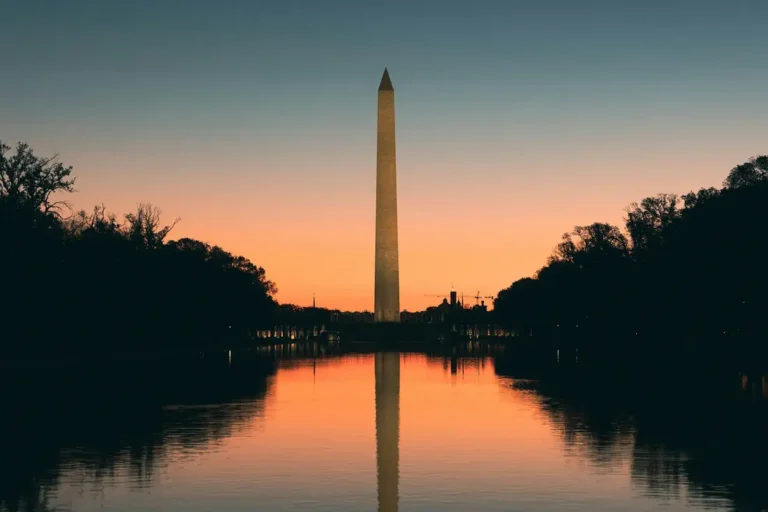
The Washington Monument at sunset, reflected in the Reflecting Pool in Washington, DC
Washington, DC

Out-of-Town & International Patients

Traveling for Anglo-Caucasian Rhinoplasty? We Help Arrange the Rest.

Patients fly in from other states and abroad for Anglo-Caucasian rhinoplasty with Dr. Naderi. Our team plans the trip with you so you make as few visits as possible.

  1. BeforeVirtual consult
  2. Arrive1 to 2 days before surgery
  3. StayAbout 1 week
  4. Follow-upsBy telehealth
  • Virtual ConsultationSend photos from home. Your surgery proposal follows by email.
  • Private TransportationThrough Noyon Transportation, from Dulles, Reagan National or BWI.
  • Where to StayPatients often choose The Ritz-Carlton Tysons Corner or JW Marriott Reston Station.
  • Concierge Nursing CarePrivate, nurse-led recovery care at your hotel from Grande Vida Co.

Anglo-Caucasian Rhinoplasty FAQs

It is rhinoplasty planned for patients of Anglo, Northern European and other Caucasian backgrounds. The goal is usually refinement: a smaller or smoother hump, narrower nasal bones and a more defined tip, under skin that is often thin. The operation is the same as any rhinoplasty; the plan is built around your face, skin and breathing.

Ethnic rhinoplasty often builds up a low bridge or strengthens a soft tip. Caucasian rhinoplasty more often reduces and refines: lowering a hump, narrowing the nasal bones and defining the tip. Dr. Naderi performs both. Read more about ethnic rhinoplasty.

Many Caucasian noses have a tall, narrow bridge, a hump where bone meets cartilage, firm tip cartilage, narrow oval nostrils and thin skin, though every nose is different. See the Caucasian nose diagrams on this page.

“Anglo” refers to English and Northern European (Anglo-Saxon) ancestry, and “Anglo nose” is an informal name for a Caucasian nose from that background. There is no single Anglo nose shape, so Dr. Naderi plans each rhinoplasty around the patient’s own anatomy and face.

Yes, both names describe the same surgery. Caucasian is the broader term for people of European descent, including Northern European, Mediterranean and Eastern European backgrounds, while Anglo-Caucasian points to English and Northern European ancestry. Dr. Naderi performs rhinoplasty for all of them.

Yes. Thin skin shows fine detail, but it also shows small edges or bumps underneath. Dr. Naderi smooths the bone and cartilage precisely and supports the tip with cartilage, so the nose stays smooth as it heals. Read about thin and thick skin in rhinoplasty.

Yes. Dr. Naderi lowers the hump while keeping the bridge smooth and the lines of the nose natural, so the profile does not look scooped. In select patients he uses preservation rhinoplasty, which lowers the bridge from underneath and keeps its natural structure.

Yes. Dr. Naderi reshapes and supports the tip, usually with cartilage from your own septum, so it looks more defined and sits where it suits your face, without looking pinched or upturned.

Yes. A deviated septum, enlarged turbinates or a narrow airway can be corrected during the same operation. Insurance does not pay for cosmetic rhinoplasty. It may cover the functional part of the surgery, and only if your plan is one The Naderi Center is in network with.

No. Dr. Naderi is a double board-certified facial plastic surgeon and a rhinoplasty and facelift specialist, with more than 20 years of strong surgical focus on rhinoplasty. He operates only on the face and neck.

Dr. Naderi has performed thousands of rhinoplasties over more than 20 years. Many of his patients come to him to correct a rhinoplasty done elsewhere.

Yes. He has served as an Oral Board Examiner for the American Board of Facial Plastic and Reconstructive Surgery and as Clinical Assistant Professor at Indiana University. He taught the Georgetown University Hospital plastic surgery residents through lectures and grand rounds, with residents scrubbing in on his cases at Suburban Hospital, and he has given talks at rhinoplasty meetings.

Both. About 85 percent of his rhinoplasties are open and 15 percent are closed. He chooses the approach for each nose based on what it needs. Read more about closed (scarless) rhinoplasty.

No. He does not use ear cartilage, silicone or other implants. When cartilage is needed, he uses your own septum first. When more is needed, he typically uses donor rib cartilage, and your own rib only as a last resort.

Inside the nose for a closed rhinoplasty. An open rhinoplasty adds one small incision on the skin between the nostrils.

Primary rhinoplasty with Dr. Naderi costs $18,000 to $27,000. That is the surgeon’s fee; anesthesia and surgical facility fees are separate. The consultation fee is $250 and goes toward your surgery if it is scheduled within three months. Financing is available through Cherry.

Plan on one week off work or school. A small cast stays on the nose for 5 to 10 days, and there is no exercise for one month. Most patients enjoy their new nose by one month. Swelling keeps settling for a year, and the nose keeps refining for 3 to 5 years, longer with thicker skin.

At about one month, roughly 90 percent of friends and family won’t guess your nose was done, and by three months 99.9 percent won’t. They notice you look better but can’t tell why.

Mild to moderate. Dr. Naderi does not routinely pack the nose, so many patients need little or no pain medication.

Avoid glasses resting on the nose and contact sports for 1 to 3 months if the nasal bones were set.

Yes. Dr. Naderi uses computer imaging at the consultation to show how your nose could look, so you agree on the plan before surgery.

The minimum age with Dr. Naderi is 14, once the face has essentially finished growing, and only when the wish is the teenager’s own. There is no upper age limit for a healthy adult, and about 1 in 5 of his rhinoplasty patients are over 40. Read about rhinoplasty after 40.

Yes. Many patients come to Dr. Naderi to correct a rhinoplasty done elsewhere. Patients wait at least one year after their last nose surgery. Revision rhinoplasty starts at $45,000 for the surgeon’s fee. Learn more about revision rhinoplasty.

Sometimes. Non-surgical rhinoplasty with filler can camouflage a small bump or slightly lift a tip in a short office visit. It is temporary and cannot make a nose smaller.

Yes. For patients who also want a slimmer lower face, buccal fat removal can be done during the same anesthesia as rhinoplasty. Learn more about buccal fat removal.

Yes. Dr. Naderi performs rhinoplasty under general anesthesia in the operating room, and the surgery takes about two hours.

Yes. Patients fly in from other states, including New York, Florida and California, and from other countries. Most start with a virtual consultation, arrive one to two days before surgery and stay for one week afterward. See our guide for out-of-town patients.

At both offices of The Naderi Center: Reston, Virginia, convenient for McLean, Great Falls and Tysons, and Chevy Chase, Maryland, a short drive from Bethesda, Potomac and Washington DC.

Anglo-Caucasian Rhinoplasty Near McLean, Great Falls, Bethesda and Washington DC

Dr. Naderi sees Anglo-Caucasian rhinoplasty patients at both offices of The Naderi Center. The Reston office is convenient for Great Falls, McLean, Vienna, Tysons, Arlington and Alexandria. The Chevy Chase office is a short drive from Bethesda, Potomac, Rockville and Northwest Washington, DC. Patients also come from elsewhere in Virginia and Maryland, and from out of state. Maryland patients can read more on our page for rhinoplasty in Bethesda and Chevy Chase.

Book a Consultation

Maryland

5454 Wisconsin Ave,
Suite 1655
Chevy Chase, MD 20815
(301) 222-2020

Monday to Thursday, 9 AM to 5 PM
Friday, 9 AM to 4 PM
Get directions

Virginia

1850 Town Center Parkway,
Pavilion II, Suite 551
Reston, VA 20190
(703) 481-0002 

Monday to Thursday, 9 AM to 5 PM
Friday, 9 AM to 4 PM
Get directions

Medically reviewed by Shervin Naderi, MD, FACS. Dr. Naderi is a double board-certified facial plastic surgeon. Last reviewed .