PRF Injections in the Washington DC Area: Reston, VA and Chevy Chase, MD
PRF injections at The Naderi Center are performed by board-certified dermatologist Dr. Alexandra Snodgrass at our offices in Reston, Virginia and Chevy Chase, Maryland, serving Washington DC, Northern Virginia and Maryland.
We use EZ Gel PRF, made from a small sample of your own blood, to thicken thin, crepey skin and soften hollows under the eyes and smile lines. The Naderi Center performs a high volume of PRF injections and is a strong proponent of PRF as a natural alternative to tear trough filler.

Strong Proponents of PRF
A High Volume of PRF Injections
100,000+ Procedures Performed
4.9★ from 1,100+ Google Reviews














Who Performs PRF Injections?
Every PRF treatment at The Naderi Center is performed by a physician. That matters most under the eyes, where the skin is the thinnest on the face.

Dr. Alexandra Snodgrass
Board-Certified Dermatologist
Dr. Snodgrass performs PRF injections at The Naderi Center, along with PRP for hair, filler and Botox. She completed her dermatology residency at the University of Florida and is a diplomate of the American Board of Dermatology. She sees patients in Reston and Chevy Chase.
Meet Dr. Snodgrass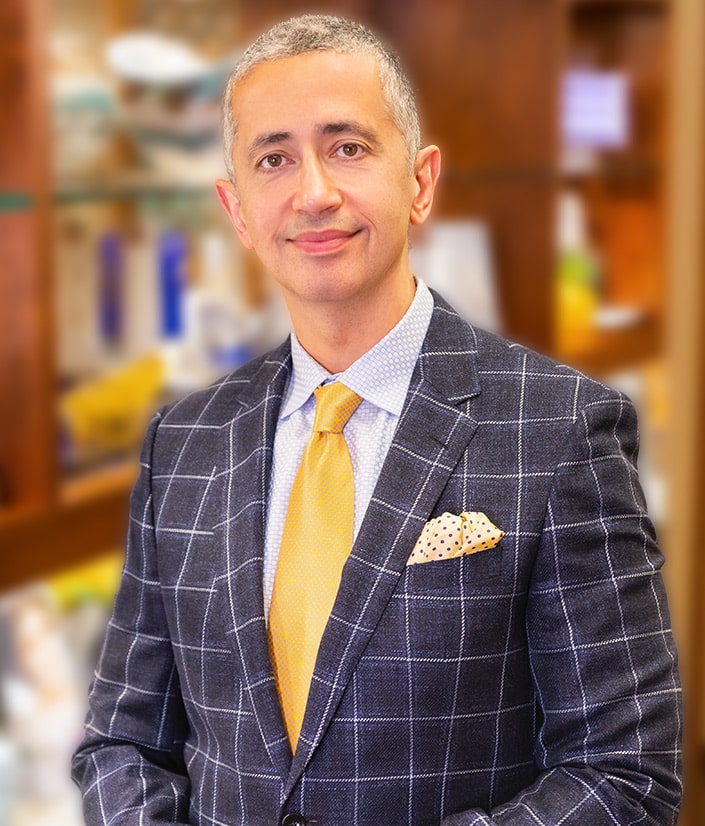
Dr. Shervin Naderi, MD, FACS
Double Board-Certified Facial Plastic Surgeon
Dr. Naderi medically reviewed this page. When PRF is not enough under the eyes, he performs lower eyelid surgery and fat injections, so every option is available under one roof.
Meet Dr. NaderiWhat PRF Injections Can Do
PRF uses growth factors from your own blood to improve the skin itself. At The Naderi Center, it is our first choice for thin skin and a mild hollow under the eyes.
Thicker, Smoother Skin
PRF stimulates new collagen, so thin, crepey skin under the eyes and in the smile lines looks thicker and smoother.
Nothing Synthetic
EZ Gel PRF is made from a small sample of your own blood and prepared in our office during your visit.
Natural, Gradual Results
The improvement builds over the weeks after treatment, without the puffy, bluish look filler can cause in thin skin.

What Is EZ Gel PRF?
PRF stands for platelet-rich fibrin. It is made from a small sample of your blood, spun in a centrifuge to concentrate the platelets and growth factors. Unlike PRP, no anticoagulant is added, so PRF forms a natural fibrin network that releases its growth factors slowly.
EZ Gel is the PRF system we use. Part of the plasma is gently heated and cooled into a smooth gel, then mixed with liquid PRF. The gel gives soft support right away, and the PRF stimulates collagen over the following weeks.
What Can PRF Injections Treat?
PRF works best where the skin is thin and needs better quality, rather than where a lot of volume is missing.
Under the eyes. Thin, crepey skin, a mild hollow along the tear trough and dark circles that come from thin skin. Learn more about tear trough correction.
Smile lines. The nasolabial folds, from the nose to the corners of the mouth, when they are not very deep. The goal is to soften them, not erase them.
Hair and scalp. Early thinning hair. Dr. Snodgrass treats the scalp with PRF or PRP, depending on your hair and your goals. See hair loss treatment.
Other areas. Thin, crepey skin on other areas of the face and body. Dr. Snodgrass will tell you at your consultation whether your area is a good fit.
Why We Chose PRF Over Tear Trough Filler
For years, filler was the standard treatment for hollows under the eyes. In thin under-eye skin, filler can look good for a few weeks and then cause swelling and a bluish-gray puffiness that can last for years. The Naderi Center has largely stepped away from tear trough filler. For thin skin and a mild hollow, we use PRF. For a deeper hollow, Dr. Naderi uses fat injections.
“If you want something non-surgical, it’s PRF gel injections. If you want something more permanent, it’s fat injections, micro and nano fat. Stay away from tear trough fillers for most people. Some of you still can, but not most.”
Dr. Shervin Naderi
What PRF does differently
- It blends in. PRF does not get lumpy and does not reflect light through thin skin the way filler can.
- Nothing synthetic. PRF is made from your own blood, so no foreign product is left under the skin.
- It improves the skin itself. PRF stimulates collagen, so the skin looks thicker and less crepey, not just fuller.
- Performed by a physician. Every PRF treatment is performed by Dr. Snodgrass, a board-certified dermatologist.
Who Is a Good Candidate for PRF?
PRF is a good fit if you have:
- Thin, crepey skin under the eyes
- A mild hollow along the tear trough
- Smile lines that are not very deep
- Early hair thinning
- A wish for a natural, gradual result with nothing synthetic
We will suggest something else when:
- Under-eye bags cast the shadow. That calls for lower eyelid surgery.
- The hollow is deep. Fat injections last longer and do more.
- The mid-face has lost volume. Filler placed deep on the bone, or fat, restores it.
- The skin is loose or wrinkled. Laser resurfacing tightens it.
- The dark circle is pigment. Skin treatments work better.
We will bring the experience.
What Happens During a PRF Treatment?
PRF is an in-office treatment, prepared from your own blood during the same visit. Your second treatment follows 6 to 8 weeks later.
Numbing and a Small Blood Draw
Arrive about 30 minutes early for numbing cream. A small amount of blood is drawn, much like a routine lab test.
Your PRF Gel Is Prepared
Your blood is spun, and the plasma is turned into EZ Gel in our office while you wait.
The Injections
Dr. Snodgrass places the PRF with a fine needle or cannula. Most people go back to their normal routine the same day.
When Will You See Results From PRF?
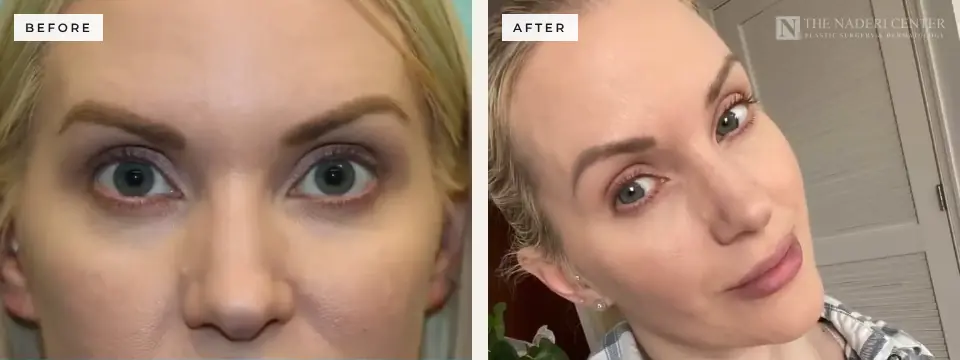
- Right after: the area looks a little puffy, by design, and smoother.
- The first few days: the swelling settles as the liquid part spreads into the tissue.
- The following weeks: collagen builds, and the skin looks thicker and less crepey.
- At 6 to 8 weeks: your second treatment builds on the first.
- Every year: one maintenance treatment keeps the result.
PRF improves the quality of the skin and softens a mild hollow. It does not add the volume of filler or fat, and it does not remove under-eye bags.
“I’m not sculpting PRF. It’s a collagen stimulator.”
Dr. Alexandra Snodgrass
What Does the Research Say About PRF?
PRF is newer than hyaluronic acid filler, and the research is still growing. Here is what published studies show so far.
How the gel works
A 2021 laboratory study in the journal Platelets tested the same kind of mixture used in EZ Gel: heated albumin gel combined with liquid PRF. Its growth factors were released slowly over 10 days, and fibroblasts, the cells that build collagen, showed more collagen activity after a week. That fits what patients see: results that build gradually rather than all at once.
Fujioka-Kobayashi M, et al. Biological characterization of an injectable platelet-rich fibrin mixture consisting of autologous albumin gel and liquid platelet-rich fibrin (Alb-PRF). Platelets. 2021;32(1):74-81.
Results on the face and scalp
A 2024 systematic review in Cureus gathered the published studies of injectable PRF. On the face, studies reported better skin texture and elasticity and fewer fine lines, measured with VISIA skin analysis as well as patient ratings. For hair loss, studies reported better hair density and growth. The authors note that the studies were small and call for larger controlled trials.
Mohale SA, et al. Effectiveness of Injectable Platelet-Rich Fibrin Therapy in Alopecia and Facial Rejuvenation: A Systematic Review. Cureus. 2024;16(6):e62198.
Our view: the evidence supports PRF for improving skin quality, and that is how we use it. We do not promise it can do what filler, fat injections or surgery can.
PRF Videos
Watch Dr. Snodgrass perform EZ Gel PRF, and hear Dr. Naderi explain when PRF is the better choice under the eyes.
10:09 video
EZ Gel PRF Under the Eyes, Step by Step
Dr. Snodgrass treats the under-eyes and smile lines with EZ Gel PRF and explains why tear trough filler is falling out of favor.
Read the transcript10:47 video
What Are PRF Injections Under the Eyes?
Dr. Snodgrass treats the under-eyes and smile lines and explains each step as she goes.
Read the transcript1:00 video
Should You Get Tear Trough Filler?
Why Dr. Naderi steers most patients away from tear trough filler, and when PRF gel is the better choice.
Read the transcript2:34 video
How Are Under-Eye Bags, Dark Circles and Tear Troughs Treated?
When the problem is bags or a deeper hollow, and what treats each.
Read the transcriptWhat Our Patients Say About PRF
★★★★★4.9 on Google from 1,100+ reviews
01 / 03
“Traditional tear trough filler would not be suitable.”
“Dr. Snodgrass is amazing! I came in for tear trough fillers and Botox. She explained to me that my under eyes actually had a combination of issues and that traditional tear trough filler would not be suitable… I trusted her judgment and oh my gosh….I’ve never been happier.”
★★★★★S.L.Google review
“She went over everything she saw in my face & recommended a different approach.”
“Went to my 1st appt to get tear trough fillers after doing a lot of research… She went over everything she saw in my face & recommended a different approach. I’m super happy with my results.”
★★★★★R.J.Google review
“My eyes finally look well-rested.”
“Dr. Snodgrass was patient, friendly, and knowledgeable from the initial consultation, to the procedure, and took the time to understand what I was interested in… my eyes finally look well-rested.”
★★★★★J.P.Google review
How Much Do PRF Injections Cost in the Washington DC Area?

Financing. The Naderi Center offers financing through Cherry. See financing options.
Insurance. Insurance does not cover cosmetic PRF.
EZ Gel PRF at The Naderi Center costs $2,300 for the first treatment and $1,800 for each treatment after that.
Most patients start with two treatments, 6 to 8 weeks apart, for a total of $4,100. After that, one treatment a year keeps the result.
| EZ Gel PRF, first treatment | $2,300 |
|---|---|
| EZ Gel PRF, second treatment | $1,800 |
| EZ Gel PRF, yearly maintenance | $1,800 |
Maintenance pricing applies to treatments within one year of your last PRF treatment. Prices are subject to change.
Included in your price
- Your blood draw, and your PRF gel prepared in our office
- Numbing cream
- Your treatment by Dr. Snodgrass, a board-certified dermatologist

Patient Financing
Pay Over Time with Cherry
Monthly payment plans for surgery and treatments, including 0% APR options for qualifying patients. Checking whether you qualify won’t affect your credit score.
How to Prepare for PRF
- For 2 weeks before, stop anything that can cause extra bleeding: aspirin, ibuprofen, naproxen, fish oil, vitamin E and garlic supplements. If a doctor prescribed a blood thinner, do not stop it without that doctor’s approval.
- Tylenol (acetaminophen) is fine if you need something for pain.
- For 3 days before, stop retinol, tretinoin and exfoliating acids on the area being treated.
- Drink plenty of water the day before, and eat before your visit. It makes the blood draw easier.
- Arrive about 30 minutes early for numbing cream.
- Plan around events. Allow a few days for puffiness, and any bruising under the eye, to settle before anything important.
- Tell us every medication and supplement you take, so nothing interferes with your treatment.
What Is Recovery Like After PRF?
Most people go back to their normal routine the same day. Expect a few days of mild swelling, and be aware that you may get a bruise under the eye.
| When | What to expect |
|---|---|
| Right after | The treated area looks a little puffy and smoother. The extra fullness is planned and settles as the liquid part spreads into the tissue. You can wear makeup the same day. |
| First 24 hours | No strenuous exercise. |
| First few days | Mild swelling and small pinpoint marks fade. You may also get a bruise under the eye, which concealer can cover. Avoid facials and rough scrubbing for 72 hours, and restart retinol and exfoliating acids after 3 days. |
| First week | For discomfort, use Tylenol, not ibuprofen or aspirin. |
| 6 to 8 weeks | Your second PRF treatment, which builds on the first. |
| Every year | One maintenance treatment keeps the result. |
Do not massage, rub or press on the treated area. Call us right away for severe or worsening pain, skin that turns white, gray or blotchy, or any change in your vision.
Is PRF Safe? Risks and Who Should Wait
Risks. PRF is made from your own blood, so there is no reaction to a synthetic product. The most common side effects are swelling, bruising, including a bruise under the eye, small pinpoint marks and temporary puffiness.
As with any injection near the eyes, a rare but serious risk is injection into a blood vessel. Unlike hyaluronic acid filler, PRF gel cannot be dissolved, so careful placement matters. That is one reason every PRF treatment here is performed by a physician.
Who should wait or choose another treatment:
- Bleeding or platelet disorders
- Blood thinners that cannot be safely stopped
- An active infection, or skin cancer, in the area to be treated
- Chemotherapy, or a condition or medication that weakens the immune system
- Current or recent Accutane
Not sure? Dr. Snodgrass will review your health history at your consultation.
PRF Injections in Reston, VA and Chevy Chase, MD
Dr. Snodgrass performs PRF injections at both offices of The Naderi Center. Patients come from Washington DC, from Northern Virginia, including McLean, Great Falls, Vienna, Arlington and Alexandria, and from Maryland, including Bethesda and Potomac.
Maryland
5454 Wisconsin Ave,
Suite 1655
Chevy Chase, MD 20815
(301) 222-2020
Monday to Thursday, 9 AM to 5 PM
Friday, 9 AM to 4 PM
Get directions
Virginia
1850 Town Center Parkway,
Pavilion II, Suite 551
Reston, VA 20190
(703) 481-0002
Monday to Thursday, 9 AM to 5 PM
Friday, 9 AM to 4 PM
Get directions
PRF Injection FAQs
What are PRF injections?
PRF injections use platelet-rich fibrin, made from a small sample of your own blood, to stimulate collagen and improve thin, crepey skin. At The Naderi Center, PRF is prepared as a soft gel (EZ Gel PRF) and injected under the eyes, in the smile lines, in the scalp and in other areas of thin skin.
Who performs PRF injections at The Naderi Center?
Board-certified dermatologist Dr. Alexandra Snodgrass performs PRF injections at our offices in Reston, Virginia and Chevy Chase, Maryland.
How much do EZ Gel PRF injections cost?
PRF injections at The Naderi Center are $2,300 for the first treatment and $1,800 for each treatment after that, including the second treatment 6 to 8 weeks later and yearly maintenance. The first two treatments total $4,100. Financing through Cherry is available for qualifying patients.
How many PRF treatments will I need?
Two to start: an initial treatment and a second treatment 6 to 8 weeks later. After that, one maintenance treatment a year keeps the result.
How long does PRF last?
Most patients keep their result with one maintenance treatment a year after their first two treatments.
What is EZ Gel, and is it the same as PRF?
EZ Gel is PRF. It is the PRF system we use, not a separate treatment. The plasma from your blood is gently heated and cooled until it forms a smooth gel, then mixed with liquid PRF. The gel gives a soft, filler-like effect, and the PRF stimulates collagen. Nothing synthetic is added.
Is PRF better than PRP?
For the under-eyes and smile lines, PRF gel has advantages. It is thicker, so it also gives a soft filler-like effect, and it releases its growth factors more slowly. PRP, a liquid, is still a good choice for hair and for skin treatments such as microneedling. Dr. Snodgrass uses both.
Can PRF replace filler under the eyes?
For thin skin and a mild hollow, yes. Under the eyes, The Naderi Center now uses PRF far more than tear trough filler. For a deep hollow, fat injections work better, and for under-eye bags, lower eyelid surgery is the answer.
Is PRF under the eyes worth it?
For the right person, yes. If your concern is thin, crepey skin or a mild hollow and you want a natural, gradual result with nothing synthetic, PRF is a good choice. If the problem is under-eye bags or a deep hollow, PRF will not give you the result you want, and we will tell you so.
Does PRF help dark circles?
It helps dark circles caused by thin skin or a mild hollow, because it thickens the skin and softens the shadow. It does not change dark circles caused by pigment, and it cannot remove under-eye bags.
Can PRF treat smile lines?
Yes. PRF can soften the nasolabial folds, the smile lines from the nose to the corners of the mouth, in people whose folds are not very deep. The goal is to soften them, not erase them.
Can PRF help with hair loss?
PRF and PRP can both be injected into the scalp for early hair thinning. Dr. Snodgrass decides which to use and how many sessions you need after examining your scalp.
Does PRF hurt?
Numbing cream is applied about 30 minutes before your treatment to keep you comfortable. You may feel pressure and small pinches as the needle goes in.
What is the downtime after PRF?
Usually a few days of mild swelling and small pinpoint marks. You may also get a bruise under the eye, which concealer can cover. The area looks a little puffy at first on purpose. Most people return to their normal routine right away.
When will I see results from PRF?
The area looks smoother once the swelling settles, and the collagen effect builds over the following weeks. The second treatment at 6 to 8 weeks builds on the first.
Is PRF safe, and what are the side effects?
PRF is made from your own blood, so there is no reaction to a synthetic product. The most common side effects are swelling and bruising, including a possible bruise under the eye. Because PRF gel cannot be dissolved like hyaluronic acid filler, careful placement by an experienced physician matters.
Who should not get PRF?
People with bleeding or platelet disorders, blood thinners that cannot be safely stopped, an active infection or skin cancer in the area, chemotherapy, a weakened immune system, or current or recent Accutane should wait or choose another treatment.
How do I prepare for PRF?
Stop anything that can cause extra bleeding, such as aspirin, ibuprofen, fish oil and vitamin E, for 2 weeks before your treatment. Stop retinoids and exfoliating acids 3 days before, drink plenty of water, eat before your visit and arrive 30 minutes early for numbing cream.
Can PRF be combined with other treatments?
Yes. PRF is often part of a larger plan that may include filler in the mid-face, Botox, laser resurfacing or medical-grade skincare. Your physician will plan the order and timing.
Where can I get PRF injections near me?
At The Naderi Center in Reston, Virginia and Chevy Chase, Maryland, serving Washington DC, Northern Virginia and Montgomery County, including McLean, Great Falls, Vienna, Arlington, Alexandria, Bethesda and Potomac. Both offices offer PRF injections.
Medically reviewed by Shervin Naderi, MD, FACS. Dr. Naderi is a double board-certified facial plastic surgeon. Last reviewed .