Can Filler Straighten a Nose with a Bump?
Often, yes. Dr. Naderi says that when there is room above the bump at the radix and below it, filler can create a straighter, more natural bridge and improve symmetry without surgery. It cannot make a nose smaller, and there is a limit to how high the radix can go before the result looks unnatural.
Key Points from Dr. Naderi
- The ideal non-surgical candidate has a low bridge, but a bump can be camouflaged when there is room above and below it.
- Filler can make a nose look more symmetric, but it cannot make it smaller, shorter or more sloped.
- He avoids inflammatory materials in the nose, such as silicone, Bellafill, ArteFill and Radiesse, which can cause significant scar tissue.
- Swelling peaks the next morning and is usually fine in two or three days. Small bruises can be covered with makeup.
- Building the radix too high to hide a bump can look unnatural, so there is a limit to how much he adds.
- Filler does not rule out surgery. A patient can still choose a surgical rhinoplasty later.
Transcript
Parts of this older recording are hard to hear. Words that could not be made out are left out.
Good morning. We're going to demonstrate a non-surgical rhinoplasty injection. I've got plenty of them on the website. You can check them out: different materials, different patients, different anatomies. As I've said before, not everybody is a candidate. The ideal non-surgical candidate is somebody with a very low dorsum, a low bridge. You need to build it up, make it look more defined, more narrow, and give it some height. But there are a variety of patients who can be candidates. For example, somebody who's got a dorsal bump on the bridge: if there is room above it, at the radix, and room below it, you can create a straighter bridge and give it more of a natural contour. It's a matter of personal taste as well.
Symmetry can also be improved. For example, if one of the upper lateral cartilages in this area is pressed inward a little bit more, by injecting this area you can create more symmetry. Nobody's perfectly symmetric. It doesn't exist on the face. But you can create the illusion of more symmetry by doing that.
However, there are certain things that you have to be aware of. It has to fit the patient. For example, if you want to make the nose smaller, want to give it more of a curvature, want to make a more cutesy, Barbie-doll type of nose, this isn't the way to go. This is more of a natural, higher bridge. It doesn't burn any bridges, literally. About a year later, if she wants to go with a different style of nose, she can go back to a surgical approach.
However, you want to make sure you're avoiding things that are inflammatory. Don't put silicone, don't put Bellafill, don't put ArteFill, don't put Radiesse into the nose, because it's very inflammatory and can cause significant scar tissue. Restylane and Juvederm are safe. Juvederm is for very thin-skinned patients. For most, I use Restylane. She's on the border, but we're going to go with Restylane.
It's micro droplets, and you'll see me inject the radix a little bit, and the sidewalls, to give it more symmetry and a natural look. Again, some of you may prefer a smaller dose, and that's perfectly fine. A little tiny poke. How was that? Not terrible? The filler has additional numbing medicine in it, called lidocaine. It's 0.3% lidocaine, so as we go, it gets better and better.
The first couple of days, it is more swollen. The next morning is actually when you have the most swelling, so the next day you don't want to have any important meetings or events. But basically, two or three days from now, you should be fine. Any little bruises can be covered with makeup.
This is the more sensitive area. I never like to put too much filler in one place and then have to massage it. I want to put the right amount of filler exactly where it needs to go, so we're doing micro droplets.
We're not done yet, but I want you to see the front view. There's a mirror right in your hand. Take a look. We're going a little bit more to the radix, above the bump. Now, there's a limit to how much you can put in here, because if you're trying to get rid of the bump completely by elevating the radix, in some patients you'll make them look like an Avatar, and we've talked about this. We don't want to look like an Avatar. We don't want the filler to come off the forehead just to cover a bump. So it depends on the starting position. It's looking much better.
There are some candidates who are ideal candidates for this. They're going to look much better non-surgically than they would even surgically. I think a lot of Asian patients fall into that category. Ideally, everything being equal, my favorite thing to do is a surgical approach to narrow the nostrils and a surgical approach to create more projection to the tip, but there's nothing that's as nice as non-surgical for the bridge when that's all you need, because it's a soft material. There are no sharp edges. You don't have to worry about asymmetries as things heal. It's just a beautiful material.
I'm going to put a little bit in the tip, for projection. The tip is a little bit more tender. I'm going to stay right on the midline. It's important to be in the middle. You get a little more projection, so that gives you more room for the filler in the bridge.
If you drop the height of the camera and look at the profile, you can see how straight it is. Here you had the bump. It's definitely straighter now. I could go even higher to make it even more straight, but then it would be too high for you. So this is the limit that we reach. The bump was a little bit too big for it to be perfect, but again, this is a much improved nose from before. She doesn't have the bump anymore. It's perfectly straight here. I do prefer a smaller, shorter, more sloped nose on her, but this is a very nice alternative until we get to the point that surgery becomes an option.
And if we look at it from the top view, you can see it's much more symmetric. The indentation that was here, which was making the nose look crooked, is gone. It'll look so much straighter from that angle as well. This little redness and purpleness is basically from the injection. That'll be gone in a day or two, but you can put makeup on and enjoy it immediately. That's essentially it. That's the non-surgical rhinoplasty.
More Answers from Dr. Naderi
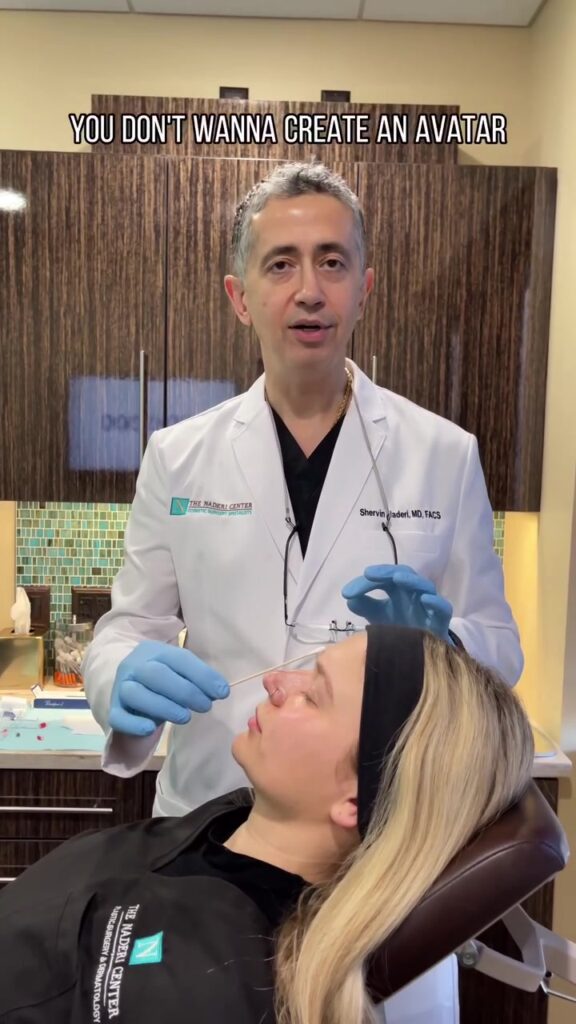 6:19Rhinoplasty
How Is a Non-Surgical Rhinoplasty Done?
 3:50Rhinoplasty
Are You a Candidate for a Liquid Nose Job?
 2:45Rhinoplasty
How Can a Low or Flat Nasal Bridge Be Raised?