Medically reviewed by Dr. Shervin Naderi, MD, FACS, double board-certified facial plastic surgeon. Last reviewed October 20, 2026.
Walk through any mall in Arlington this month and you’ll see them: glowing red masks on display stands, priced like a nice dinner out and promising younger skin while you watch TV. Patients bring them up in consultations all the time now. Some already own one. Others want to know if they should buy one before the holidays or put the money toward a treatment in the office.
It’s a fair question, and it deserves a straight answer from someone who uses light on skin every week. Red light has real science behind it. We use it in our own office after every facial. But a mask on your couch in Washington DC and a laser in a treatment room do very different jobs, and mixing them up is how people spend a year waiting for results that a home device was never built to deliver.
The short answer
Red light masks can help skin look calmer and a little brighter when you use them consistently, but they’re a gentle helper. They won’t fade brown spots, and they won’t resurface wrinkles. For those, you need an in-office light or laser such as Sciton BBL, 3D Miracle or UltraClear. The smart move for most people is both: the office treatment does the correcting, and a mask, if you like using one, helps with upkeep between visits.
Do red light masks actually work?
Yes, within limits. Red light is low-energy light that doesn’t burn or remove any skin, so the changes it makes are small and build slowly. People in McLean who use a mask faithfully often tell us their skin looks less tired. People who use it twice and forget it in a drawer tell us it did nothing. Both are being honest.
“I’m not against home masks,” says Dr. Shervin Naderi, a double board-certified facial plastic surgeon. “I’m against expecting a home mask to do a laser’s job. If your goal is a healthier glow and you’ll actually use it, fine. If your goal is to erase sun spots from twenty summers of tennis, a mask isn’t the tool.”
What does red light do to your skin?
Red light works by giving skin cells a gentle nudge rather than an injury. On our facials page we describe what it does after a treatment: it helps jumpstart collagen production and speeds up healing. Patients mostly notice that their skin looks calmer and less red when they leave.
That calming effect is why we use it after facials instead of as a stand-alone fix. A patient from Vienna who comes in for a facial every few weeks gets red light at the end of each visit as part of the routine. It’s the finishing step, the part that settles the skin down after extractions and exfoliation, and it adds no downtime at all.
How is an at-home mask different from red light in a medical office?
In our office we use LightStim by Elipsa after every facial, and red or blue LED can be included in a HydraFacial as well. The light is part of a plan: the skin has been cleaned and treated first, and someone who looks at skin all day decides what comes before and after. A mask at home is the same idea on a smaller scale, without the rest of the treatment around it.
“Red light therapy is a powerful way to biohack your skin’s natural regeneration process,” Dr. Naderi says. “When used consistently and in conjunction with expert aesthetic treatments, it significantly boosts results and keeps the skin functioning at its best.” The key words there are consistently and in conjunction. Red light is a supporting player.
When do you need a laser instead of a red light mask?
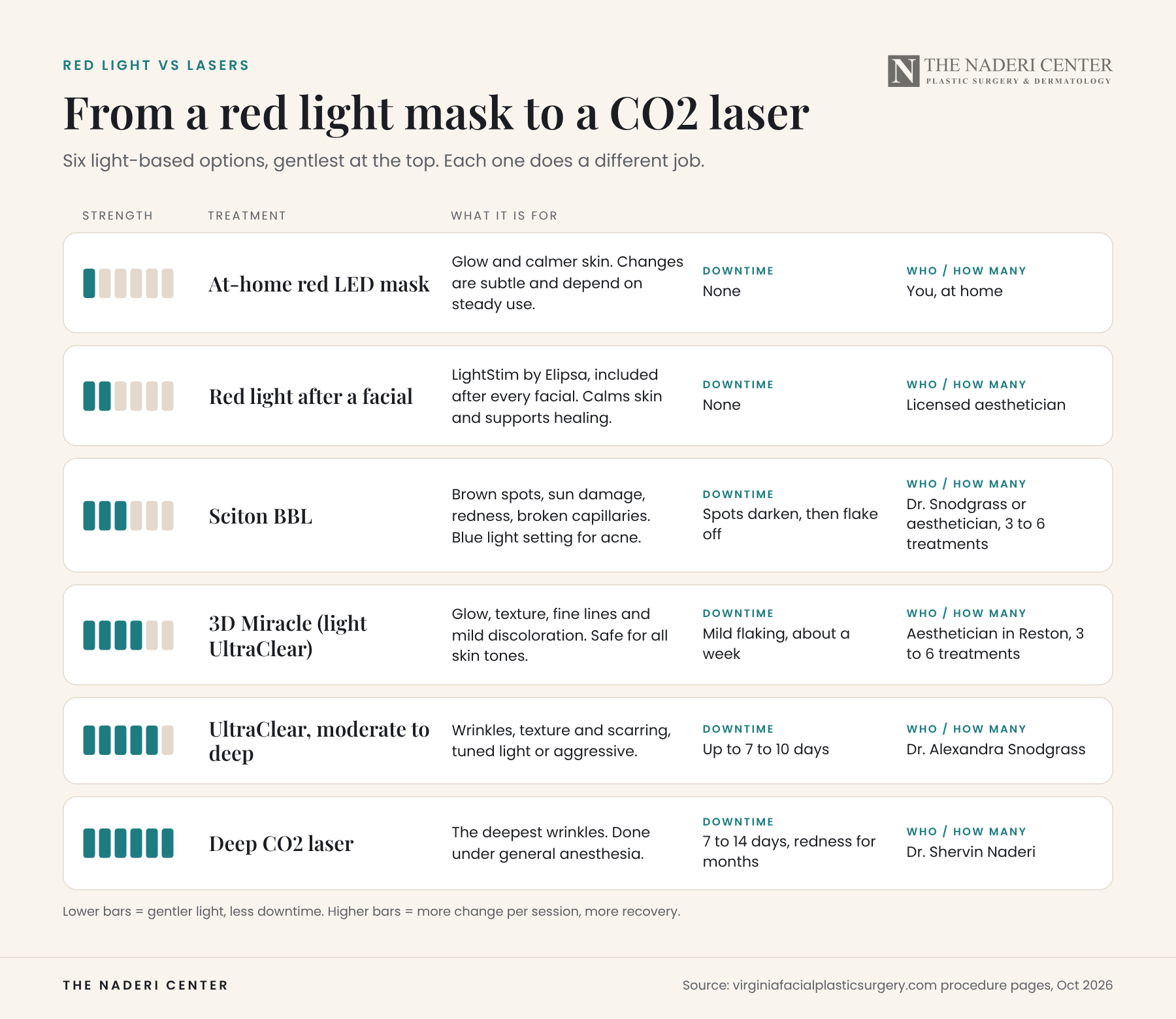
You need an in-office laser or light treatment when the problem is something you can point to: a brown spot, a cluster of broken capillaries, rough texture, etched fine lines or acne scars. Those need energy strong enough to change the skin on purpose, and that’s exactly what a mask is designed not to do, because it has to be safe to use alone at home.
“Patients sometimes feel guilty that the mask didn’t work,” Dr. Naderi says. “It’s not their fault. They bought a flashlight and asked it to do surgery. Once we sort out which problem they’re actually trying to fix, the right tool is usually obvious.”
What does Sciton BBL do that a red light mask can’t?
Sciton BBL is broadband light, a much stronger cousin of the light in a mask. It targets brown pigment and redness, so it can fade sun spots and freckles, and it’s one of the best treatments we have for rosacea and broken capillaries. Its blue light setting is used for active acne. Almost everyone sees an improvement after one session, and a series of three to six is the usual plan. Here, BBL can be done by our master aesthetician or by Dr. Alexandra Snodgrass, our board-certified dermatologist.
BBL does have rules a mask doesn’t. You can’t be tan, so the summer crowd from Old Town Alexandria who spent August on the water usually waits for the fall. Some skin types are pre-treated with hydroquinone and Retin-A for several weeks first, and BBL isn’t recommended for very dark skin. After treatment, brown spots darken and then flake off. That’s expected, and it means the treatment is doing its job.
Is UltraClear or 3D Miracle better than red light for fine lines and texture?
For fine lines and texture, yes. 3D Miracle is a very light setting of the UltraClear cold fiber laser. It removes a thin layer of damaged surface skin, which prompts new collagen, so skin looks smoother and brighter. It’s safe across skin tones, the discomfort is mild, and most patients do a series of three to six. Our licensed aesthetician does it at the Reston office, and mild flaking for about a week is the main downside.
When lines or scars are deeper, UltraClear can be turned up to moderate or deep settings, which Dr. Alexandra Snodgrass, our board-certified dermatologist, performs. For the deepest wrinkles, Dr. Naderi does deep CO2 laser resurfacing under general anesthesia. “The question I ask is how much change the patient wants and how much downtime they can live with,” he says. “Those two answers pick the laser for me.”
How much downtime does each treatment have?
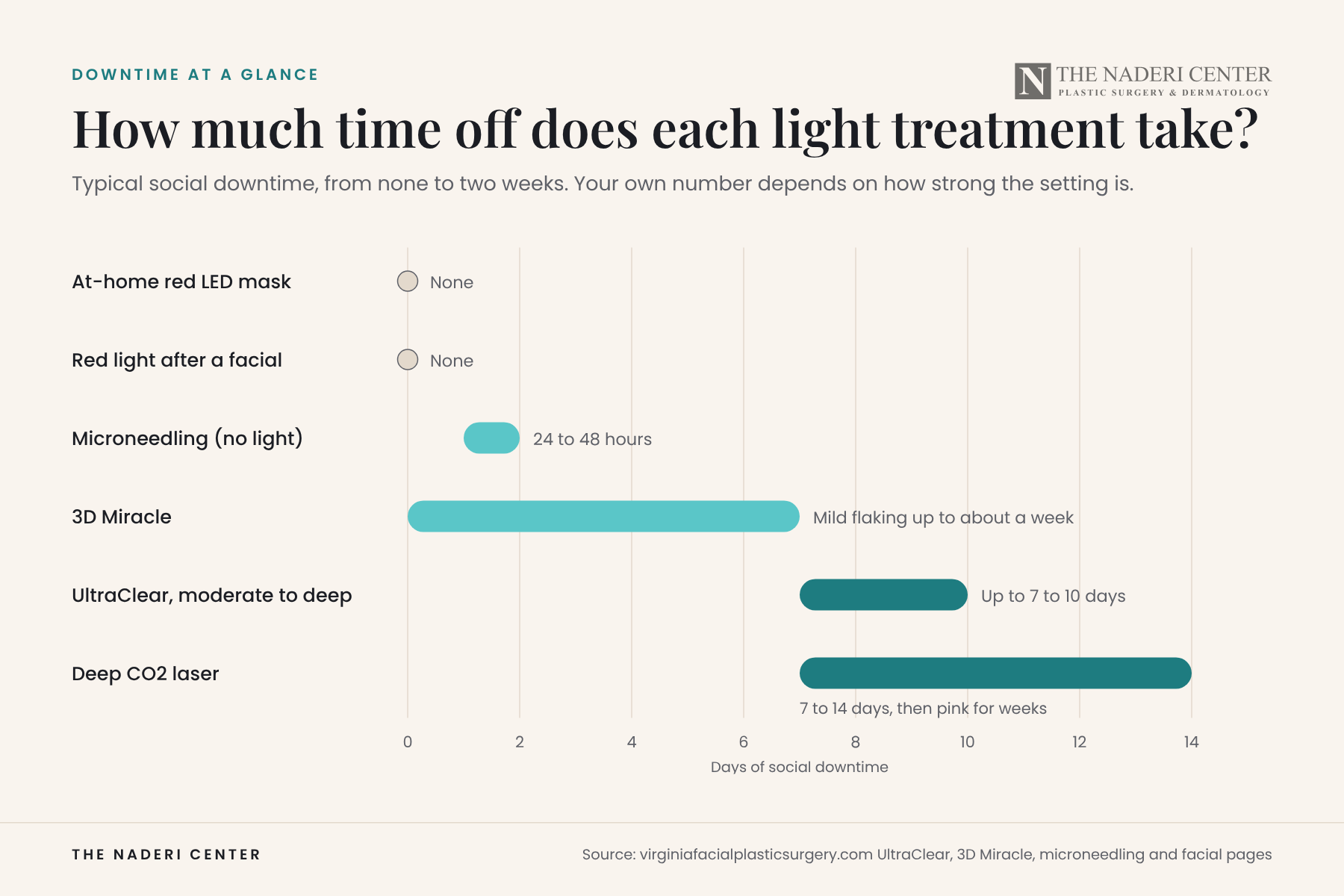
Red light, whether at home or after a facial, has none. Microneedling usually means a day or two of pinkness. 3D Miracle brings mild flaking for up to about a week, and most people can wear makeup after 24 hours. A deeper UltraClear treatment can mean up to seven to ten days of social downtime, and deep CO2 means a real recovery of one to two weeks, with pinkness that lasts longer.
For a lawyer in Bethesda with court on Monday, that range matters more than anything else in this guide. Plenty of people schedule a deeper treatment over a long weekend or a work-from-home week, and save the gentle options for weeks when they have to be on camera. There’s no wrong answer, as long as you know what you’re signing up for.
Are red light masks safe for melasma, rosacea and darker skin?
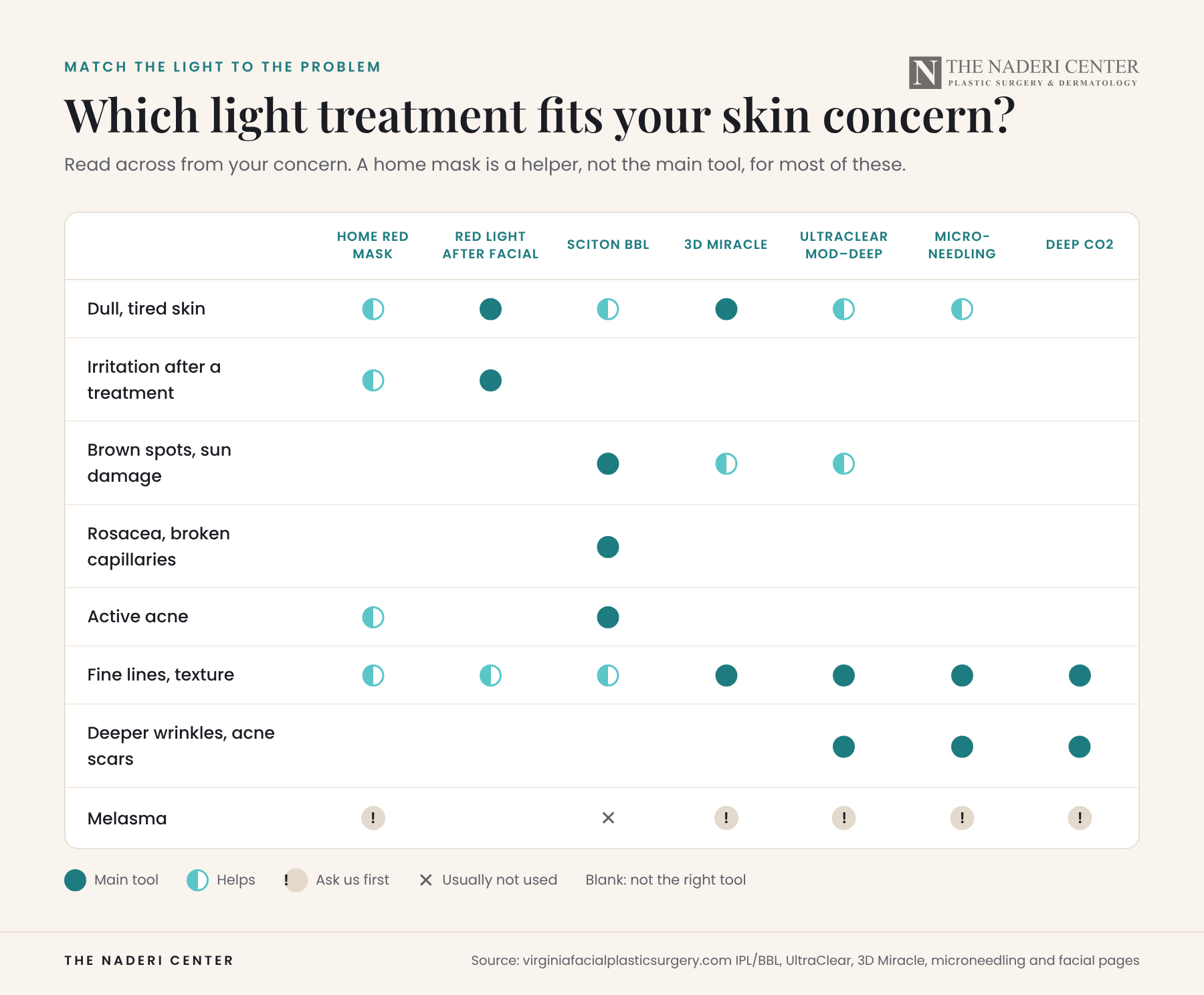
Generally, red light is gentle, but melasma is the exception worth a conversation. Melasma is stubborn and can flare with heat and light, which is also why BBL usually isn’t used for it. If you have melasma, talk to us before adding any light device to your routine. For rosacea, a mask may feel soothing, but it won’t close the broken capillaries that BBL can treat.
“With darker skin tones the worry is always pigment,” Dr. Naderi says. “That’s a big reason we like the UltraClear platform, because it’s a cold laser and the risk of darkening is lower. Whatever you use at home, protect your eyes and tell us about it at your visit. I’d rather know than guess.”
Why is fall the best time to start?
Most light treatments and lasers need skin that isn’t tanned and isn’t about to be in strong sun. October and November give you exactly that. Once the trails at Great Falls Park and the towpath out past Potomac are covered in leaves instead of sunshine, it’s much easier to keep treated skin out of the sun for the weeks that follow. A BBL series that starts this month can wrap up before the holidays.

Where can I get red light therapy and laser treatments near McLean, Bethesda or Washington DC?
The Naderi Center has two offices, and consultations are offered at both. Our Reston office is at 1850 Town Center Parkway, Pavillion II, Suite 551, Reston, VA 20190, (703) 481-0002, a short drive for patients in McLean, Great Falls and Vienna. Our Chevy Chase office is at 5454 Wisconsin Ave, Suite 1655, Chevy Chase, MD 20815, (301) 222-2020, convenient for Bethesda, Potomac and most of Washington DC.
If you want to try red light therapy in Reston, the easiest way in is a facial, since red light is included at the end of every one. A few treatments are only done in one office. The HydraFacial and 3D Miracle, for example, are offered only at the Reston office. Our team will tell you where your treatment happens when you book, and plenty of Maryland patients have a consultation in Chevy Chase and then come to Reston for a specific treatment.
Should I buy a red light mask?
If you enjoy the ritual and you’ll use it, a mask can be a nice extra. Look for one with eye protection, follow its directions, and don’t expect it to replace sunscreen, which still matters more for aging skin than any gadget on the market. “Buy the mask if you want it,” Dr. Naderi says. “Just think of it like a toothbrush. You still need to see the dentist.”
If you already own one, bring it up at your visit. We’ll tell you when to pause it around a laser treatment and whether it fits with your skincare. We would much rather build it into a plan than have you guess.
The best results we see come from matching the treatment to the problem and sticking with it. If you’re not sure where to start, book a consultation in Reston or Chevy Chase and we’ll look at your skin and give you a plan that makes sense. “Start with what bothers you most,” Dr. Naderi says. “Then we’ll pick the light that actually fixes it.”
Laser and light treatment before and after photos
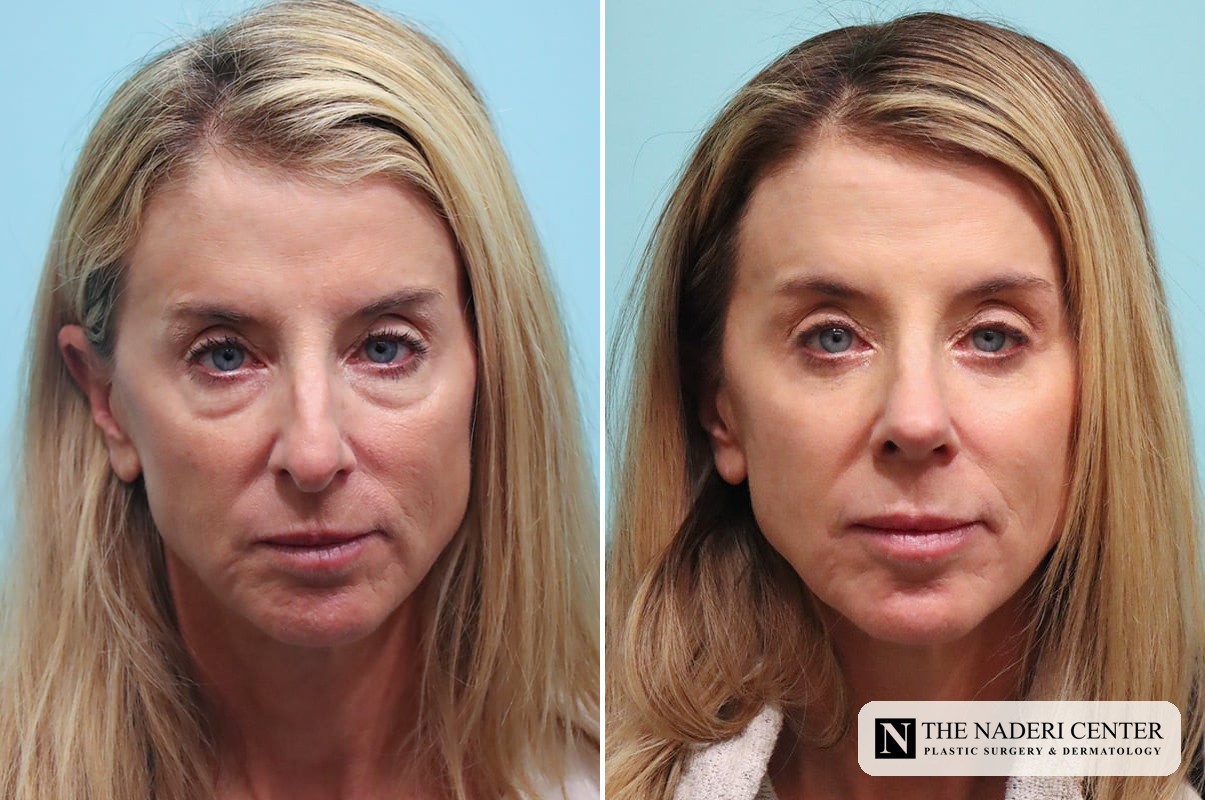
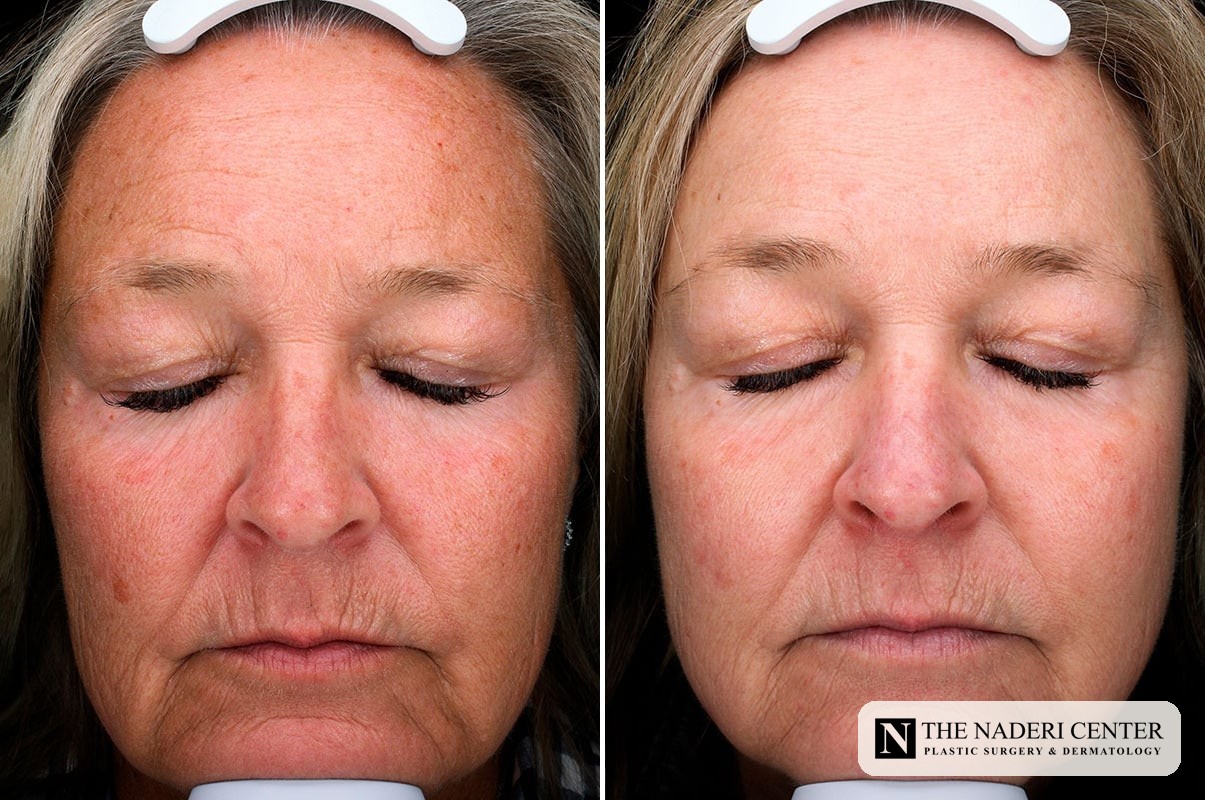
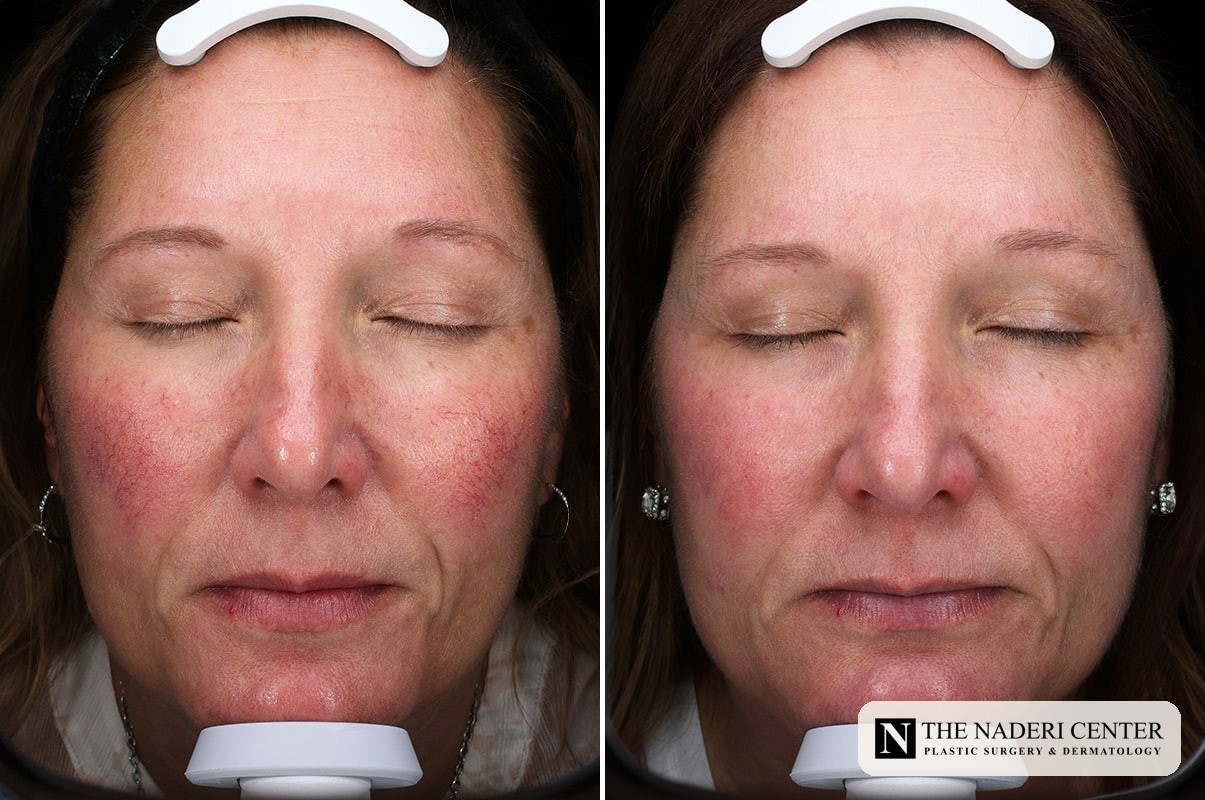
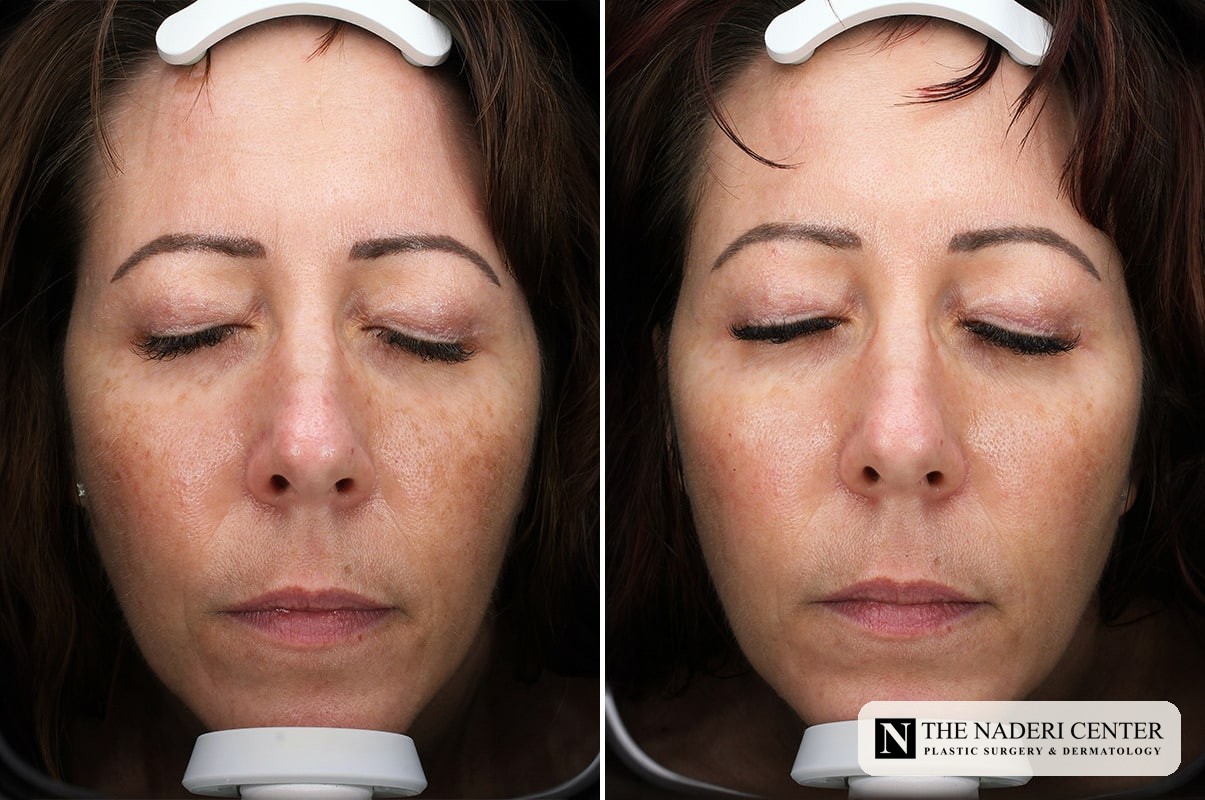
Real patients of The Naderi Center. Individual results vary.
Frequently asked questions
Do red light masks work as well as in-office treatments?
No. A home red light mask can help skin look calmer and brighter with steady use, but it doesn’t have the strength to fade brown spots or resurface wrinkles. In-office treatments such as Sciton BBL, 3D Miracle and UltraClear are designed to make those changes.
Is red light therapy the same as BBL or IPL?
No. Red light is gentle, low-energy light that doesn’t injure the skin. Sciton BBL is broadband light strong enough to target pigment and redness, which is why it can fade sun spots and rosacea redness and a mask cannot.
Do you include red light with facials at The Naderi Center?
Yes. We use LightStim by Elipsa red light after every facial, and red or blue LED can be included in a HydraFacial. The HydraFacial is offered only at our Reston office and takes about an hour.
Can a red light mask fix melasma?
No. Melasma is a chronic condition that tends to come back, and it usually isn’t treated with BBL. Treatment centers on consistent at-home skincare and strict sun avoidance, so talk to us before adding any light device if you have melasma.
Can I use my red light mask after a laser treatment?
Ask first. After a laser or BBL treatment your skin follows specific aftercare instructions, and we’ll tell you when it’s safe to go back to any home device.