The Anatomy, Psychology, and Technical Errors Behind Unnatural Facelift Results
Few procedures in aesthetic surgery carry the same emotional weight as a facelift.
Unlike rhinoplasty or eyelid surgery, a facelift does not alter a single isolated feature. It changes the overall architecture of the face itself, the structure through which people recognize us, interpret our emotions, and often define identity. When facelift surgery succeeds, patients simply look healthier, more rested, and subtly younger. Friends notice something improved but cannot quite identify why.
When facelift surgery fails, however, the results are often immediately recognizable.
Patients describe these outcomes in remarkably similar language. They say their face looks “pulled.” They no longer recognize themselves in photographs. Their smile feels different. Their face appears tight, unnatural, or strangely expressionless. In many cases, they do not necessarily look younger. They simply look surgically altered.

Key Takeaways
- Facial aging affects the deeper structures too not only the skin.
- Natural facelift results depend on restoring the face, neck, and midface together.
- Excessive skin tension can create a pulled or unnatural appearance.
- Deep plane techniques reposition deeper tissues while preserving softness and movement.
- The surgeon’s experience, judgment, and restraint are essential for protecting the patient’s identity.
Not All Facelifts Are the Same
At The Naderi Center, Dr. Shervin Naderi believes one of the biggest misconceptions surrounding facelift surgery is the assumption that all facelifts are fundamentally the same operation.
They are not.
With more than 20 years devoted exclusively to aesthetic facial plastic surgery, Dr. Naderi emphasizes that natural facial rejuvenation requires far more than tightening tissue. It requires a sophisticated understanding of facial anatomy, aging biomechanics, structural balance, facial identity, and surgical restraint.
“A facelift is not simply about lifting the face upward,” says Dr. Naderi. “It is about restoring anatomical relationships that have changed over time while preserving natural movement, softness, and identity. That level of nuance is what separates natural rejuvenation from an operated appearance.”
Why Facelifts Often Fail
Most failed facelifts are not caused by recklessness.
They are caused by oversimplification.
Some surgeons approach facial aging as a superficial skin problem rather than a deeper structural process. Others rely on outdated techniques that create tension rather than restoration. Some fail to adequately address the neck, while others over-tighten the jawline and ignore the midface entirely.
The result is often a face that looks tighter but not truly younger.
Understanding why facelifts fail requires understanding how the face actually ages.
Facial Aging Is a Structural Process, Not Simply a Skin Problem
One of the central scientific misunderstandings behind many unnatural facelift results is the belief that aging occurs primarily within the skin.
In reality, facial aging is a far more complex three-dimensional process involving multiple anatomical layers simultaneously. As patients age, the retaining ligaments that support youthful facial contours gradually weaken. Deep fat compartments descend downward and inward. Bone structure subtly remodels over time. Skin loses elasticity, collagen diminishes, and facial proportions slowly shift.
What patients perceive externally as jowls or heaviness along the jawline is often the visible consequence of much deeper structural change occurring beneath the surface.
“Most meaningful facial aging originates below the skin,” explains Dr. Naderi. “If surgery only addresses the surface, the rejuvenation almost always looks incomplete or unnatural.”
This distinction is enormously important because it explains why older facelift techniques frequently produced tight, artificial results. Historically, many procedures focused heavily on skin tightening because it was technically simpler than mobilizing deeper anatomical structures.
Unfortunately, skin is not designed to bear long-term lifting tension.
Mistake #1: Placing Too Much Tension on the Skin
Perhaps the most recognizable failed facelift is the classic “windswept” appearance, the face that looks unnaturally stretched sideways.
This outcome usually occurs when excessive tension is placed directly on the skin rather than on the deeper structural layers responsible for facial support. When the skin bears the burden of the lift, several problems can emerge simultaneously. Facial movement becomes restricted, scars widen under tension, the mouth may appear distorted, and the ears can look unnaturally pulled.
Over time, these results often age poorly because the underlying anatomy was never truly restored.
Modern deep plane facelift techniques approach rejuvenation very differently. Rather than simply pulling the surface tighter, deeper facial structures are repositioned more anatomically so the skin can drape naturally without excessive force.
“The skin should never be carrying the entire lift,” says Dr. Naderi. “When deeper structures are elevated properly, the face retains softness and natural movement.”
This is one reason sophisticated deep plane facelift surgery often appears dramatically more natural than older facelift techniques despite creating more comprehensive rejuvenation.
Mistake #2: Failing to Treat the Neck as Part of the Face

One of the most common reasons patients remain dissatisfied after facelift surgery is incomplete neck rejuvenation.
The face and neck are not separate aesthetic units. They function together anatomically and visually. A sharper jawline loses its impact entirely if heaviness persists beneath the chin or platysmal banding remains visible in the neck.
Yet many facelift procedures inadequately address cervical aging.
Sometimes this occurs because surgeons attempt to shorten operative time or minimize surgical complexity. In other cases, the neck is improved superficially without comprehensive structural correction.
The result is often imbalance. The lower face may appear tighter while the neck continues revealing age.
“Natural facial rejuvenation depends on continuity,” explains Dr. Naderi. “The jawline transitions directly into the neck. If one area is rejuvenated while the other is neglected, the result rarely looks harmonious.”
For many patients, neck contour is actually one of the strongest subconscious indicators of youthfulness.
Mistake #3: Ignoring the Midface
Another hallmark of outdated facelift surgery is excessive focus on the jawline without properly addressing the cheeks and midface.
Patients sometimes emerge with tighter lower faces while persistent heaviness remains around the nasolabial folds and central face. The result can feel subtly unnatural because one portion of the face appears surgically tightened while another continues reflecting advanced aging.
Scientifically, this occurs because aging is not purely vertical or isolated to the lower face.
As deep cheek fat compartments descend medially over time, volume shifts downward toward the nasolabial region while the upper cheek gradually flattens. This changes how light reflects across the face and contributes significantly to an aged appearance.
Deep plane facelift techniques often produce more natural rejuvenation precisely because they restore continuity between the cheeks, jawline, and neck rather than treating them as separate structures.
“The face ages as a complete anatomical system,” says Dr. Naderi. “Sophisticated rejuvenation restores balance throughout the face instead of tightening isolated areas.”
Mistake #4: Using Excessive Filler Instead of Restoring Anatomy
Over the last two decades, injectable fillers transformed aesthetic medicine. Used strategically, fillers can create beautiful improvement in selected patients.
But fillers cannot reposition descended tissue.
Many patients seeking facelift surgery today arrive after years of progressively increasing filler treatments intended to postpone surgery indefinitely. Over time, however, adding volume to already descended facial structures can create a distinctly unnatural heaviness.
The face appears wider. Puffier. Less defined.
Ironically, patients may look older despite having more volume.
“Volume loss and tissue descent are two completely different biological problems,” explains Dr. Naderi. “At a certain point, the issue is no longer lack of volume. The issue is structural descent.”
This phenomenon is one reason many sophisticated patients are now moving away from repeated filler correction and toward anatomically restorative facial surgery.

Plan Your Facial Rejuvenation
Schedule a consultation with Dr. Shervin Naderi to discuss a precise and individualized approach.
Mistake #5: Poor Surgical Vector Design
One of the most technically nuanced aspects of facelift surgery involves vector control, the precise direction tissues are elevated during surgery.
Subtle differences in vector design can dramatically affect whether a result appears elegant or artificial.
If tissues are pulled too horizontally, the face may appear stretched sideways. If elevation lacks adequate vertical support, lower facial heaviness may recur prematurely. If vectors are asymmetrical, even minor differences can create imbalance in expression or contour.
These are often millimeter-level decisions with profound visual consequences.
“The direction of tissue movement matters enormously,” says Dr. Naderi. “Facial rejuvenation is not simply about lifting upward. It is about restoring tissue along anatomically natural trajectories.”
This is one reason facelift surgery remains highly operator dependent even among experienced surgeons.
Mistake #6: Distorting the Hairline or Ears
Many patients instinctively evaluate facelift results by looking first at two subtle areas: the ears and the hairline.
Poor incision design or excessive tension can distort both.
The tragus may appear unnaturally flattened. The earlobe can become elongated or attached. The hairline may shift visibly upward or backward. Even technically successful lifting can look obviously surgical when these landmarks are not preserved carefully.
“Natural facelift surgery is often judged by what people do not notice,” explains Dr. Naderi. “When the ears, hairline, and incisions remain invisible, the face itself looks more believable.”
These details require meticulous planning and surgical restraint because once distorted, they can be extraordinarily difficult to correct.

Mistake #7: Losing the Patient’s Identity
Perhaps the most psychologically devastating facelift failures occur when patients no longer feel they resemble themselves.
This typically happens when surgeons prioritize dramatic transformation over facial harmony and individuality.
The human brain is extraordinarily sensitive to subtle changes in facial identity. Small alterations in expression, mouth tension, eye shape, or facial proportion can create a face that feels emotionally unfamiliar even if observers cannot immediately explain why.
“The greatest facelift results preserve identity completely,” says Dr. Naderi. “Patients should still look entirely like themselves. The goal is restoration, not reinvention.”
This psychological component is one reason facial rejuvenation requires artistic judgment in addition to technical expertise.
Patients are not simply trying to erase wrinkles.
They are often trying to restore congruence between how they feel internally and how they appear externally.
Why Deep Plane Facelifts Often Look More Natural
The growing interest in deep plane facelift surgery reflects a broader shift in how surgeons understand facial aging itself.
Rather than leaning mostly on superficial tightening, the deep plane approach mobilizes and repositions deeper anatomic structures that are responsible for a youthful facial contour. Since tension gets distributed more naturally through the deeper support system, outcomes often look softer, more balanced, and more anatomically believable, too.
What Creates a More Natural Result
The cheeks retain movement. The jawline appears cleaner without looking over-tightened. The nasolabial folds soften more organically because descended tissue has actually been repositioned rather than simply stretched.
Still, Dr. Naderi emphasizes that no technique alone guarantees beautiful results.
“There is no magical operation in facial plastic surgery,” he explains. “Beautiful outcomes depend on anatomy, judgment, restraint, and experience.”
Even advanced techniques can produce poor results if performed without sufficient expertise or artistic sophistication.
Facelift Before & After
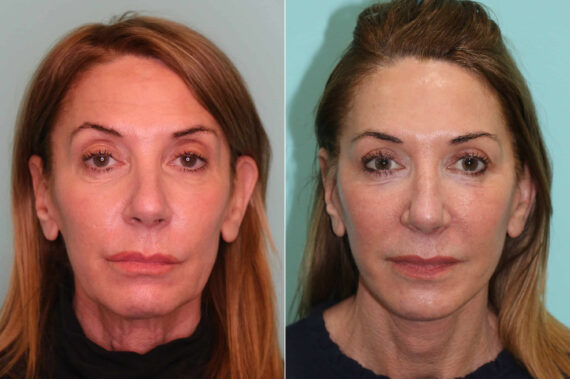
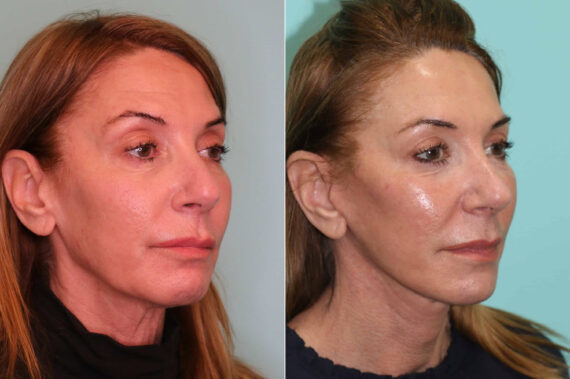
*Results vary from patient to patient
The Psychology of Facelift Satisfaction
One of the most overlooked dimensions of facelift surgery is emotional psychology.
Patients rarely go for surgery only over wrinkles. Usually it’s not that simple; they’re reacting to something deeper, a slow-growing disconnect between how they look on the outside and their internal sense of vitality.
When rejuvenation actually works, patients often say they feel back to themselves again.
When it fails, the emotional consequences can be profound because the face is so deeply tied to identity and self-recognition.
“Facial rejuvenation is uniquely personal,” says Dr. Naderi. “Patients are not asking for a different face. They are asking to restore familiarity, energy, and natural confidence.”
This is why restraint remains one of the most important principles in sophisticated facelift surgery.
How Patients Can Avoid a Failed Facelift
Patients researching facelift surgery should evaluate far more than before-and-after photographs alone.
Equally important are:
- The surgeon’s anatomical philosophy
- Consistency of natural outcomes
- Specialization in facial surgery
- Ability to explain aging scientifically rather than relying on vague marketing language.
Facial rejuvenation is extraordinarily nuanced because millimeters matter. Small technical decisions profoundly affect expression, movement, contour, and identity.
With more than two decades spent mostly on aesthetic facial plastic surgery, Dr. Naderi thinks successful facelift surgery needs to respect the individuality of each face rather than applying some standardized formula.
“The face is the most psychologically important structure we possess,” says Dr. Naderi. “Surgery must honor that responsibility with precision, restraint, and deep anatomical understanding.”
Natural Facial Rejuvenation Requires Anatomical Precision
At its highest level, facelift surgery is not about making patients look dramatically different.
It is about restoring structural harmony while preserving identity, movement, and authenticity.
That requires far more than tightening skin.
Dr. Shervin Naderi combines more than 20 years of specialized aesthetic facial plastic surgery experience with advanced deep plane facelift techniques grounded in anatomical precision, artistic restraint, and natural-looking rejuvenation.
For patients considering facial rejuvenation, understanding why facelifts fail may ultimately be just as important as understanding how exceptional facelifts succeed. Book a consultation in our Chevy Chase or Reston offices.
Frequently Asked Questions About Failed Facelifts
About Dr. Shervin Naderi
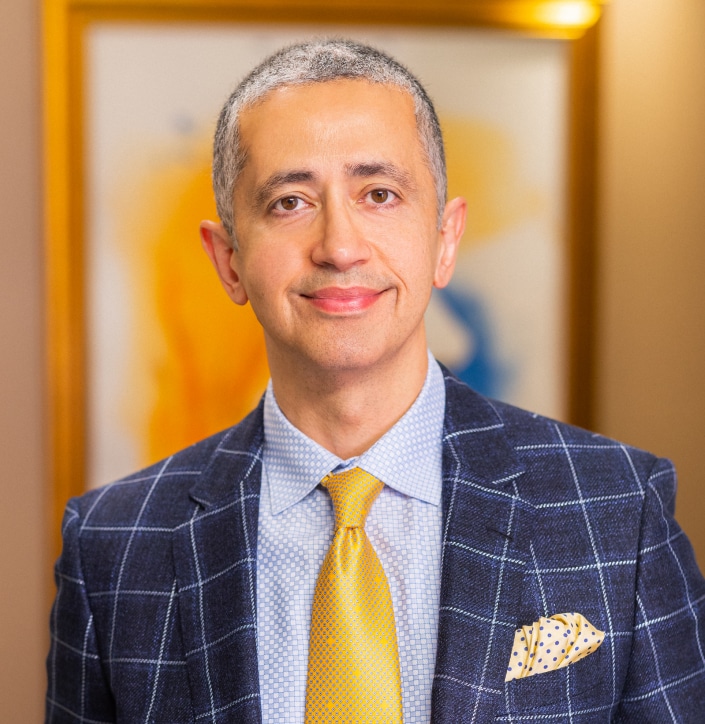
Dr. Shervin Naderi, MD, FACS, is double board certified in facial plastic and reconstructive surgery and otolaryngology. He completed an accredited fellowship in facial plastic and reconstructive surgery and has served as an oral board examiner for the American Board of Facial Plastic and Reconstructive Surgery. He has also taught surgical residents and contributed to medical publications on facelift, rhinoplasty, and eyelid surgery.
Written by: The Naderi Center Team
Medically reviewed by: Dr. Shervin Naderi
Last reviewed: July 31st, 2026