
Medically reviewed by Dr. Shervin Naderi, MD, FACS, double board-certified facial plastic surgeon. Last reviewed October 24, 2026.
Here is your guide to acne scar laser treatment in Reston and Chevy Chase, written for the many patients who visit us each autumn from Reston and Vienna hoping to smooth skin that acne marked years ago. Acne scars are among the most personal concerns we see, and we find that patients feel more at ease once they understand what their scars are and how each treatment helps.
The short answer: the right acne scar treatment depends on the shape of your scars. Depressed boxcar and rolling scars usually respond well to fractional laser resurfacing such as UltraClear, deep and widespread scarring may call for fractional CO2, softer texture often improves with Morpheus8 or microneedling, and raised scars flatten with a small steroid injection. Most patients do best with a plan that combines two of these, designed by a physician after a careful look at your skin.
In this guide
What type of acne scar do I have?
Acne scars fall into two families: depressed (atrophic) scars that sit below the surface and raised (hypertrophic) scars that sit above it. It also helps to tell a scar from a mark. A flat red or brown spot left after a breakout is an acne mark, which changes color rather than texture and often fades over several months. A true scar changes the smoothness of the skin itself and will not go away on its own.
Depressed scars come in three shapes. Ice pick scars are deep, narrow divots that look like tiny punctures, and they are the most difficult kind to treat. Boxcar scars are wider and shallower, with steep, sharply defined edges where collagen was lost after an inflamed breakout. Rolling scars are broad, gentle dips with soft borders that give the skin a hill and valley look.
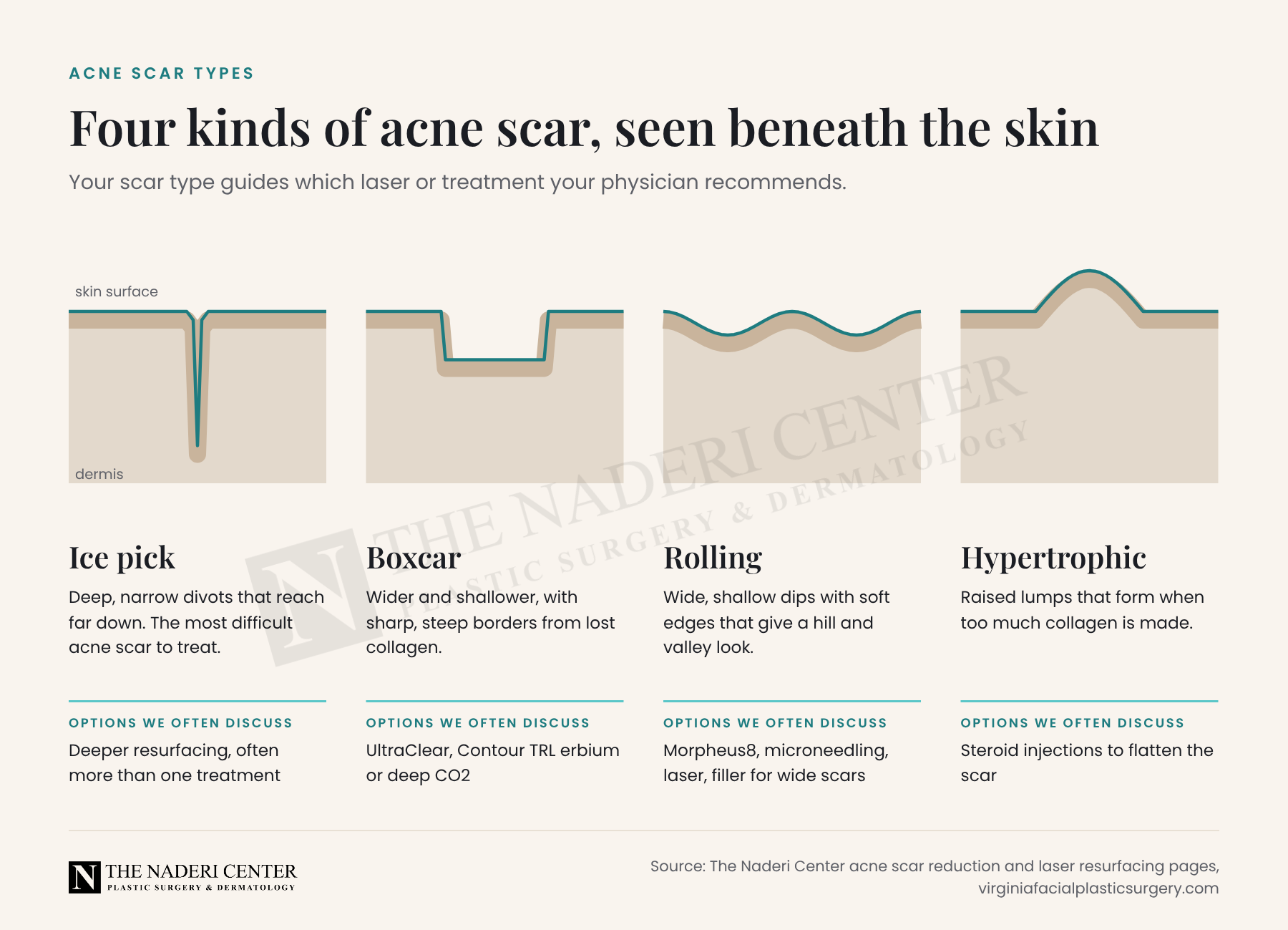
“Most of our patients have more than one type of scar on the same cheek,” says Dr. Shervin Naderi. “That is why we look closely, from several angles, before we recommend anything. The shape of each scar tells us which treatment will help it most.”
Which laser is best for acne scars?
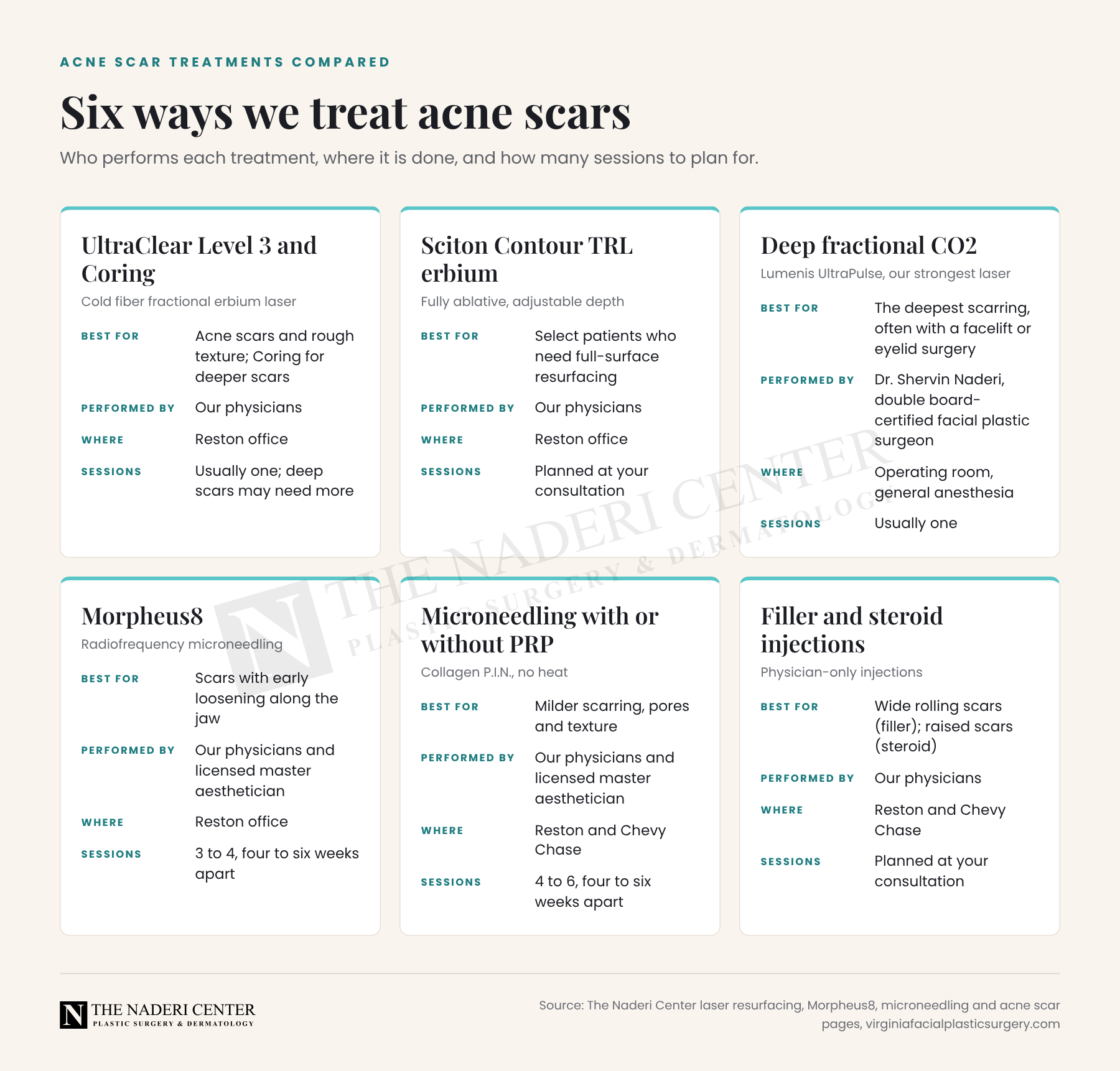
For most depressed acne scars, our first choice is UltraClear, a cold fiber fractional erbium laser that renews tiny columns of skin while leaving the skin around them intact. Our physicians perform the deeper UltraClear Level 3 and Coring treatments at our Reston office and match the depth to each scar. Many patients see a meaningful change after a single treatment, while deeper scarring often benefits from a second. We explain how it works in more detail in our article on UltraClear laser scar removal.
For select patients who need even, full-surface resurfacing, we also use the Sciton Contour TRL erbium laser on our Sciton Joule. Its depth can be set anywhere from a light laser peel to deeper laser resurfacing, which gives us fine control over how much skin is renewed in one visit.
When scarring is deep and widespread, Dr. Naderi performs fractional CO2 resurfacing with the Lumenis UltraPulse, our strongest laser. He performs it in the operating room at Prince William Surgery Center under general anesthesia so you are completely comfortable, and it pairs naturally with a facelift or eyelid surgery for patients planning both. “Deep CO2 is a wonderful tool in experienced hands,” says Dr. Naderi. “We reserve it for the patients who truly need it, and we take great care with every pass.”
When is Morpheus8 or microneedling the better choice for acne scars?
Microneedling is a gentle way to rebuild collagen beneath milder scars, enlarged pores and uneven texture. Using the Collagen P.I.N., we create tiny channels that prompt your skin to make new collagen, with or without platelet-rich plasma (PRP) from your own blood. Most patients begin with 4 to 6 sessions spaced 4 to 6 weeks apart and then keep their results with one session every 4 months. We offer it in Reston and also provide microneedling in Chevy Chase.
Morpheus8 adds radiofrequency heat to deeper microneedles, so it can soften acne scars and gently firm skin that has begun to loosen along the jawline. It is a lovely option for patients who notice both scarring and the first signs of laxity. Most people need 3 to 4 sessions, 4 to 6 weeks apart, followed by one session a year, and treatments are done at our Reston office. Our guide to Morpheus8 skin tightening covers what to expect at each visit.
“The most natural results come from layering treatments thoughtfully,” says Dr. Naderi. “A laser renews the surface, while Morpheus8 or microneedling builds collagen underneath. Planned in the right order, each one helps the next.”
Can filler or injections help deep or raised acne scars?
Yes. Hyaluronic acid filler can lift a wide, rolling scar from beneath so it sits level with the surrounding skin, with very little downtime, and it can help break down scar tissue and encourage new collagen as well. We use Juvederm, Restylane and RHA fillers and choose among them by how deep the scar sits. Every injection at The Naderi Center is performed by one of our physicians, whose detailed training in facial anatomy guides each placement.
Raised, hypertrophic scars are treated differently. A small injection of corticosteroid into the scar helps it flatten and soften, and the same injection can calm a painful deep cyst during an active breakout. For a single prominent scar, a minor surgical scar revision such as a Z-plasty can realign it to rest within a natural crease, with resurfacing added once it heals.
Do I need to clear active acne before treating scars?
Yes, and it is the first step in every plan we design, because new breakouts create new scars. Depending on your skin, your physician may suggest a medical-grade regimen with the ZO Skin Health acne line, SkinBetter Science or Alastin, Blue Light BBL sessions that target acne-causing bacteria, or the VI Precision Purify peel, which treats acne along with the dark marks it leaves behind.
Lingering redness is addressed alongside the scars, and Sciton BBL photofacials are one of our favorite ways to soften post-acne redness and broken capillaries. “Patients are often surprised by how much calmer and more even their skin looks once the redness settles,” says Dr. Naderi. “It lets the smoother texture show.”
How much downtime should I plan for acne scar treatment?
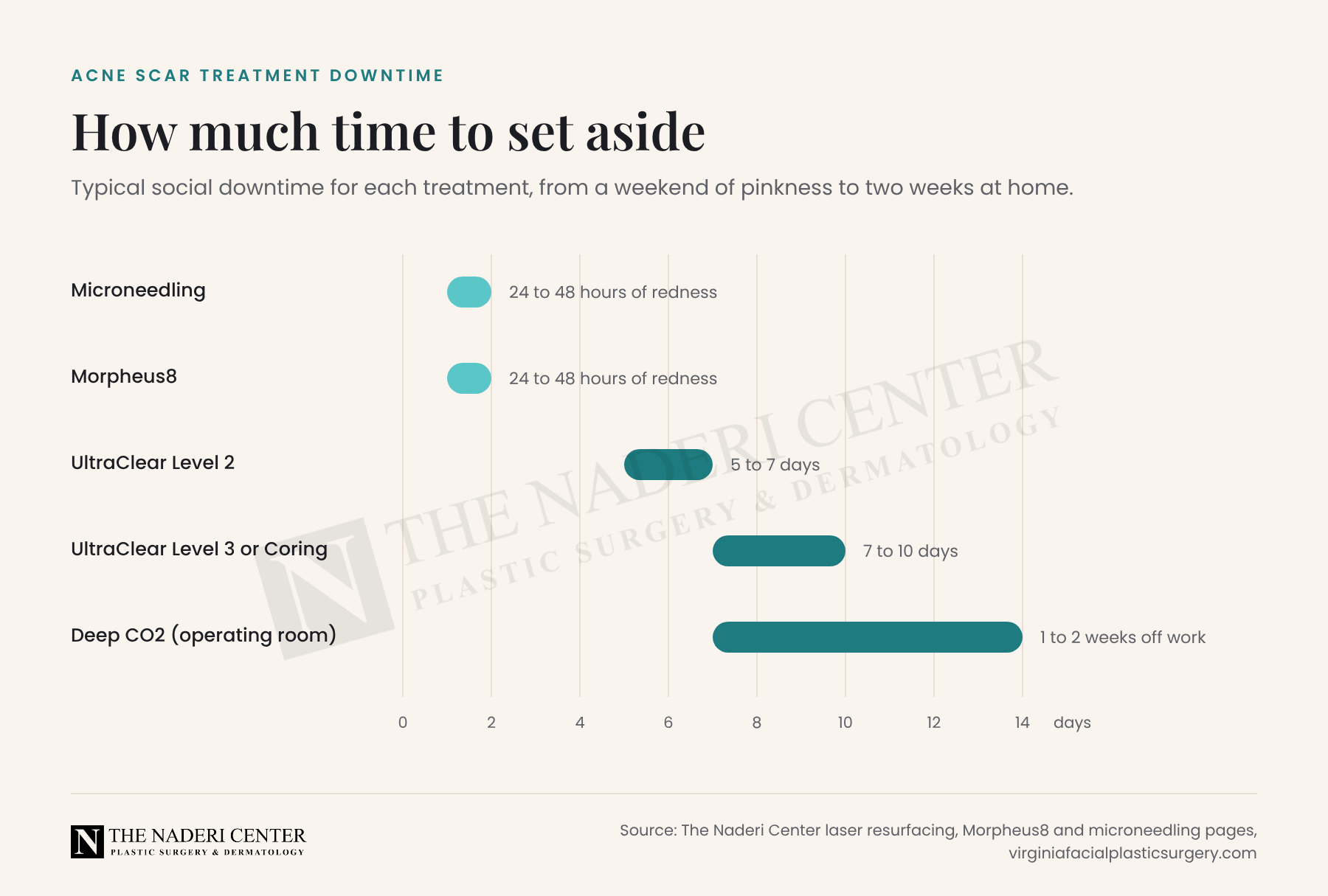
Downtime ranges from a day or two to about two weeks. Microneedling and Morpheus8 usually leave 24 to 48 hours of redness, which many of our patients in Arlington and Bethesda time for a Friday visit. After UltraClear, plan on 5 to 7 days of social downtime for a lighter Level 2 treatment and 7 to 10 days after Level 3 or Coring. After deep CO2 in the operating room, most patients return to work in 1 to 2 weeks.
In the first day or two after UltraClear, the skin feels warm, like a mild sunburn, and between days two and five it flakes and may look bronzed as older cells shed. We kindly ask you not to pick or exfoliate, since a gentle routine helps you heal beautifully. Smoother skin often shows within the first few weeks, and collagen keeps remodeling for three to six months, so your scars continue to soften long after the pinkness fades. Our UltraClear recovery guide walks through each day of healing.
Why is fall a good time to start acne scar treatment?
Every laser treatment calls for strict sun protection for three months afterward, which is far easier when the sun is low. In the Washington DC area, the UV index falls from about 9 in July to about 4 in October, then rests at 2 to 3 from November through February, so starting now lets you heal through the mildest months of the year. Our guide to fall laser resurfacing explains the seasonal timing in more detail.
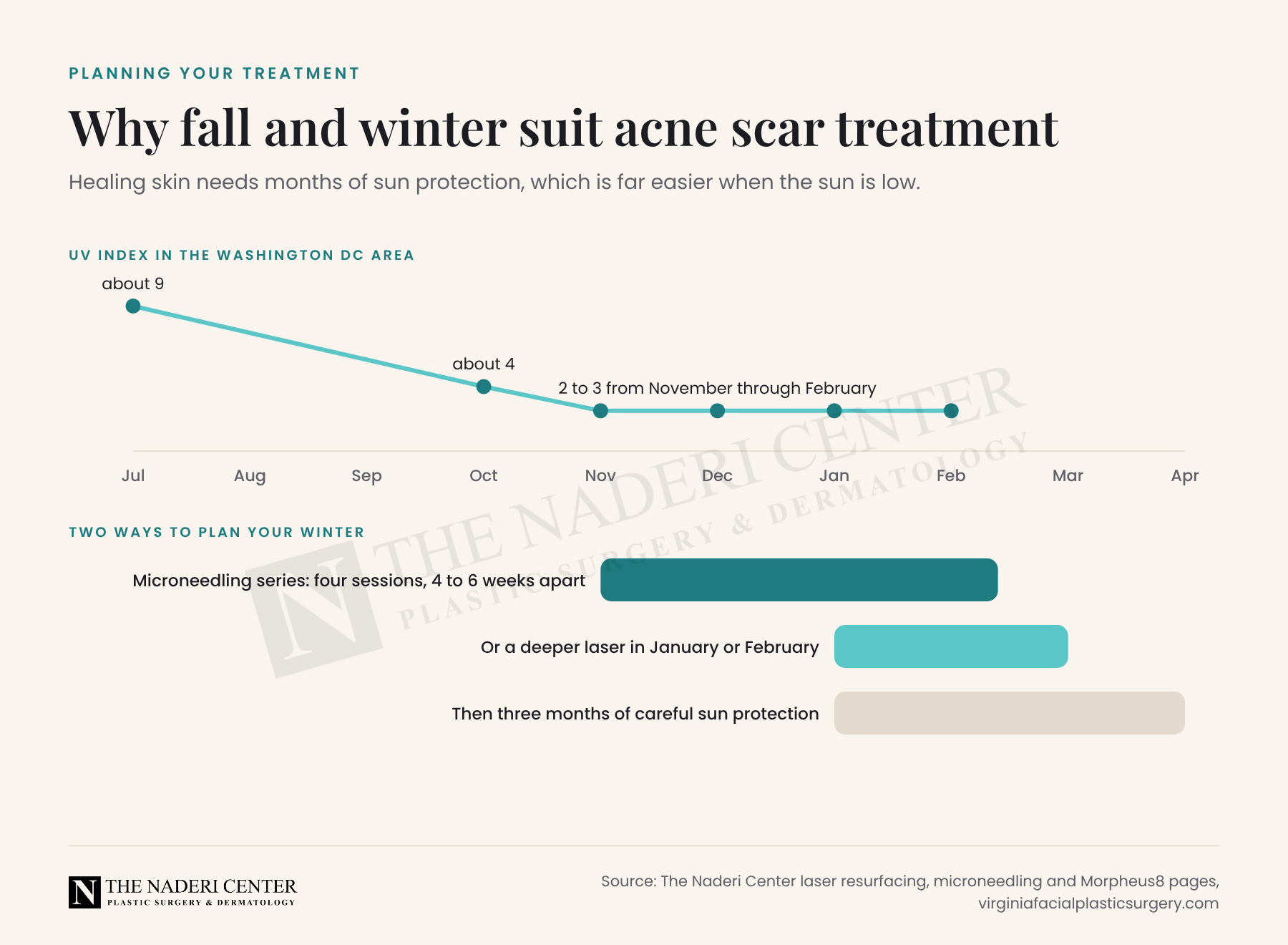
A microneedling or Morpheus8 series that begins in November can often be complete by late winter, well before spring sunshine returns to the gardens of Great Falls and Potomac. Patients who prefer a single deeper treatment often choose January or February for deeper UltraClear, Contour TRL or deep CO2, when the holidays are behind them and a quiet week at home is easier to find.
“Fall is my favorite season to begin skin work,” says Dr. Naderi. “Our patients heal comfortably through the darker months and greet spring with fresh, smooth skin.”
Acne scar treatment before and after photos
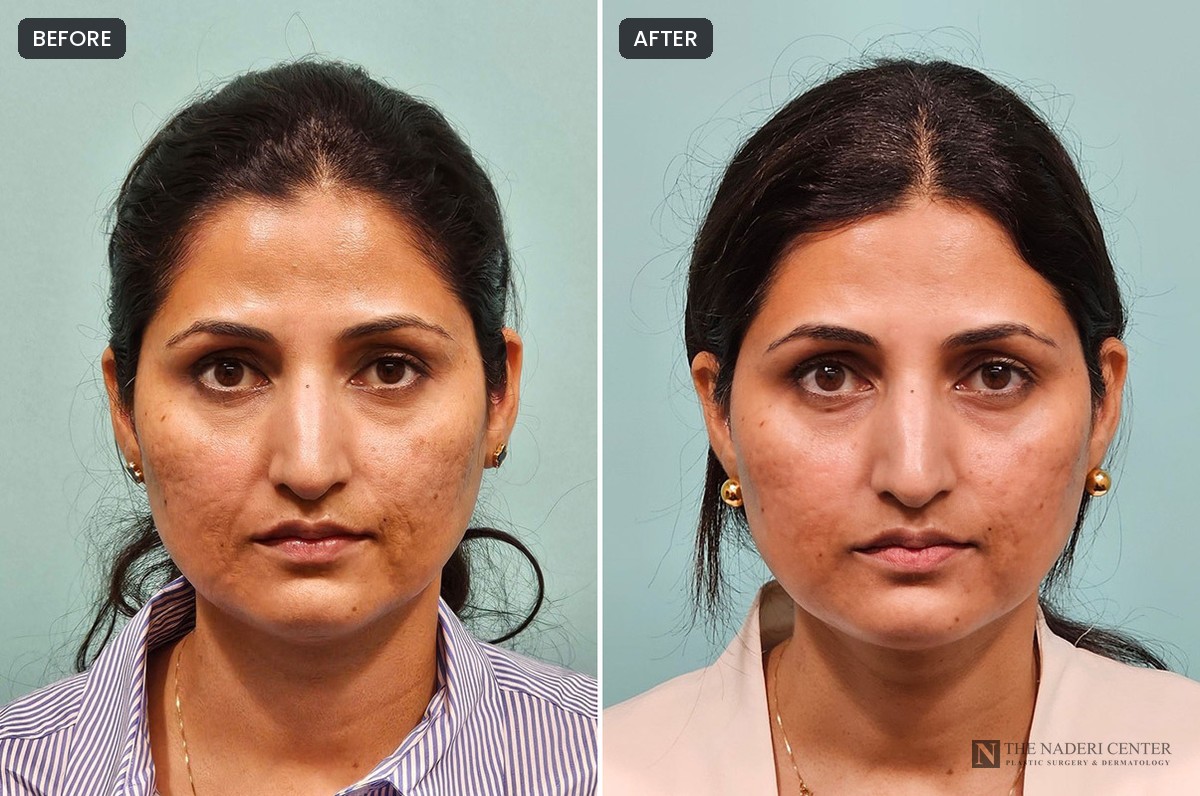
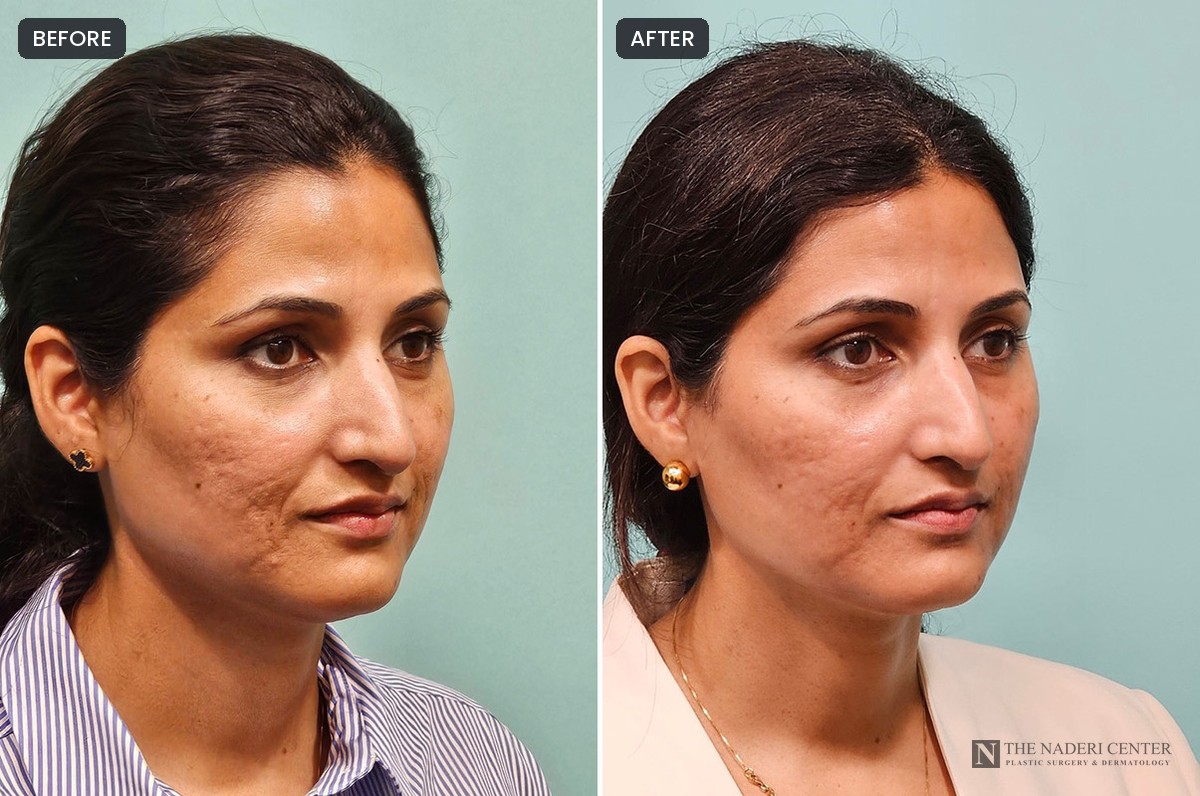
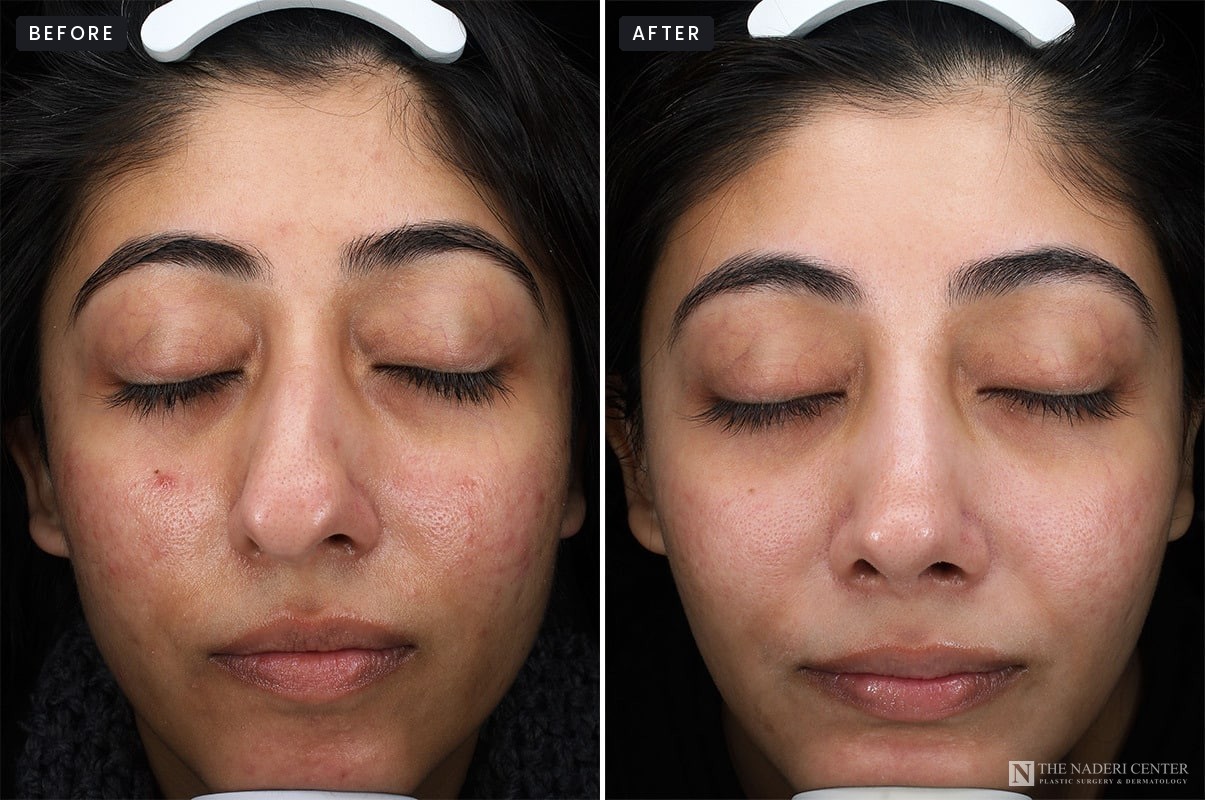
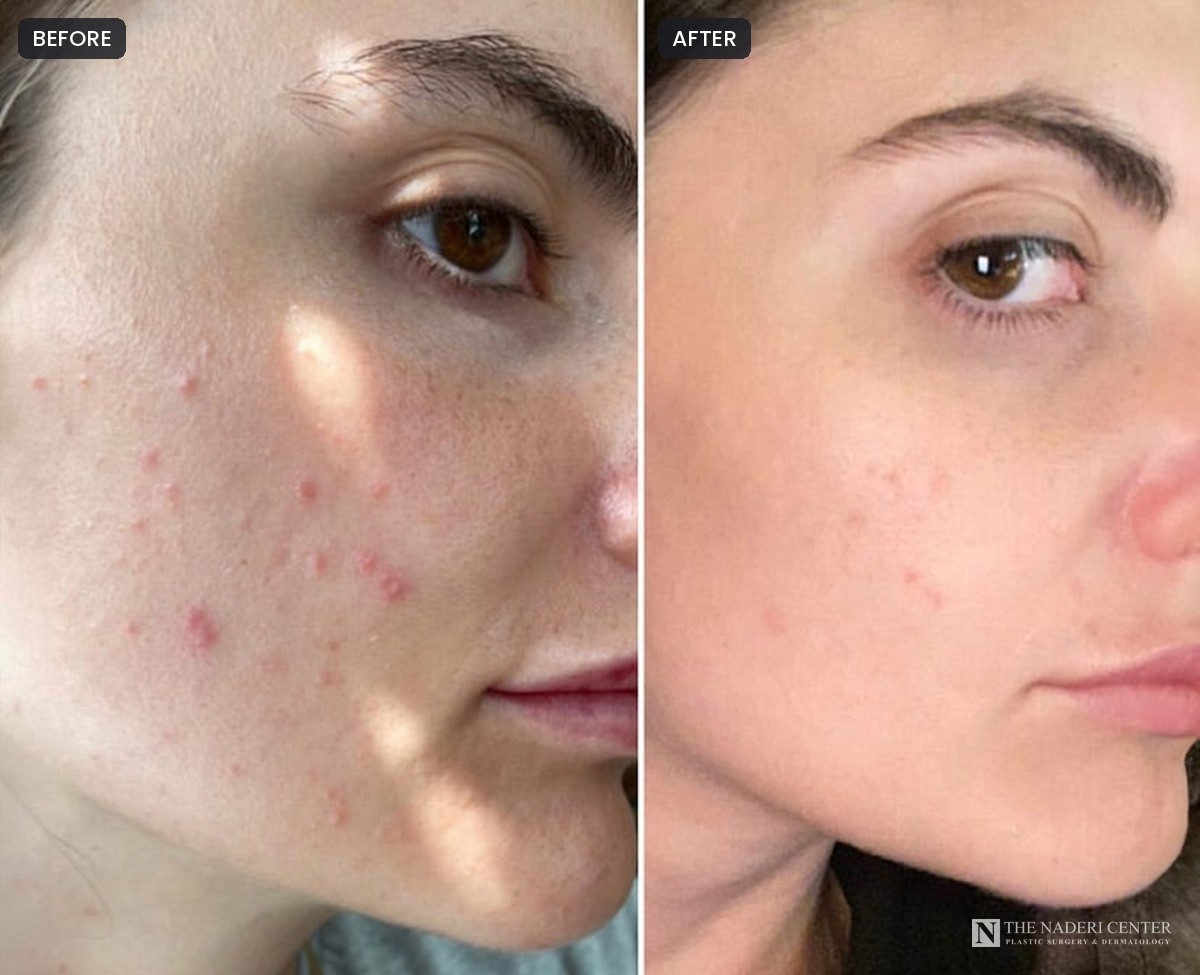
Real patients of The Naderi Center. Individual results vary.
You can see more results in our skin resurfacing before and after gallery.
Where can I get acne scar treatment near McLean, Bethesda or Washington DC?
We welcome you at two offices. Our Reston office, at 1850 Town Center Parkway, Pavilion II, Suite 551, Reston, VA 20190, (703) 481-0002, serves patients from across Northern Virginia. Our Chevy Chase office is at 5454 Wisconsin Ave, Suite 1655, Chevy Chase, MD 20815, (301) 222-2020, and consultations are offered at both.
Many of our Virginia patients come to Reston from McLean and Alexandria, often fitting a morning consultation in before work. Families in Chevy Chase and Washington DC tend to begin at our office on Wisconsin Avenue, and our team coordinates each visit so the whole plan feels seamless.
Who performs acne scar treatment at The Naderi Center?
Your care is led by physicians, and every plan is designed by a physician after a careful look at your skin. Dr. Shervin Naderi, a double board-certified facial plastic surgeon named by Newsweek among America’s Best Plastic Surgeons for rhinoplasty in 2023, 2024, 2025 and 2026 and for facelift in 2026, founded The Naderi Center and performs deep CO2 resurfacing and facial surgery. Our team has been performing laser resurfacing for more than 20 years.
At your consultation, we examine your scars closely, talk through your skin history and any acne medicines you have taken, and plan around the time you can set aside. “A beautiful result begins with listening,” says Dr. Naderi. “We want you to leave your first visit knowing which treatment suits your skin and why.”
How do I begin acne scar treatment?
We would be delighted to help you plan a smoother, more confident complexion this season. You can request a consultation at either office, and our team will gently guide you to the visit that suits you best.
Frequently asked questions about acne scar treatment
How much does acne scar treatment cost at The Naderi Center?
It depends on the treatment and how many sessions you need. Gentler treatments such as microneedling and Morpheus8 begin at $700 and $1,500 per session, and a single deeper laser resurfacing treatment typically ranges from $3,000 to $10,000. We will map out your plan, and its cost, at your consultation.
Is acne scar laser treatment safe for darker skin tones?
Yes, with the right laser. UltraClear works with very little heat, so it is safe for all skin types, including brown and Black skin that older lasers could not treat safely. Microneedling is another good choice for darker skin, since hyperpigmentation after microneedling is very rare.
Can I have acne scar treatment after taking Accutane?
We ask you to wait until 6 months after your last dose of isotretinoin (Accutane) before laser resurfacing or Morpheus8. Treatment should also wait if you are pregnant or breastfeeding, have an active cold sore or skin infection, or have a fresh tan or sunburn.
Can acne scars be removed completely?
Acne scars can be improved a great deal, although severe scarring is rarely erased entirely. We aim for clear, visible improvement, and a thoughtful plan can make scars far less noticeable.
Can you treat acne scars on the chest or back?
Yes. Laser resurfacing can treat the neck, chest, back and shoulders as well as the face, and Morpheus8 Body is designed for larger areas. Your physician will plan each area at your consultation.
Does acne scar treatment hurt?
Most patients find it very manageable. For UltraClear, numbing cream is applied about an hour before treatment, and patients usually describe the feeling as warmth or prickling. Morpheus8 also begins with about an hour of numbing.