Around the second week of October, the phones at The Naderi Center start ringing with a particular kind of call. It’s the patient who spent July at Rehoboth, August on a boat or a golf course, and September on the sideline of a kid’s soccer game in Vienna, and who has just looked in a magnifying mirror under good light. The brown spots are darker. The lines around the eyes look deeper than they did in May.
Dr. Shervin Naderi, the double board-certified facial plastic surgeon who founded the practice, has watched this cycle repeat for more than 25 years. “Summer does the damage and fall shows it to you,” he says. “The good news is that fall is also when we can do something about it.”
The short answer: fall and winter are the best time for laser skin resurfacing in the Washington, DC area because the sun is weaker, people spend less time outdoors, and freshly lasered skin has to stay out of ultraviolet light while it heals. Here, laser season runs from about mid-October through the end of February. That is the window the practice steers most resurfacing patients toward, and they come from Reston, McLean, Great Falls, Vienna, Arlington, Alexandria, Bethesda, Potomac, Chevy Chase and the District.
Why is fall the best time for laser resurfacing?
A resurfacing laser works by making a controlled injury. It removes or heats damaged skin so the body replaces it with new collagen and a fresh surface. For several weeks afterward, that new skin has very little defense against ultraviolet light.
Hit it with sun too early and you can end up with exactly what you were trying to erase: blotchy brown discoloration, which doctors call post-inflammatory hyperpigmentation. “The laser is the easy part,” Dr. Naderi says. “What you do in the eight weeks after it decides whether you love the result.”
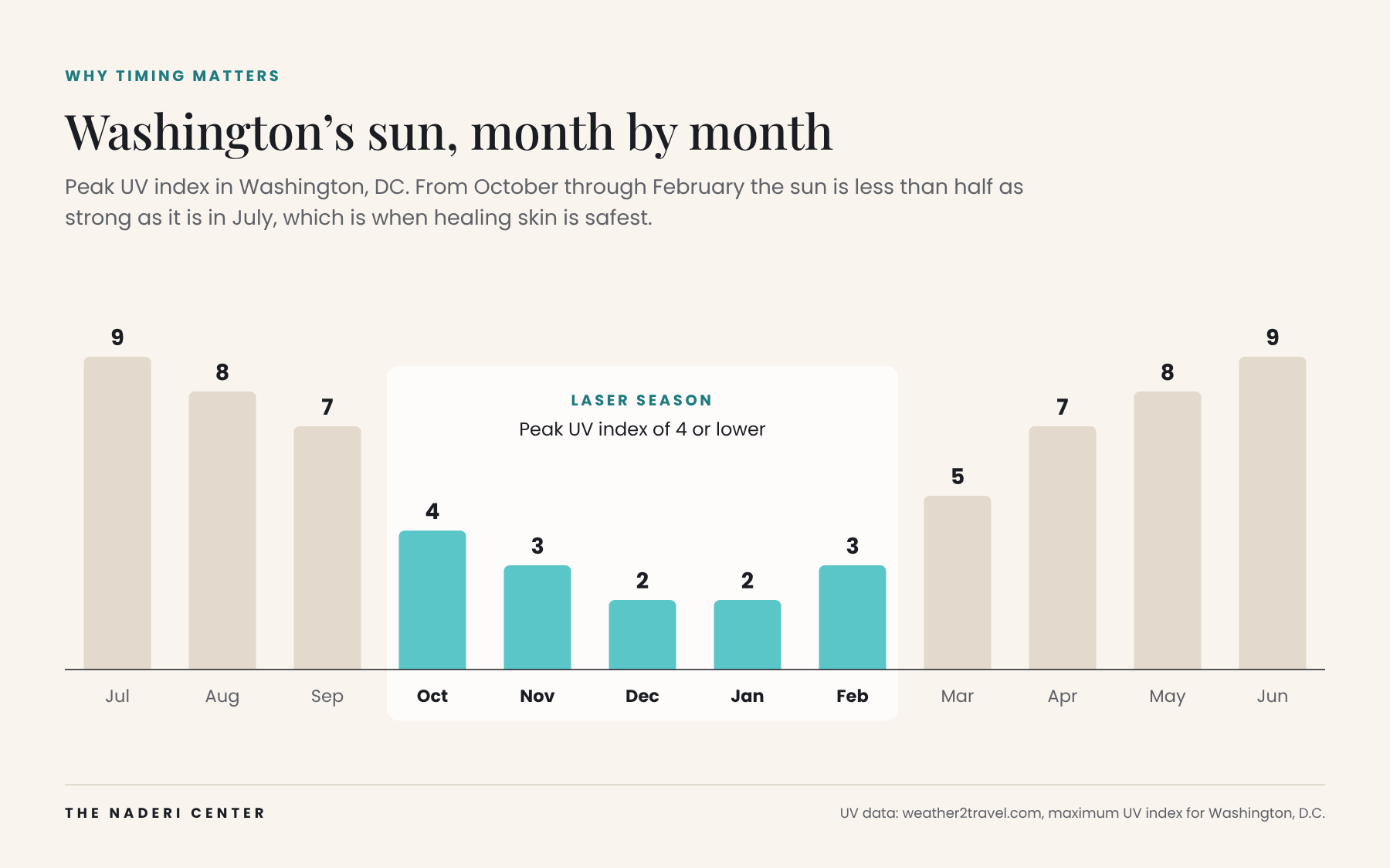
This is where the calendar matters. Washington’s peak UV index runs around 9 in July and is still 7 in September. By October it drops to about 4, and it sits at 2 or 3 from November through February. In December the sun is roughly a quarter as strong as it is in July, on days when most of us are indoors by five o’clock anyway.
There is a second reason, and it has to do with the skin you bring in. A tan means your pigment cells are switched on, and devices aimed at pigment don’t mix well with a tan. At The Naderi Center, resurfacing is postponed if a patient shows up sunburned, and BBL photofacials aren’t done on tanned skin at all. By mid-fall the summer color has faded and skin is safer to treat. It doesn’t hurt that scarves, short days and a work-from-home Friday make a pink face much easier to hide in November than at a pool party in June.
What does a Washington summer do to your skin?
Sun damage is cumulative, and it’s sneaky. UV light breaks down collagen and elastin and pushes pigment cells into overdrive. Over the years that shows up as freckles that have merged into patches, fine crosshatched lines on the cheeks, enlarged pores, broken capillaries around the nose, and a rough, dull texture that no moisturizer fixes.
Dr. Naderi thinks people here underestimate their exposure. “Nobody in Arlington thinks of themselves as a sun worshipper,” he says. “But they run the W&OD trail, they sit on the Beltway with the sun on the left side of their face, they eat lunch outside. It adds up.” Good skin care helps. Past a certain point, though, the damage sits deeper than a cream can reach, and that is where energy devices come in.
Which laser is right for me: UltraClear, CO2 or BBL?
There is no single best laser, and anyone who tells you otherwise is probably selling the one machine they own. The right choice comes down to three things: what you’re trying to fix, how much pigment your skin has, and how many days you can afford to look rough. The Naderi Center uses three main tools for sun-damaged skin.
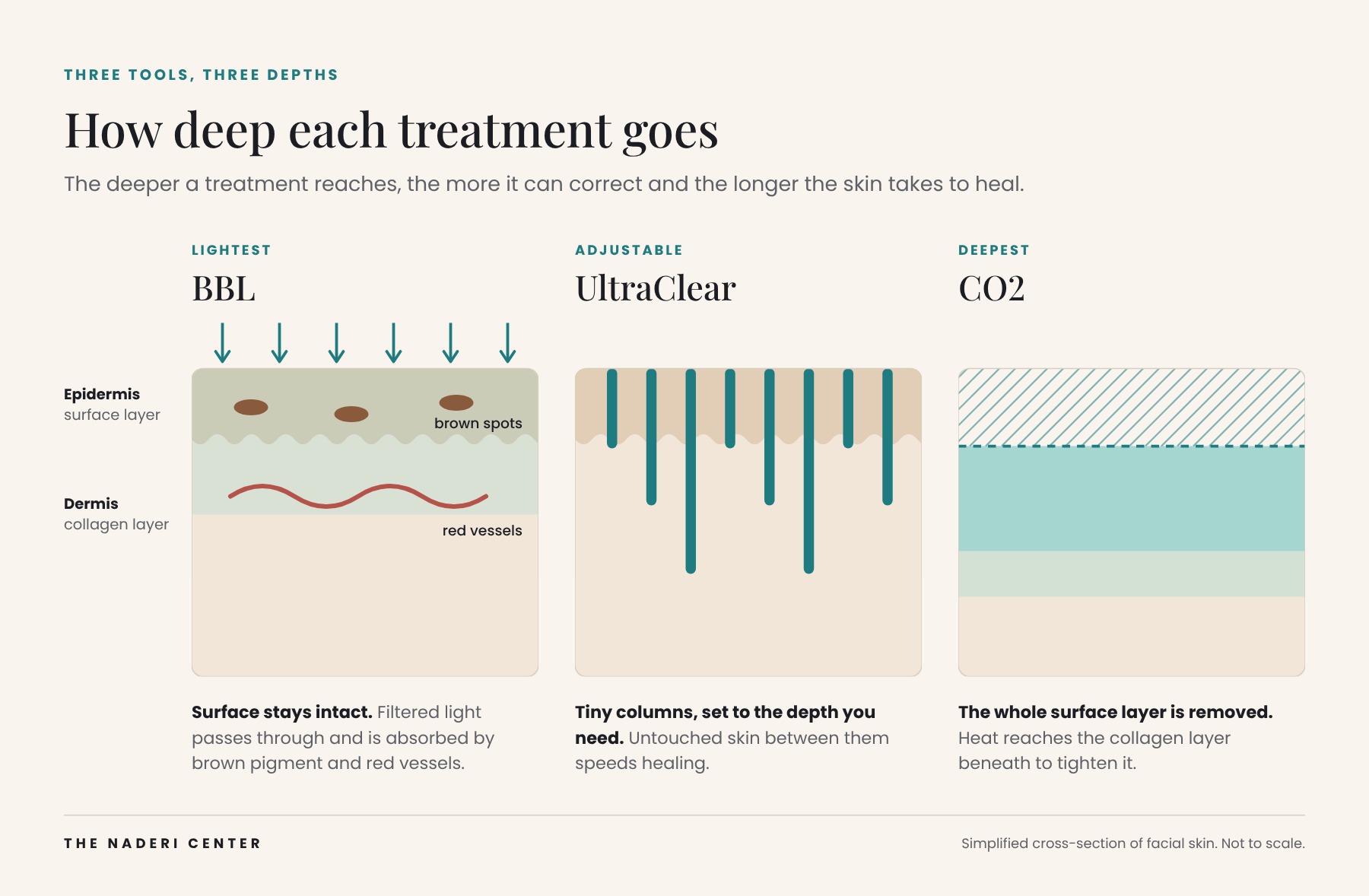
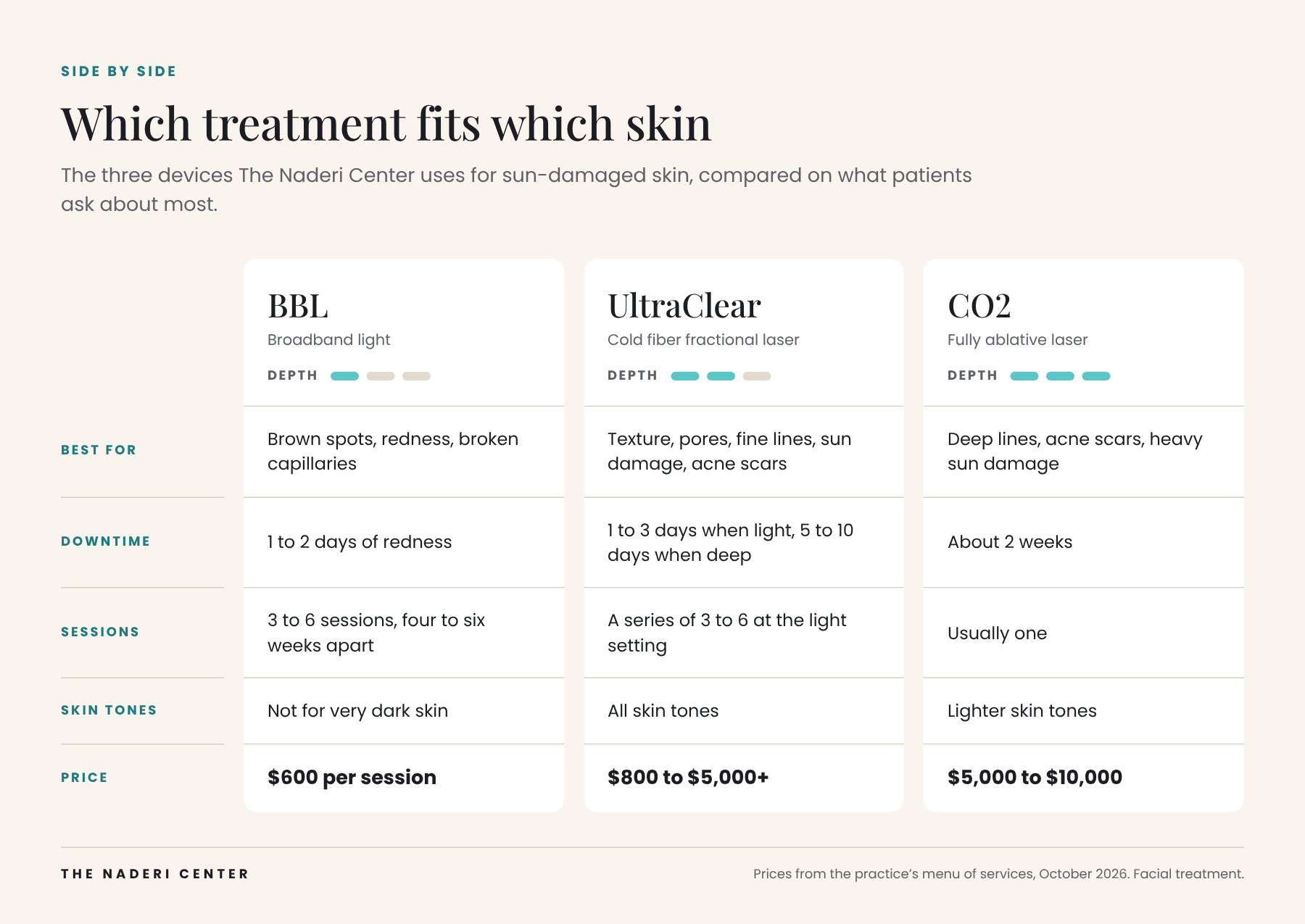
BBL, short for broadband light, is the gentlest of the three. Strictly speaking it isn’t a laser. It uses filtered pulses of light to pick off brown spots, redness and broken capillaries without breaking the skin. Expect a day or two of redness and plan on three to six sessions, four to six weeks apart. It suits the patient whose main complaint is color more than wrinkles.
UltraClear is the workhorse. It is a cold fiber fractional laser with a 2910-nanometer wavelength, and it can be dialed anywhere from a superficial polish to deep resurfacing. It puts far less stray heat into the skin than older lasers do, which is why it is considered safe for every skin tone, including darker ones. A light pass means one to three days of redness and flaking. A deep one means five to ten days of keeping a low profile.
Fully ablative CO2 resurfacing is the heavy equipment. It takes off the outer layer of skin completely and heats the layer beneath it, which is why it does the most for etched-in lines around the mouth and eyes and for acne scars. It is usually a one-time treatment. It is also the one with real downtime, and it is best suited to lighter skin types.
“I think of it like refinishing a floor,” Dr. Naderi says. “Sometimes you buff it. Sometimes you sand it. Sometimes you have to take it down to bare wood. The mistake is sanding a floor that only needed buffing, or buffing one that needed sanding and then wondering why nothing changed.” Dr. Alexandra Snodgrass, the practice’s board-certified dermatologist, performs the UltraClear treatments, so patients get a dermatologist’s judgment on their skin.
How long is the downtime after laser resurfacing?
This is the question everyone wants answered first, and the honest answer is that it depends on depth. With a light UltraClear treatment, most people are red and warm for a day, see a faint grid of tiny dots for the next few days, peel around days five to seven, and are healed by day seven to ten. Patients rate the discomfort at about 2 or 3 out of 10.
CO2 is a bigger commitment. The first three days are raw, swollen and stingy. Swelling starts to settle around day four or five. By days seven to ten the crusting is gone and the skin underneath is pink. Most patients can wear makeup at ten to fourteen days and are back in the gym at two weeks. Early results show at four to six weeks, and the skin keeps improving for about six months as new collagen forms. The practice has a separate, more detailed guide to UltraClear recovery.
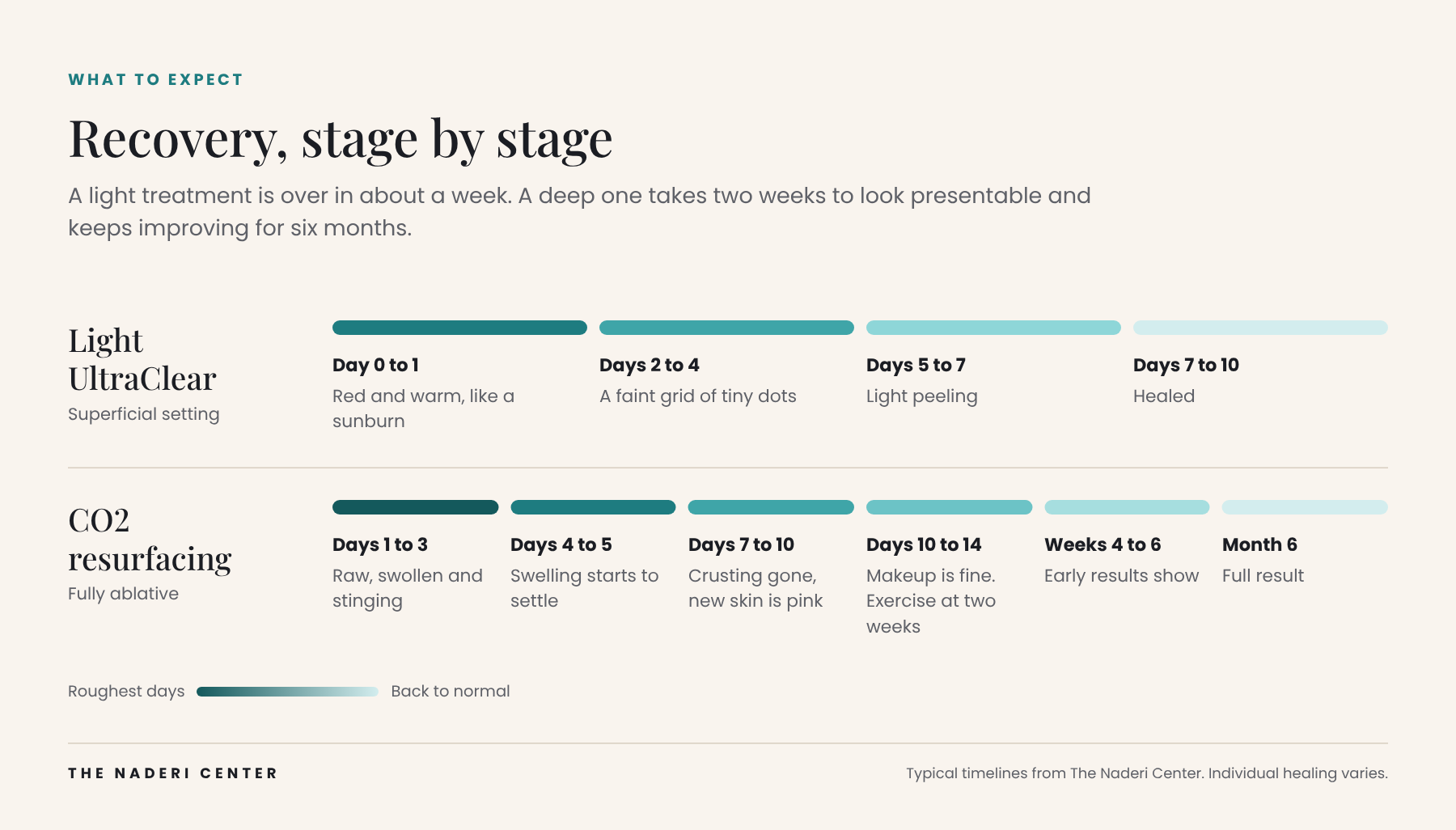
“I tell people to plan for the recovery they’d have on a bad day, not a good one,” Dr. Naderi says. “If you heal faster, wonderful. But don’t book a deep laser nine days before your daughter’s wedding in Potomac and hope for the best.”
Laser resurfacing before and after photos
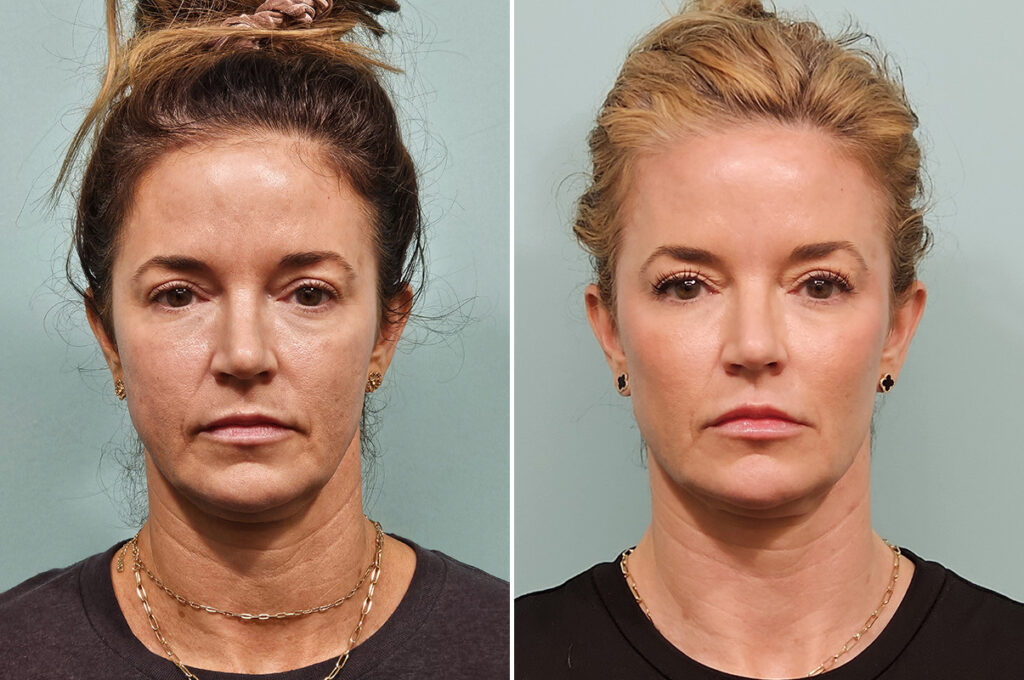
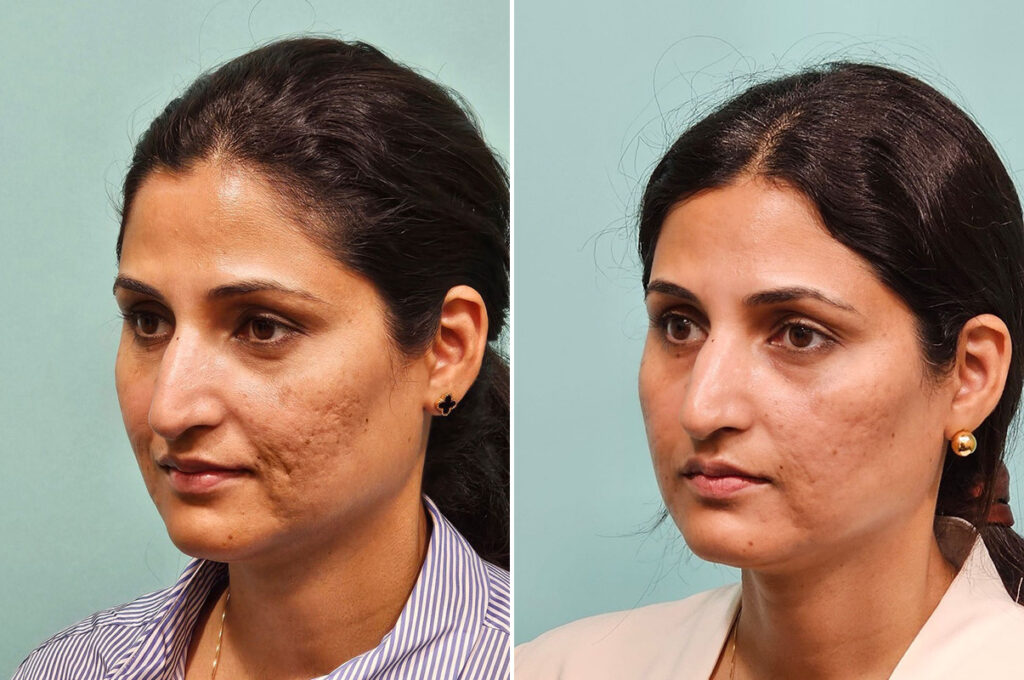
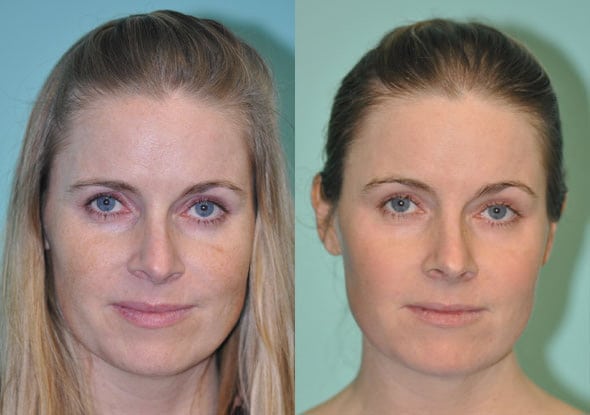
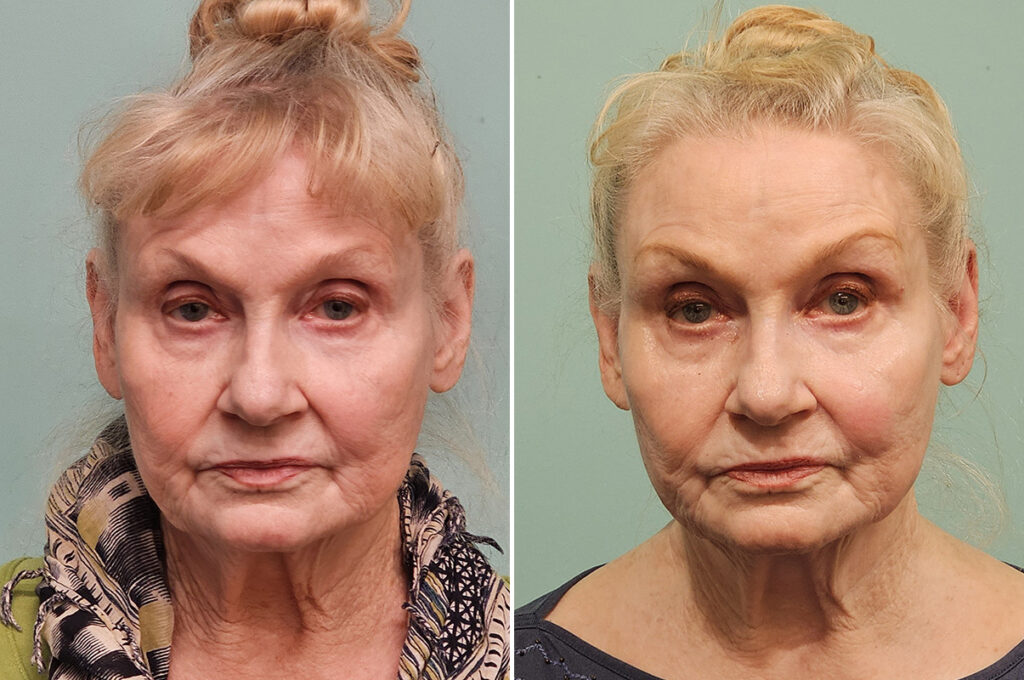
Real patients of The Naderi Center. Individual results vary.
When should I book to be healed by the holidays?
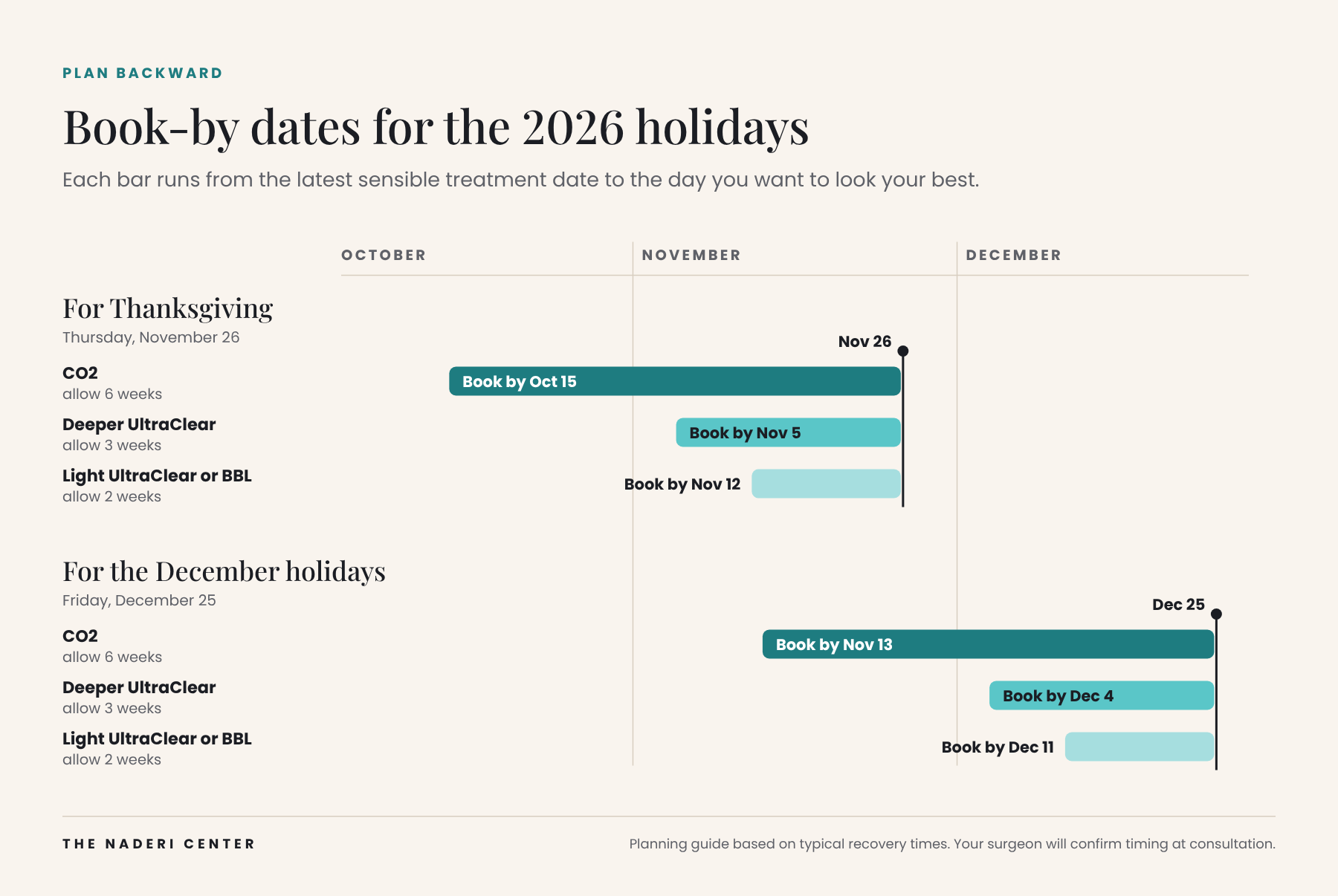
Work backward from the date you care about. Thanksgiving falls on November 26 this year. For that, a CO2 treatment should be done by about October 15, so that window is closing now. A deeper UltraClear treatment needs roughly three weeks of cushion, which means the first week of November. A light UltraClear or a BBL session can be done as late as about November 12 and still look good at the table.
For December parties and family photos, the math is friendlier. Aim for CO2 by mid-November, deeper UltraClear by the first days of December, and lighter treatments by about December 11. Patients who would sooner skip the holiday rush have another option. January and February are the darkest and most forgiving weeks of the year to heal.
How much does laser resurfacing cost in Reston and Chevy Chase?
Price depends on depth and on how large an area is treated. On the practice’s current menu of services, a BBL photofacial is $600 per session. UltraClear for the face starts at $800 for the superficial 3D Miracle treatment and runs from $1,800 to $5,000 and up for progressively deeper levels. Full CO2 resurfacing ranges from $5,000 to $10,000. An exact number takes a consultation, because it depends on what your skin needs.
Is laser resurfacing safe for darker skin tones?
It can be, with the right device. Greater Washington is one of the most diverse regions in the country, and the practice treats every skin tone. Traditional CO2 carries a real risk of discoloration in olive, brown and deep skin, and BBL isn’t recommended for very dark skin. UltraClear is the usual choice for those patients. “People with darker skin have been told for years that lasers aren’t for them,” Dr. Naderi says. “That’s out of date. They do need to be picky about the device, and pickier about who’s holding it.”
When is a laser the wrong tool?
Dr. Naderi is known for talking patients out of procedures, and lasers are no exception. A laser improves the surface: color, texture, fine lines, pores, shallow scars. It does not lift jowls, tighten a loose neck or put back lost volume. “If the fabric is wrinkled, I can iron it,” he says. “If the fabric is hanging off the frame, ironing won’t help, and I’d rather tell you that in the consultation than after you’ve spent the money.”
When the real concern is sagging, the conversation usually turns to a deep plane facelift or a neck lift. The two approaches can work together, with surgery handling structure and laser handling surface. For someone in their thirties or forties with early sun damage, a light laser treatment or two each winter and a serious sunscreen habit may be all they ever need.
Where can I get laser resurfacing near McLean, Bethesda or Washington, DC?
The Naderi Center has two offices. The Virginia office is at 1850 Town Center Parkway in Reston, with free garage parking, and it is the easy choice from Great Falls, Vienna, McLean and the rest of western Fairfax County. The Maryland office is at 5454 Wisconsin Avenue in Chevy Chase, right at the District line, and it draws patients from Bethesda, Potomac, Chevy Chase and Northwest Washington. Arlington and Alexandria sit between the two, and patients there tend to choose based on which bridge they dislike less.
Laser season is short. If there is a date you want to look good for, count backward from it and book a consultation with Dr. Naderi or Dr. Snodgrass. The Reston office is at (703) 481-0002 and the Chevy Chase office is at (301) 222-2020.
Frequently asked questions
What is the best month for laser resurfacing in the Washington, DC area?
Mid-October through February. The peak UV index in Washington is 4 or lower in those months, compared with 9 in July, so healing skin is much less likely to discolor.
Can I have laser resurfacing in the summer?
Light treatments are possible if you can truly stay out of the sun. Deeper resurfacing is better left for fall and winter, and no pigment-targeting treatment should be done on tanned or sunburned skin.
How long do I need to avoid the sun afterward?
After CO2, at least eight weeks, with SPF 50 or higher. For BBL, three weeks before and three months after. For UltraClear, two weeks before treatment and throughout healing.
How many treatments will I need?
CO2 is usually a single treatment. Light UltraClear works best as a series of three to six. BBL usually takes three to six sessions spaced four to six weeks apart, with a maintenance session about once a year.
Who performs laser treatments at The Naderi Center?
Dr. Alexandra Snodgrass, a board-certified dermatologist, performs the UltraClear moderate to deep resurfacing. Dr. Naderi performs the deep CO2 laser under general anesthesia. The practice is led by Dr. Shervin Naderi, a double board-certified facial plastic surgeon, and consultations are offered at both the Reston, Virginia and Chevy Chase, Maryland offices.