Few things are harder for a parent than watching a son or daughter lose confidence to acne that simply will not settle. If your teen has tried the cleansers and drugstore spot treatments and still wakes up to painful breakouts, you may have heard a pediatrician or a friend mention Accutane. Here is your guide to what Accutane for teens really involves, written for families in McLean, Bethesda and across the Washington DC area.
The short answer: Accutane (isotretinoin) is the most effective acne medication available, and for a teen with severe, cystic or scarring acne it is often the treatment most likely to bring lasting clearance. It is prescribed with careful monitoring because it has real side effects, so the right setting matters as much as the medication itself. At The Naderi Center, board-certified dermatologist Dr. Alexandra Snodgrass prescribes it through our own Accutane program.
Is Accutane safe for teenagers?
Accutane is safe for most teenagers when it is prescribed by a dermatologist and followed closely, and teens are among the patients it helps most. Acne is driven largely by hormones, which is why it so often begins in the early teen years, and the deeper forms of acne leave marks and scars that can last far longer than the breakouts themselves. The care around the medication is what keeps it safe. Patients under 18 always come with a parent or guardian, and Dr. Snodgrass explains each medication and its side effects to both of you, so your teen understands their own treatment and you feel fully informed.
“Accutane has a reputation that makes many parents nervous, and we understand that completely. With a dermatologist watching closely every month, it becomes one of the most rewarding treatments we offer, because we see young people get their confidence back,” says Dr. Shervin Naderi, double board-certified facial plastic surgeon and founder of The Naderi Center.
Which teens are good candidates for Accutane?
Accutane is usually recommended for teens with deep nodules and cysts, acne that is leaving scars, or acne that keeps returning after other prescriptions have been given a fair chance. Milder acne, such as blackheads, whiteheads and occasional small breakouts, usually clears with prescription skincare and in-office care instead.

“Parents often come to us after a long stretch of creams and cleansers that never quite worked. When acne runs deep or is starting to scar, we would much rather treat it thoughtfully now than repair the scars later,” says Dr. Naderi.
Dr. Snodgrass makes that decision at the consultation, after examining your teen’s skin and talking through what has already been tried. Some teens begin with a topical plan and move to Accutane only if their skin needs it, and some families are relieved to hear that their teen’s acne can be managed without it.
Book a Consultation
Thinking about Accutane for your teen? Our physicians see patients at our offices in Reston, VA and Chevy Chase, MD.
Book a ConsultationLearn about acne treatment
Call Reston (703) 481-0002 or Chevy Chase (301) 222-2020.
How does Accutane clear acne?
Accutane works by shrinking the oil glands in the skin, which is why it reaches acne that creams and washes cannot. A breakout begins when a pore clogs with oil and dead skin, bacteria grow inside it, and the skin around it becomes inflamed. With the oil glands quieted, the pore has far less oil to clog it and far less for bacteria to feed on, so the inflammation that drives deep, painful cysts calms over time. This is what makes it so useful for the deeper types of acne, the nodules and cysts that sit well beneath the surface and are most likely to scar.

What happens at the first Accutane visit?
The first visit is a full acne consultation with Dr. Snodgrass, including VISIA skin analysis, a review of your teen’s medical history and baseline lab work. VISIA photographs the skin in detail, which gives you and your teen a clear record to compare against as treatment goes on. Every Accutane patient is also enrolled in iPLEDGE, the FDA’s safety program for isotretinoin. Patients who can become pregnant have a pregnancy test before treatment begins and follow the program’s pregnancy prevention rules throughout treatment, because Accutane causes birth defects. Dr. Snodgrass walks families through these requirements with care and discretion.
What do the monthly visits and lab checks involve?
Our Accutane program includes an office visit and a lab check every month, from the first prescription to the last. At each visit Dr. Snodgrass looks at your teen’s skin, reviews the latest lab results and adjusts the dose as needed.

Most courses last several months and continue until your teen reaches the full dose recommended for their weight. Finishing the full course gives the best chance that the acne stays away, so we gently encourage families to see it through even once the skin looks clear.
“Dr. Snodgrass takes time with both the teen and the parent at every visit. A sixteen-year-old deserves to understand their own treatment, and a parent deserves to feel completely at ease,” says Dr. Naderi.
What side effects should parents watch for?
Dry lips are the side effect nearly every teen notices, along with dry skin and dry eyes. Occasional nosebleeds can happen, and lab values can shift, which is what the monthly labs are there to catch. The first few weeks can bring a short flare of breakouts before the skin begins to clear steadily. Families who know this in advance tend to feel much calmer when it happens.

“The first month can test a family’s patience. A little flare early on is common, and it usually gives way to steady clearing that teens can see in the mirror,” says Dr. Naderi.
We also ask parents and teens to tell us right away about any change in mood or behavior, between visits as well as at them. Adolescence brings its own ups and downs, and an open line with your dermatologist means any concern is looked at promptly and thoughtfully.
How can teens stay comfortable during Accutane?
A rich lip balm used throughout the day and a gentle, fragrance-free moisturizer make the biggest difference to comfort. Dryness is expected on Accutane, and Dr. Snodgrass manages it at each visit so that it never becomes the focus of your teen’s day. Accutane also makes the skin more sensitive to the sun, so a non-comedogenic sunscreen of SPF 30 or higher belongs in your teen’s backpack, whether they spend afternoons at soccer practice in Arlington or weekends on the water near Alexandria. We also ask teens not to pick or squeeze breakouts, since picking deepens marks and causes scars.
How do families in Northern Virginia, Maryland and Washington DC fit monthly visits into a school year?
Most families choose the office closest to home or school and book the monthly visit at the same time each month, which keeps the routine easy to remember. Both offices take calls throughout the week, and our team will help you choose clinic days that fit around your teen’s school schedule, such as an early dismissal or a teacher workday.
Families from Reston, Vienna and Great Falls usually come to our Reston office, while families from Chevy Chase, Bethesda, Potomac and Northwest Washington DC often find our Chevy Chase office on Wisconsin Avenue the simplest choice. Accutane visits are offered at both locations, so your teen can stay with Dr. Snodgrass even if the family’s schedule shifts during the year.
What happens after the last Accutane dose?
After the final dose, a simple daily routine keeps the skin clear, and many teens need far less than they used before. A gentle acne cleanser, a retinoid at night and an oil-free sunscreen are the usual foundation, often from ZO Skin Health or another medical-grade line chosen for your teen’s skin.
If acne has left indented scars, acne scar treatment waits until 6 months after the last dose. At that point UltraClear laser resurfacing, which works very well for acne scars, along with microneedling and Morpheus8, can smooth what the acne left behind. Scar consultations are available at either office, and UltraClear treatments are done at our Reston office.
“Scars can be treated beautifully later, but the kindest thing we can do for a teenager is to prevent them in the first place,” says Dr. Naderi.
Are there gentler options to try before Accutane?
Yes, and for many teens they are the right place to begin. Prescription tretinoin and other topicals keep pores from clogging and usually show results in 8 to 12 weeks, and they form the base of most acne plans at our practice.
For red, tender breakouts, our licensed aesthetician offers Sciton BBL Forever Clear blue light, given once a week for 6 to 8 sessions at our Reston office, as well as VI Peels for breakouts and the dark marks they leave. A HydraFacial in Reston clears clogged pores and blackheads with gentle suction rather than squeezing. You can see every option side by side on our acne treatment page.
Acne treatment before and after photos
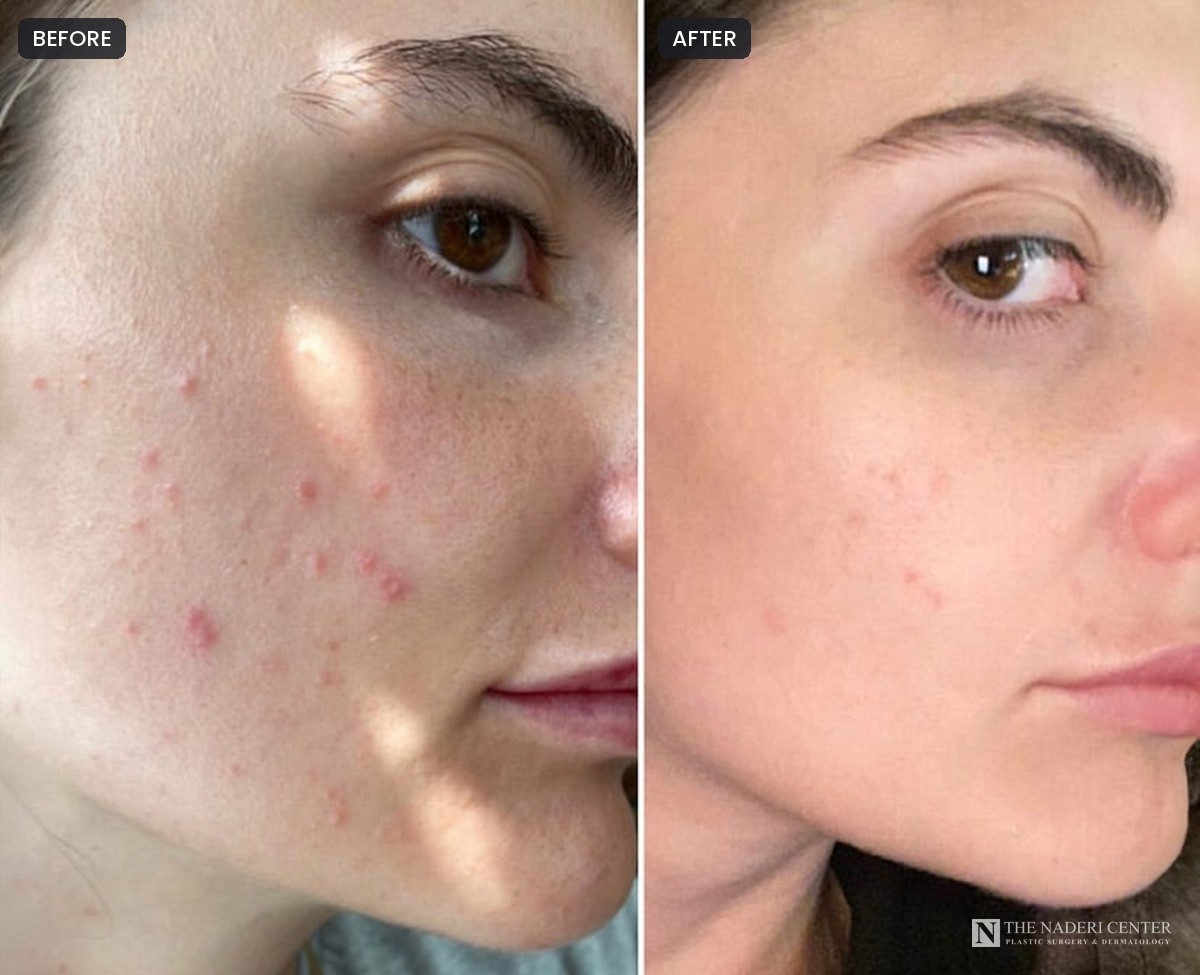
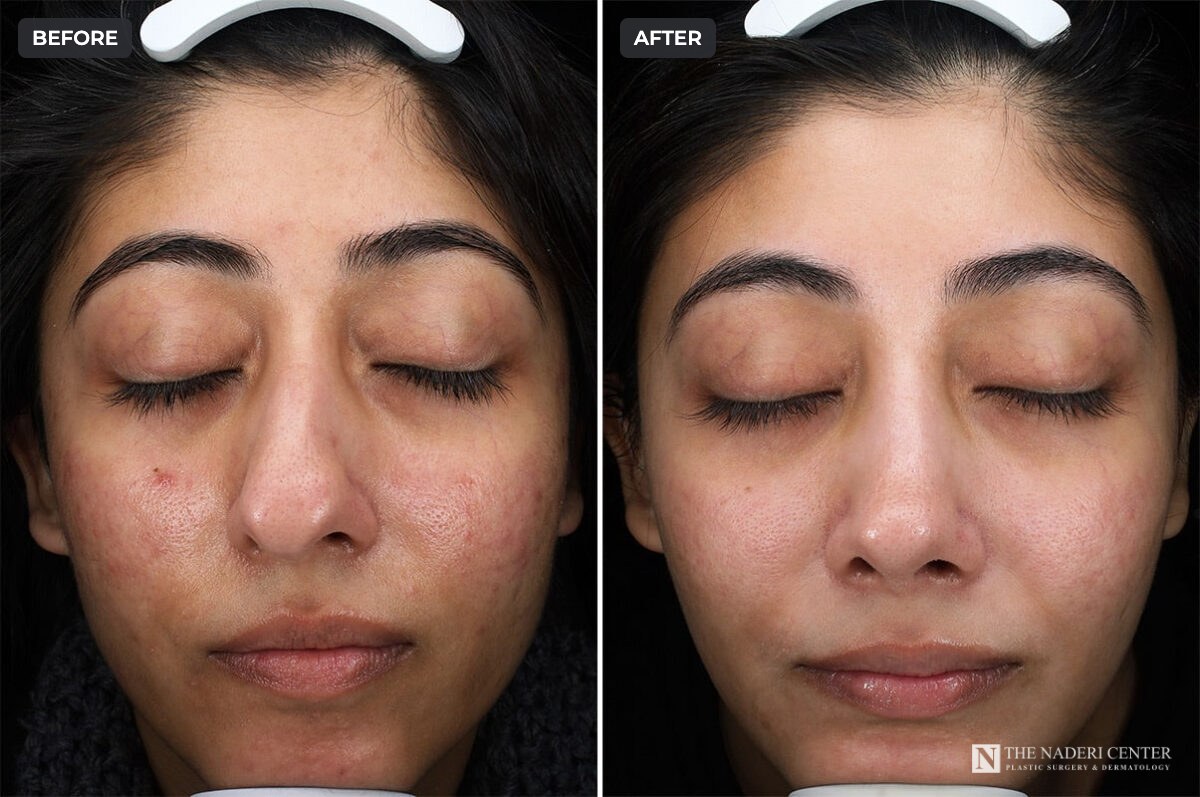
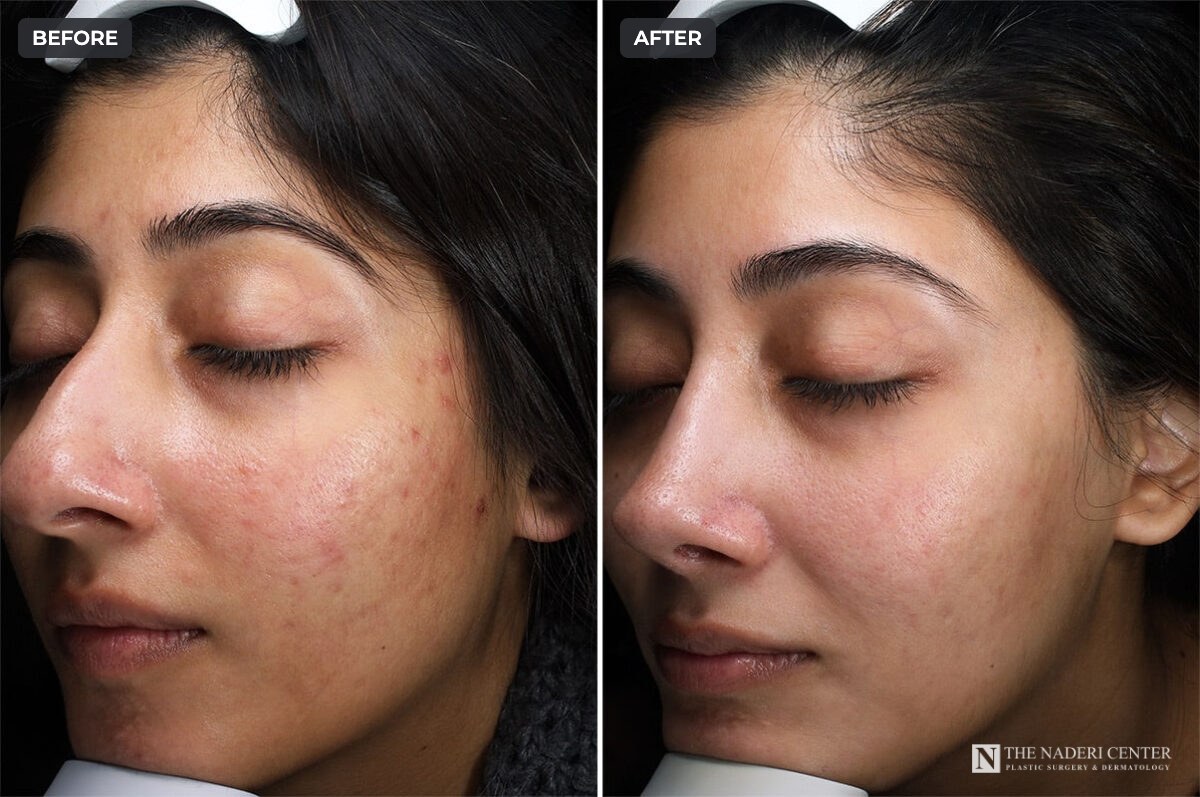
Real patients of The Naderi Center. Individual results vary.
Which of our offices is right for your family?
You are welcome at either office. Our Reston office is at 1850 Town Center Parkway, Pavilion II, Suite 551, Reston, VA 20190, (703) 481-0002. Our Chevy Chase office is at 5454 Wisconsin Ave, Suite 1655, Chevy Chase, MD 20815, (301) 222-2020.
If your teen’s acne is deep, painful or beginning to scar, we would be delighted to help you decide together whether our Accutane program is the right next step. You can book a consultation online or call either office, and our team will find a time that works around the school week.
Book a Consultation
Thinking about Accutane for your teen? Our physicians see patients at our offices in Reston, VA and Chevy Chase, MD.
Book a ConsultationLearn about acne treatment
Call Reston (703) 481-0002 or Chevy Chase (301) 222-2020.
Accutane for Teens: Frequently Asked Questions
How much does acne care for a teen cost at The Naderi Center?
Acne care begins with a $250 consultation with Dr. Snodgrass that includes VISIA skin analysis. Accutane care is offered as a package, priced according to the length of the course Dr. Snodgrass prescribes. The medication itself and other prescriptions are filled at your pharmacy and priced separately, and your pharmacy may bill your insurance plan for them. The Naderi Center does not bill insurance for acne visits or in-office treatments, and Dr. Snodgrass reviews the plan and its costs with you at the consultation.
Can a painful cyst be calmed quickly before school photos or a dance?
Yes. Dr. Snodgrass can inject a tiny dose of cortisone into a painful cyst or nodule, and it usually flattens within 1 to 3 days. Call either office as soon as the cyst appears.
What should we bring to the first visit?
Bring a list of every product and medication your teen uses, including anything already tried for acne. If possible, your teen should arrive with clean skin so the VISIA analysis gives an accurate picture.
Does diet cause teen acne?
Diet is a smaller factor than hormones and genetics. Some people notice more breakouts with high-sugar foods or dairy, and Dr. Snodgrass is happy to talk through your teen’s habits at the consultation.
Do you also treat acne in adults?
Yes. We treat acne that starts or returns after age 20, including hormonal breakouts along the jawline and chin, so parents and older siblings are welcome to book their own visit.
Medically reviewed by Dr. Shervin Naderi, MD, FACS, double board-certified facial plastic surgeon. Last reviewed November 14, 2026.

Patient Financing
Pay Over Time with Cherry
Monthly payment plans for surgery and treatments, including 0% APR options for qualifying patients. Checking whether you qualify won’t affect your credit score.