Non-Surgical Rhinoplasty and Gummy Smile Botox
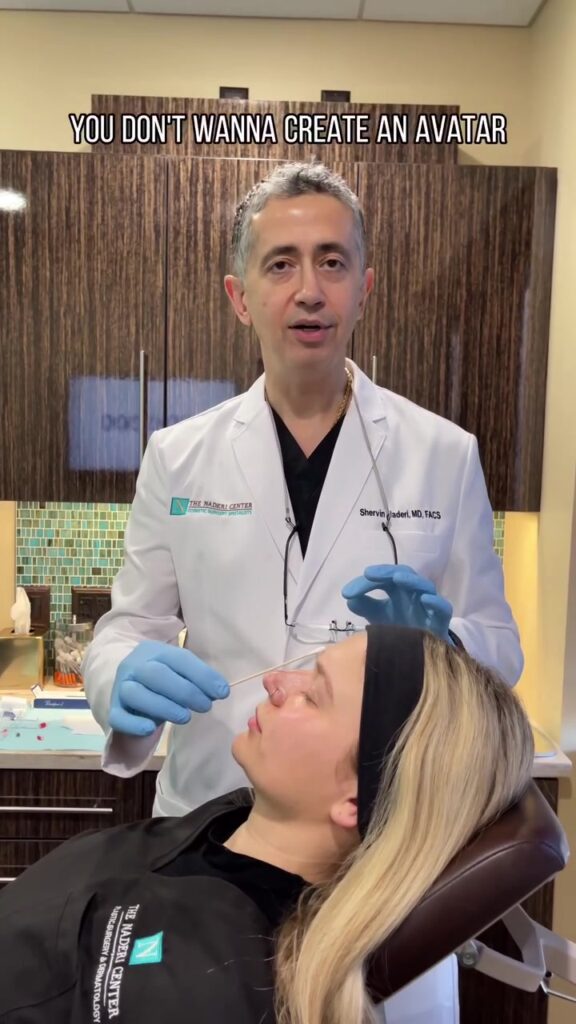
Dr. Naderi demonstrates a maintenance non-surgical rhinoplasty with half a cc of Restylane, placed in tiny droplets right in the midline, then a small dose of Botox to soften a gummy smile. He explains why he avoids permanent and inflammatory fillers in the nose and why patients come back about twice a year to maintain the result.
Key Points from Dr. Naderi
- Results last about a year if left alone, but he asks patients to come back about twice a year so the nose is maintained rather than started from scratch.
- Restylane is his favorite filler for the nose, placed one tiny droplet at a time instead of a large amount that has to be massaged.
- Staying in the midline of the tip and never pressing hard on the plunger protects the blood vessels. Safety comes first.
- Overfilling the bridge looks masculine and unnatural, so he keeps a soft, feminine curve.
- The day after treatment is the most swollen, so plan a week or two before a big event.
- A tiny dose of Botox in the upper-lip elevators softens a gummy smile, with the full effect in about two weeks.
Transcript
Parts of this older recording are hard to hear. Words that could not be made out are left out.
Welcome. We're doing another injection tutorial video. This is a non-surgical rhinoplasty. This isn't her first time, so the starting point of the nose is higher, with a more defined bridge, and today we maintain it.
People typically ask how long it lasts. If you wait for the whole thing to go away, it lasts about a year, maybe a little longer, but that's not the best way to do it. We ask patients to come back roughly twice a year for maintenance. You don't want to start from scratch again; you want to maintain it. So we do an injection about six months or so later. These are the refill sessions.
I want to show the technique. The other thing I'm going to show after the non-surgical rhinoplasty is a little bit of Botox to reduce a gummy smile. It keeps the lips more full, so when the patient smiles, the gums don't show as much and the lips stay full.
We're going to start with Restylane. I love Restylane for non-surgical rhinoplasty. It's my favorite. I use a micro-droplet technique: I place one drop at a time. When I inject, I make sure my fingers are maintaining the proper pocket for the injection. I don't want the injection to spread. I don't put a significant amount in one spot; it's always moving. I use a micro-droplet technique for almost everything, because you don't want to place too much in one spot and then sit there for 20 minutes massaging it. I'd rather put the drops where they need to go.
Sometimes, if the nose is asymmetric, I can place injections on the more indented side to make it look straighter. She has a very nice, straight nose; I'm just going to maintain it. You can see how deep the needle goes here. The reason is there's quite a bit of filler there from before. Like I said, this is just a maintenance dose.
As we do this, you can see the nose take shape. You can make the nose look more narrow by elevating the bridge. This is quite common in Asian, Latino and African American patients, but it can also be done in Caucasian patients. When there's a bump, you can inject above the bump or below the bump, but you have to select patients properly. Not every single person is a candidate. It does make the nose larger, but it makes it look more defined. Most patients actually need a smaller nose, so like I said, this is not for everybody. Most patients still need a traditional rhinoplasty.
You can see it's shaped right in front of our eyes. I can do a little bit to the tip, but you can't do much to the tip. It's extremely important to stay right in the midline of the tip. Don't force the tip. You can see the tip just came up, and she has a nicer, more defined point to her tip. It's important to stay right on the midline of the tip because of the blood vessels. With any filler, you do not want to press too hard on the plunger. You don't want to force it into blood vessels or block a blood vessel. Safety first. We're trying to create beauty, but we want to maintain safety. You can see how gentle that is, an extremely gentle technique. If you get a little bleeding, you just hold pressure and it stops.
It doesn't typically bruise too badly on the nose. Right after we're done, we tell patients to put on a little makeup and get on with their life. Just don't go to the gym for a day or two. The next day is always more swollen, so next week it's going to look a little different than it does today. The very next day is the most swollen point, so if you have a major event, work or social, don't do it the day before. As long as you give yourself a week or two before it, you're perfectly fine.
If you drop the camera, you can see how the bridge is now defined. We're creating a nicer bridge, and I can even define the tip a little bit, so we can lift the tip a little and create a nice bridge. We don't want an avatar. I've seen a lot of patients with injections on different websites where they over-inject the nose and lift it up so much that the nose looks perfectly straight, and as you do that, you create a very masculine, very unattractive result. We still want a feminine softness to it, even though we're giving it more definition and height at the bridge. We do not want to create a Roman or Grecian nose for the patient.
I've looked from multiple angles to make sure everything is nice and symmetric. She's doing very well. We go back a little more to the tip, and you can see I stay right down the middle. I can even go down to the columella, very gently filling as I pull out, and as I do that, you get more projection to the tip. You're doing okay? A little bit here in the tip lobule gives it better projection as well. Again, everything is right down the midline. You don't want to be off to the side, where the blood vessels are. And sometimes it's not just a matter of the blood vessel itself but of pressure. If you put too much pressure around a blood vessel, you can actually close it off. So it's very, very important not to overfill. This is especially important in patients who have had a rhinoplasty, because the skin and tissues are tighter. If you overfill, they can be at risk of a blocked blood vessel.
You can see my injections are in multiple planes. I don't put it all in the same place, because I want it to last longer. I've seen some people use a cannula technique; I don't really see an indication for a cannula here. I've seen some people put in a large amount and then start massaging it. I don't think that's the best, but every opinion is different. I think placing filler at different levels is a nice way of doing it, and the body has a tougher time getting rid of it, so it lasts a little longer. You can see each time I'm injecting, my plunger is barely moving. I've used half a cc and injected her many, many times. This is truly micro-droplet, not macro-droplet. You don't always need to put the entire syringe in.
If you drop the camera angle, you can see how it looks really nice, but it still has a soft curvature, so it doesn't look perfectly straight. A perfectly straight, high bridge just doesn't look very nice on this patient. Since I built up the tip a little and gave it more projection, it's allowing me more room to inject a little in the supratip. Unless you get the tip to come up, you don't have much room to inject that area; otherwise you're going to create a hump. So we get a little more projection to the tip, and then I can bring the bridge up a little more. I check again, and it looks really good. I want to make sure I'm maintaining a nice midline injection. The redness is just from the injection, and it will go away. You can put makeup on immediately and start enjoying it. Let's look at the profile again. We're pretty much done. A beautiful nose with a nice curvature. Everything looks good.
Now I'm going to show you Botox for a gummy smile. There are multiple elevator muscles of the upper lip. If I want to prevent the lip from thinning, I stay closer to the border of the lip. If I want to treat a gummy smile, I go a little higher, into the elevators of the upper lip. It's very minimal: in her, it's just one little shot on each side. Within two or three days you'll start seeing some effect, but it takes about two weeks for the full effect with Botox.
Let's take a peek at the profile. That's where you can really tell, and the profile looks very nice. So that's essentially the injection technique. This was a non-surgical rhinoplasty, a maintenance injection with half a cc of Restylane. I don't necessarily like Juvederm here unless the skin is extremely thin and we're trying to smooth things out; for definition, Restylane works better. Not Radiesse: it's too inflammatory, it creates scar tissue, and I don't like it. I've had to deal with it in rhinoplasty patients who were injected elsewhere. I prefer Restylane; I think it's the best substance for the nose. There are longer-lasting fillers like Bellafill, ArteFill and silicone. Just don't. With permanent injections, you can get permanent problems: permanent infections, permanent nodules. Safety first. Thank you very much.
More Answers from Dr. Naderi
 6:19Rhinoplasty
How Is a Non-Surgical Rhinoplasty Done?
 3:50Rhinoplasty
Are You a Candidate for a Liquid Nose Job?
 2:45Rhinoplasty
How Can a Low or Flat Nasal Bridge Be Raised?