Medically reviewed by Dr. Shervin Naderi, MD, FACS, double board-certified facial plastic surgeon. Last reviewed October 27, 2026.
The weeks between Thanksgiving and New Year’s are when many of our patients finally give themselves the gift of time. Offices grow quieter, and a week at home draws little notice. For patients across Washington DC and its suburbs who have thought about their nose for years, this season often becomes the moment to move forward. Here is your guide to planning rhinoplasty around the holidays with Dr. Shervin Naderi, from the first conversation to the day you feel ready to be photographed again.
The short answer: plan backward from the gatherings that matter most to you. A consultation this fall leaves room for computer imaging, pre-operative testing and a surgery date that lets the early swelling settle before the occasions you most want to enjoy.
In this guide
Why do so many patients plan rhinoplasty around the holidays?
Most patients choose the holidays because the time off already exists. Many offices in Washington DC slow down in the last two weeks of December, and college students come home for a long winter break. Rhinoplasty recovery fits gracefully into that rhythm, so you can return to your routine in January with the most visible part of healing behind you.
“The holidays give patients something precious, which is unhurried time,” says Dr. Naderi. “When you aren’t counting the hours until you must be back at your desk, you rest well and you care for your nose the way we hope you will. That peace of mind makes the first days far more comfortable.”
When should I book a consultation for holiday rhinoplasty?
We suggest booking your consultation in the next few weeks. Surgery is typically scheduled a few weeks to a couple of months after the consultation, and pre-operative testing is done with your own doctor within 30 days of your surgery date. For families in McLean, a fall weekday visit is often easier to arrange than one in December, once school concerts and holiday travel begin to fill the calendar.
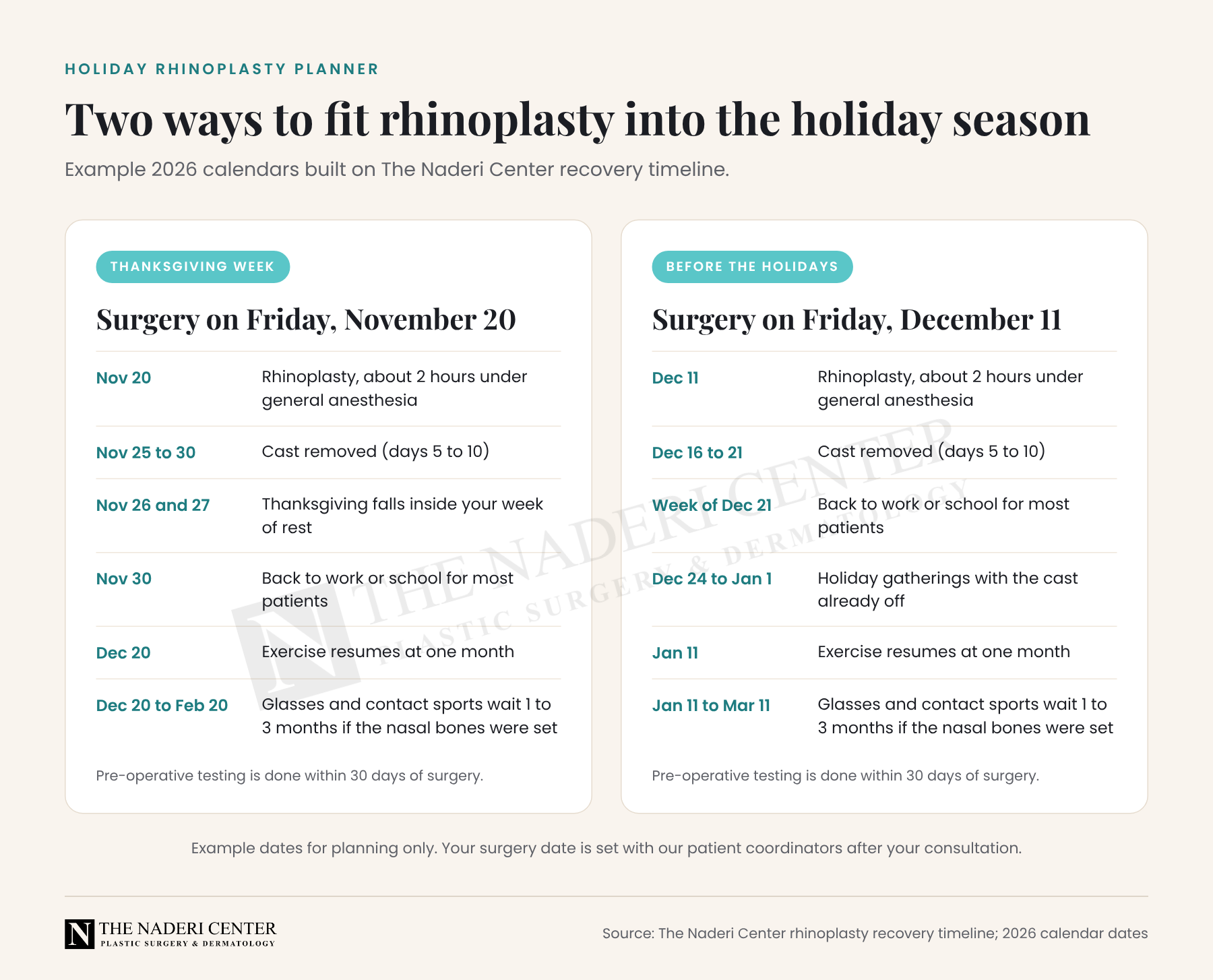
Two windows tend to work beautifully. A Friday surgery just before Thanksgiving week lets the holiday fall during your recovery at home, while a date in early or mid December allows the cast to come off before Christmas Eve. The planner below shows both with example dates you are welcome to bring to your consultation.
What does a natural-looking nose mean today?
A natural nose is one that looks as if you were born with it and sits in harmony with the rest of your face. That wish is shared widely: in a May 2026 release, the American Academy of Facial Plastic and Reconstructive Surgery reported that 73 percent of its surgeons say looking unnatural is their patients’ top concern, and that rhinoplasty is the leading surgical procedure for patients under 34.
Dr. Naderi plans every nose with computer imaging that he performs himself, morphing your own photographs on a large screen so you can see the proposed change and ask for adjustments before surgery. “It’s important to me that as the surgeon, I perform all of the imaging rather than a photographer, making sure what I show on the computer screen is surgically plausible,” he explains. You are welcome to bring photos of noses you admire, and of looks you would rather avoid.
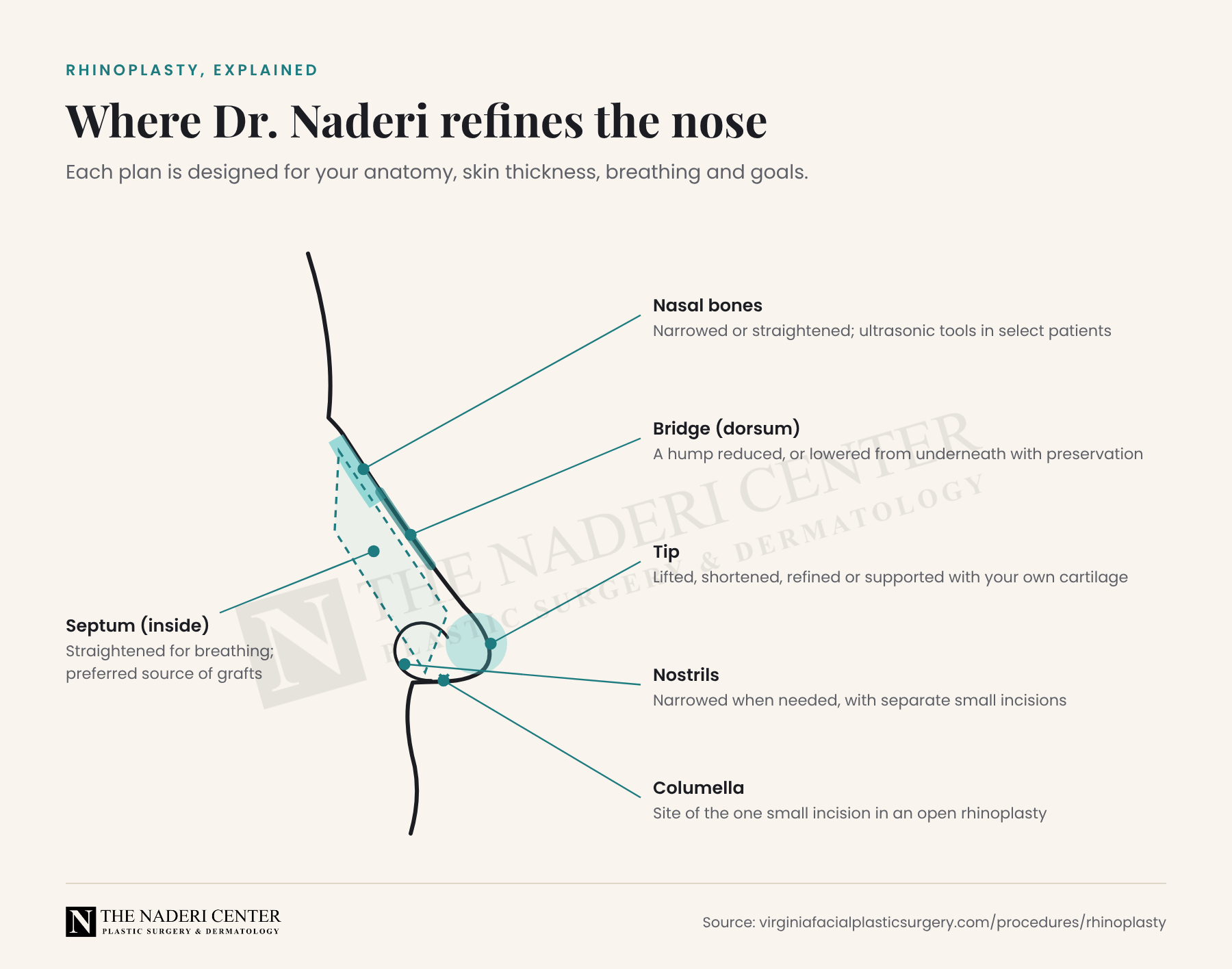
Depending on your anatomy, the plan may reduce a dorsal hump, narrow the nasal bones, or lift, shorten and refine the tip. When there is enough of it, Dr. Naderi prefers to use cartilage from your own septum for support, and he reserves techniques such as preservation rhinoplasty and ultrasonic rhinoplasty for the noses they suit. The diagram below shows where these refinements take place.
Will I need closed or open rhinoplasty?
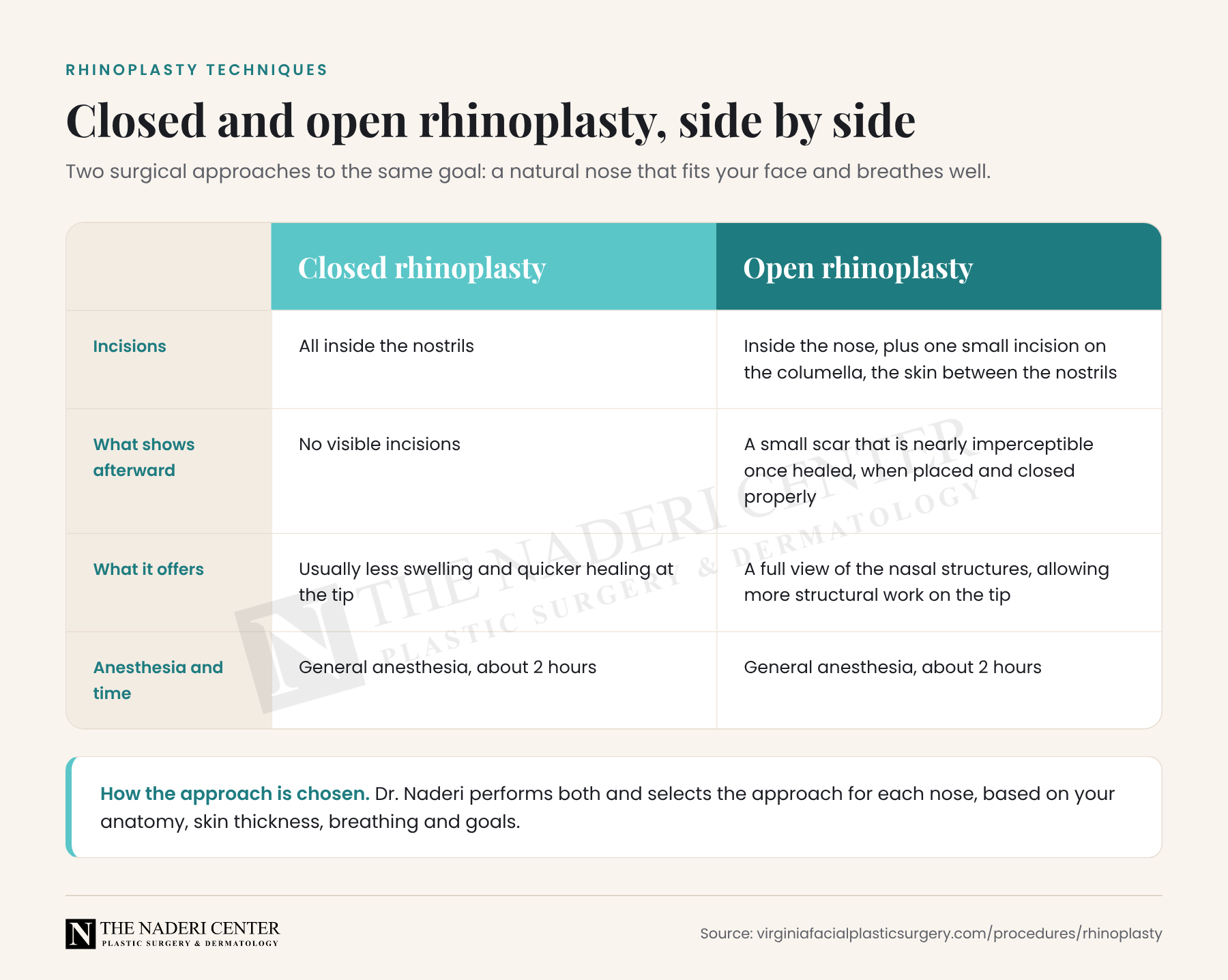
Dr. Naderi performs both and chooses the approach for each nose. In a closed rhinoplasty every incision sits inside the nostrils, which usually means less swelling and quicker healing at the tip. An open rhinoplasty adds one small incision on the columella, the skin between the nostrils, which gives a full view of the framework for more structural work on the tip. Placed and closed properly, that small incision becomes nearly imperceptible.
“I don’t use technique names as a selling point,” says Dr. Naderi. “Your skin, your breathing and the shape you hope for tell me which approach will give you the most graceful, lasting result, and I’m happy to walk you through that reasoning at your consultation.” If your skin is on the thicker side, our guide to thin-skinned and thick-skinned rhinoplasty explains how it shapes the plan.
What is rhinoplasty recovery like, week by week?
Rhinoplasty takes about two hours under general anesthesia at Prince William Surgery Center, where board-certified anesthesiologists oversee your anesthesia care. Dr. Naderi does not routinely pack the nose, so many patients need little or no pain medication.
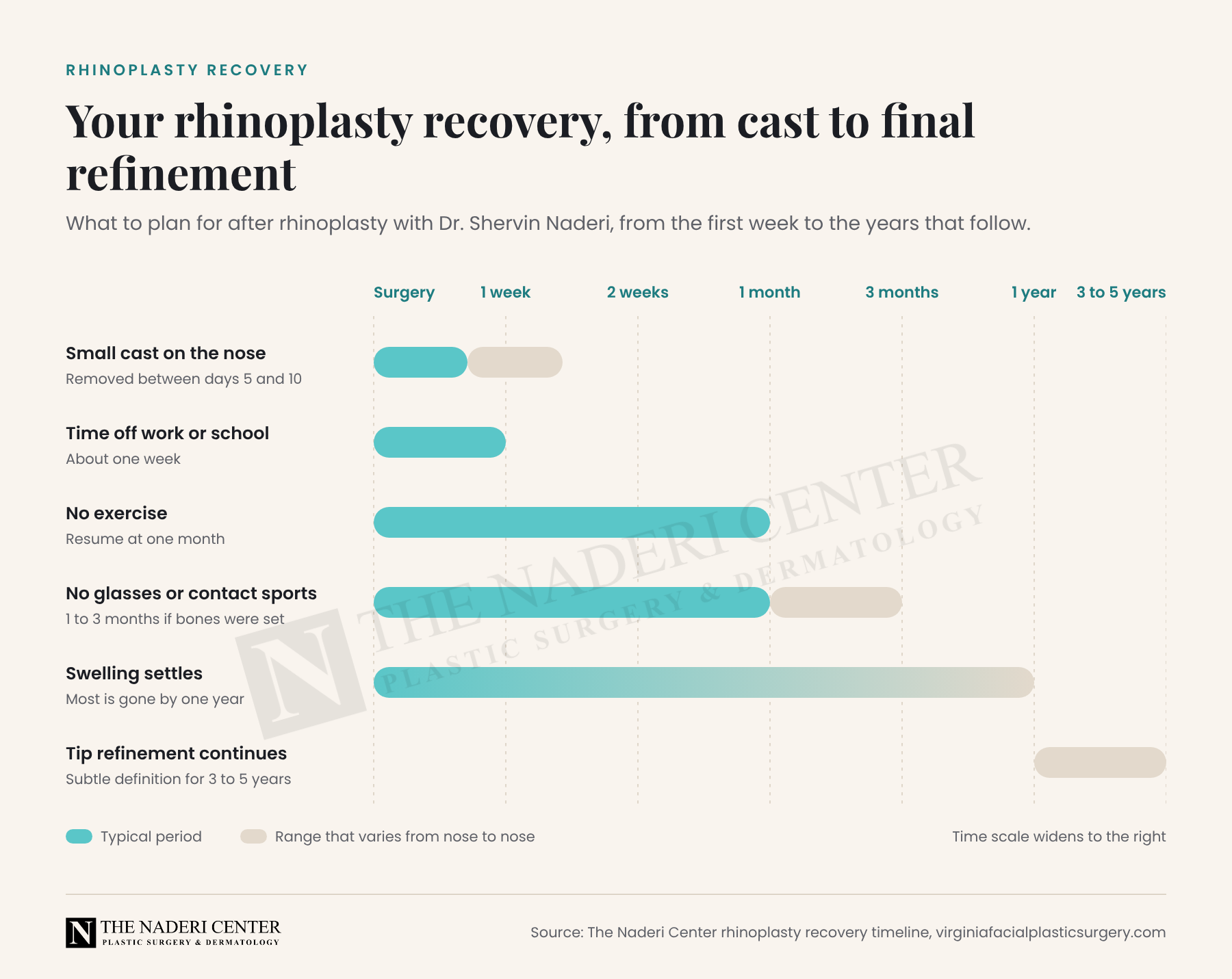
During the first week a small cast protects your nose, and some bruising and swelling around the nose and eyes is expected. Cold compresses are soothing. Dr. Naderi removes the cast between days 5 and 10, and most patients return to work or school after about one week, with a little cover-up makeup for any light bruising. Patients in Arlington and Alexandria who work in the District often pair that first week with holiday leave or telework days.
Exercise waits for one month, which helps prevent nosebleeds and keeps swelling down. If the nasal bones were set, glasses and contact sports wait one to three months, and your physician will let you know which timeline applies to you.
Most patients are enjoying their new nose within a month, and most of the swelling has resolved by one year. After that, the tip continues to refine and gain definition for three to five years, particularly with thicker skin. “I always encourage a little grace with the tip,” Dr. Naderi says. “The nose you see at one month is lovely, and it keeps becoming more refined for years. That gradual settling is part of why it looks like your own.”
Can I travel for the holidays after rhinoplasty?
Yes, with gentle planning. Heavy exercise, excess heat and changes in altitude can increase swelling in the early weeks, so a long flight or a hot tub at a ski lodge is best saved for later in your recovery. If your holiday plans include a drive west from Great Falls into the mountains, Dr. Naderi will help you time it around your healing.
Patients who come to us from out of town follow a simple plan. You arrive one to two days before surgery to meet Dr. Naderi in person, stay for one week afterward and then travel home, with your one-month visit done by telehealth. Our offices are close to Dulles International, Reagan National and BWI airports, and our guide for out-of-town patients includes hotels near the Reston office, such as the JW Marriott Reston Station and the Hyatt Regency Reston.
Closer to home, a family dinner in Potomac during your second week is often quite comfortable, since the cast is off by then. “We choose your date together, around the moments you want to be fully present for,” says Dr. Naderi. “That bit of planning lets you welcome the season with confidence.”
How should I prepare in the weeks before rhinoplasty?
Preparation is simple and makes a meaningful difference. Stop smoking at least two weeks before surgery, since smoking impairs circulation and slows healing, and review your medications, vitamins and herbal supplements with our team. Avoid aspirin and ibuprofen before and after surgery, and use Tylenol if you need a pain reliever. Patients from Vienna often like to have cold compresses and the recovery products our surgeons recommend waiting at home before surgery day.
Feeling ready matters as much as the practical steps. Dr. Naderi takes time to understand why you want surgery, and he will gently advise against it when it is not in your best interest. For a teenager home on winter break, the minimum age is 14, and only once the face has essentially finished growing; he often meets younger patients more than once, because the decision must belong to the person having surgery.
Where can I get rhinoplasty near McLean, Bethesda or Washington DC?
For rhinoplasty in Washington DC and its suburbs, Dr. Naderi sees patients at both offices of The Naderi Center, and consultations are offered at each. Patients join us from Bethesda and Chevy Chase in Maryland and from throughout Northern Virginia, so you may choose whichever office suits your week.
Our Reston office is at 1850 Town Center Parkway, Pavillion II, Suite 551, Reston, VA 20190, (703) 481-0002. Our Chevy Chase office is at 5454 Wisconsin Ave, Suite 1655, Chevy Chase, MD 20815, (301) 222-2020, on the Maryland side of the District line. For patients from Maryland and Washington DC, we hold your consultation, pre-operative visit and follow-up appointments in Chevy Chase whenever possible. The surgery itself takes place at Prince William Surgery Center in Virginia, where Dr. Naderi has served as medical director since 2023, and car service to and from surgery can be arranged if you need it.
Dr. Naderi brings more than 20 years of experience with a strong surgical focus on rhinoplasty, and he was named to Newsweek’s America’s Best Plastic Surgeons for rhinoplasty in 2023, 2024, 2025 and 2026. “Rhinoplasty is surgery measured in millimeters,” he says. “It is a privilege to help someone see a nose in the mirror that finally feels like theirs.” You can read more about his training on his biography page.
Rhinoplasty before and after photos
The patients below each had rhinoplasty with Dr. Naderi. You may notice how each nose sits in balance with the face, with changes that look settled and personal. Many more cases are in our rhinoplasty gallery.
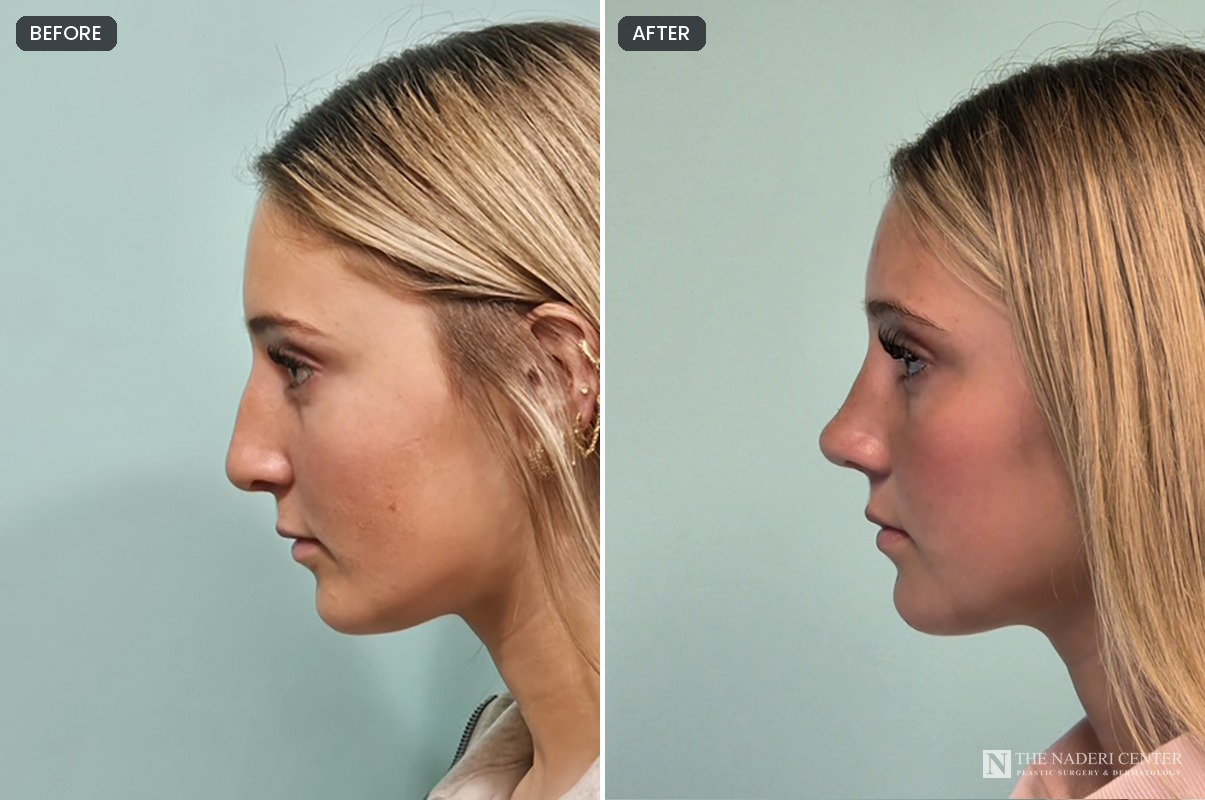
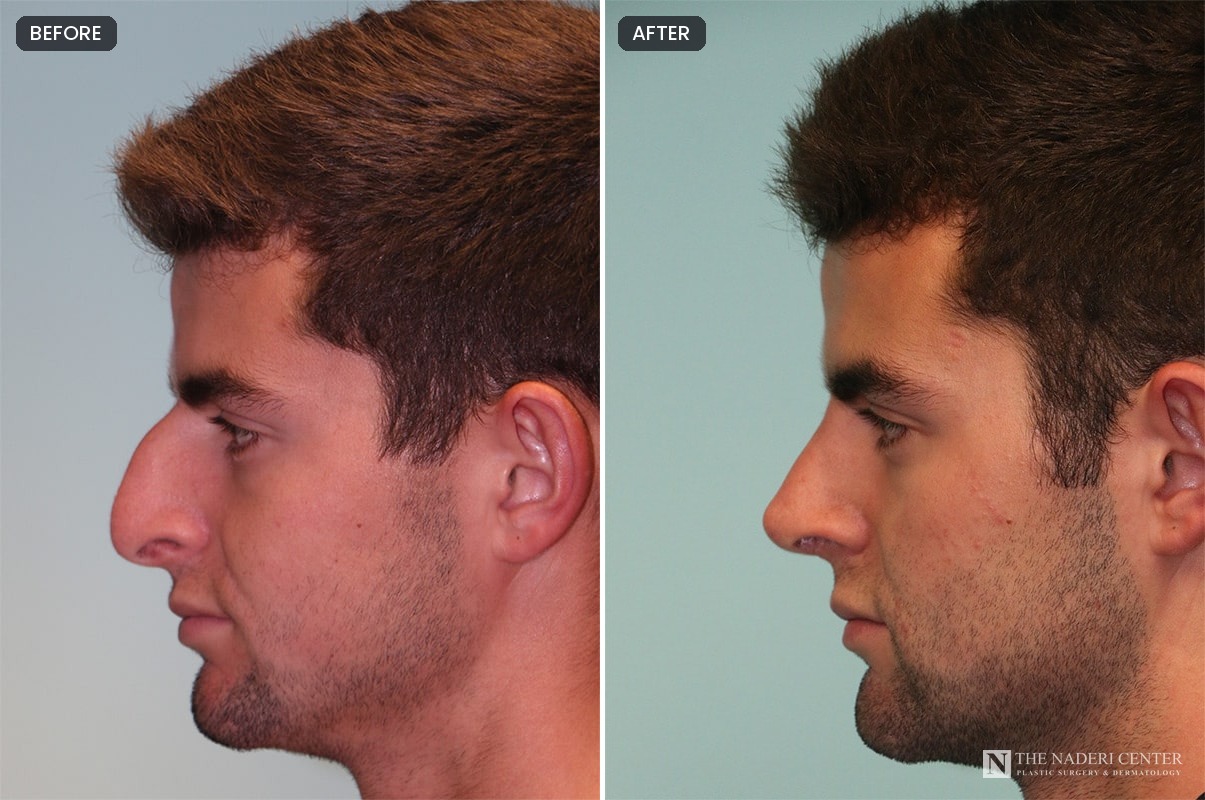
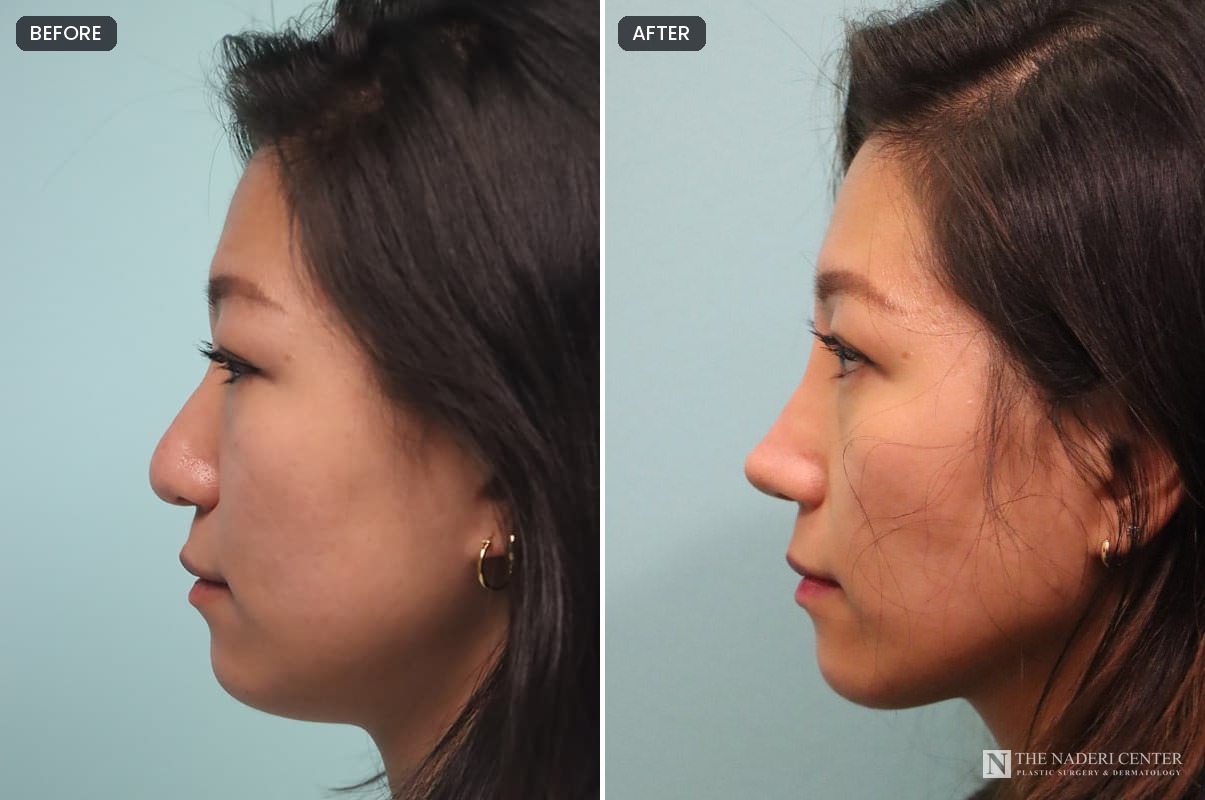
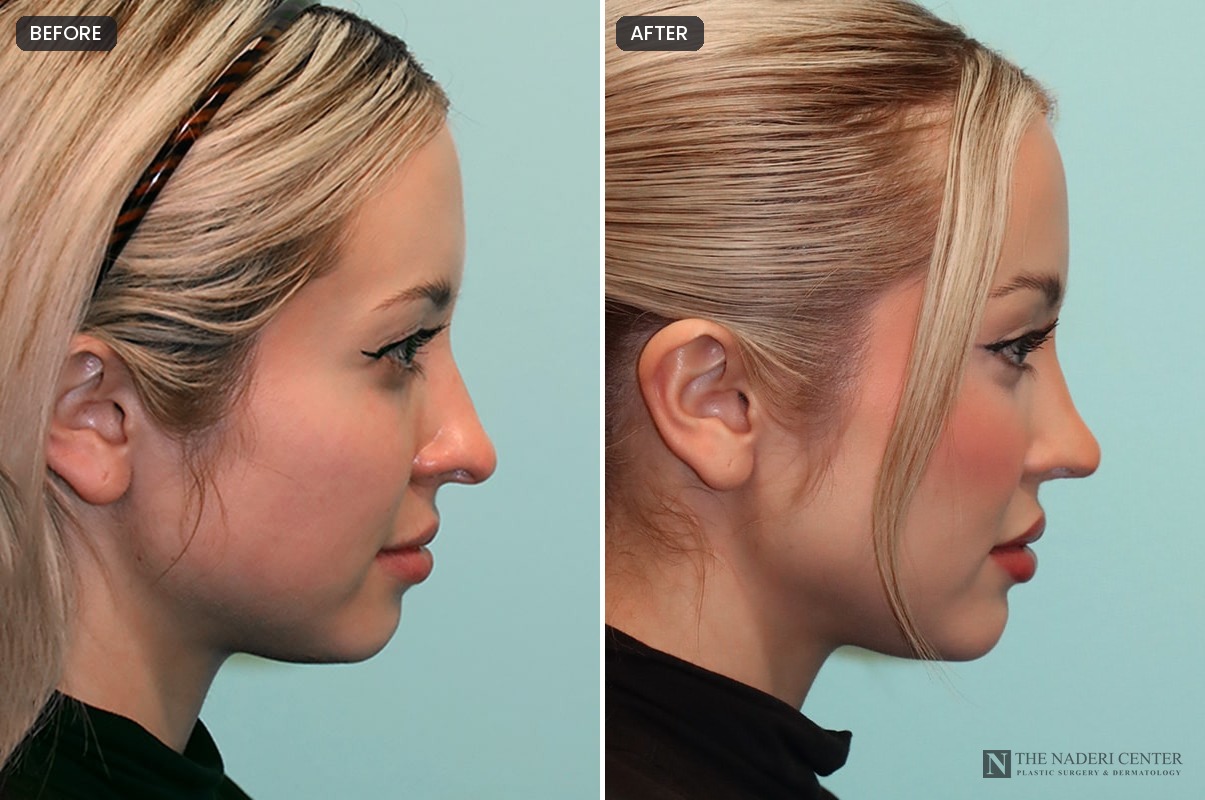
Real patients of The Naderi Center. Individual results vary.
If a refined, natural nose has been on your mind, the holiday season may be the gentle opening you have been waiting for. We would be delighted to welcome you to Reston or Chevy Chase and show you, with imaging, what is possible for your face. You can book your consultation online, and our patient coordinators will be glad to help with every detail.
Frequently asked questions
How much does rhinoplasty cost at The Naderi Center?
Primary rhinoplasty with Dr. Naderi is $18,000 to $27,000, which includes the surgeon’s fee, anesthesia and the surgical facility. The consultation for primary rhinoplasty is $250 and is applied to your surgery when you schedule within three months, and financing is available through Cherry.
Will insurance pay for any part of my rhinoplasty?
Medical insurance does not pay for cosmetic rhinoplasty. The functional portion of nasal surgery, such as correcting a breathing problem, may be covered when your plan is one we are in network with, and our team will be glad to help you check.
Can a deviated septum be corrected at the same time?
Yes. Rhinoplasty and septoplasty are often performed together, so the septum can be straightened for better airflow during the same operation that refines the shape of your nose.
Is it normal for the tip of my nose to feel firm afterward?
Yes. Swelling and early scar tissue feel firm, and cartilage grafts add some firmness of their own. Much of that firmness softens with time, though a little of it remains as part of the nose’s new support.
Can I start with a virtual consultation?
Yes. You can begin with a virtual consultation by sending photos using our rhinoplasty photo guide, and your consultation fee includes an in-person visit with Dr. Naderi before surgery.
Is there an upper age limit for rhinoplasty?
No. As long as you are healthy, there is no upper age limit, and in older patients, lifting a drooping tip can make the whole face look more rested and youthful.