Fat Transfer Under the Eyes: Who It Helps and What to Expect
A hollow under the eyes can make you look tired no matter how well you slept. Here is your guide to treating it with your own fat: who it suits, how Dr. Shervin Naderi performs it, and what the weeks afterward look like.
The short answer
- For a true hollow under the eyes, your own fat is the longest-lasting option.
- Bags are different: they are treated with lower eyelid surgery, often with fat below them.
- Fat transfer is surgery, done by Dr. Naderi in the operating room under general anesthesia.

The skin under the eyes is the thinnest on the face. When volume fades from the area where the lower eyelid meets the cheek, a groove forms there, called the tear trough. Light catches the edge above it and leaves a shadow below, and the eyes start to look tired, even after a full night of sleep.
Many people first try concealer, then filler. For some, those work well. For others, especially patients who want something that lasts, the conversation turns to fat transfer: moving a small amount of your own fat to fill the hollow.
Is It a Hollow or a Bag?
This is the first question Dr. Naderi answers at every under-eye consultation, because the two look similar in photos and need opposite treatments.
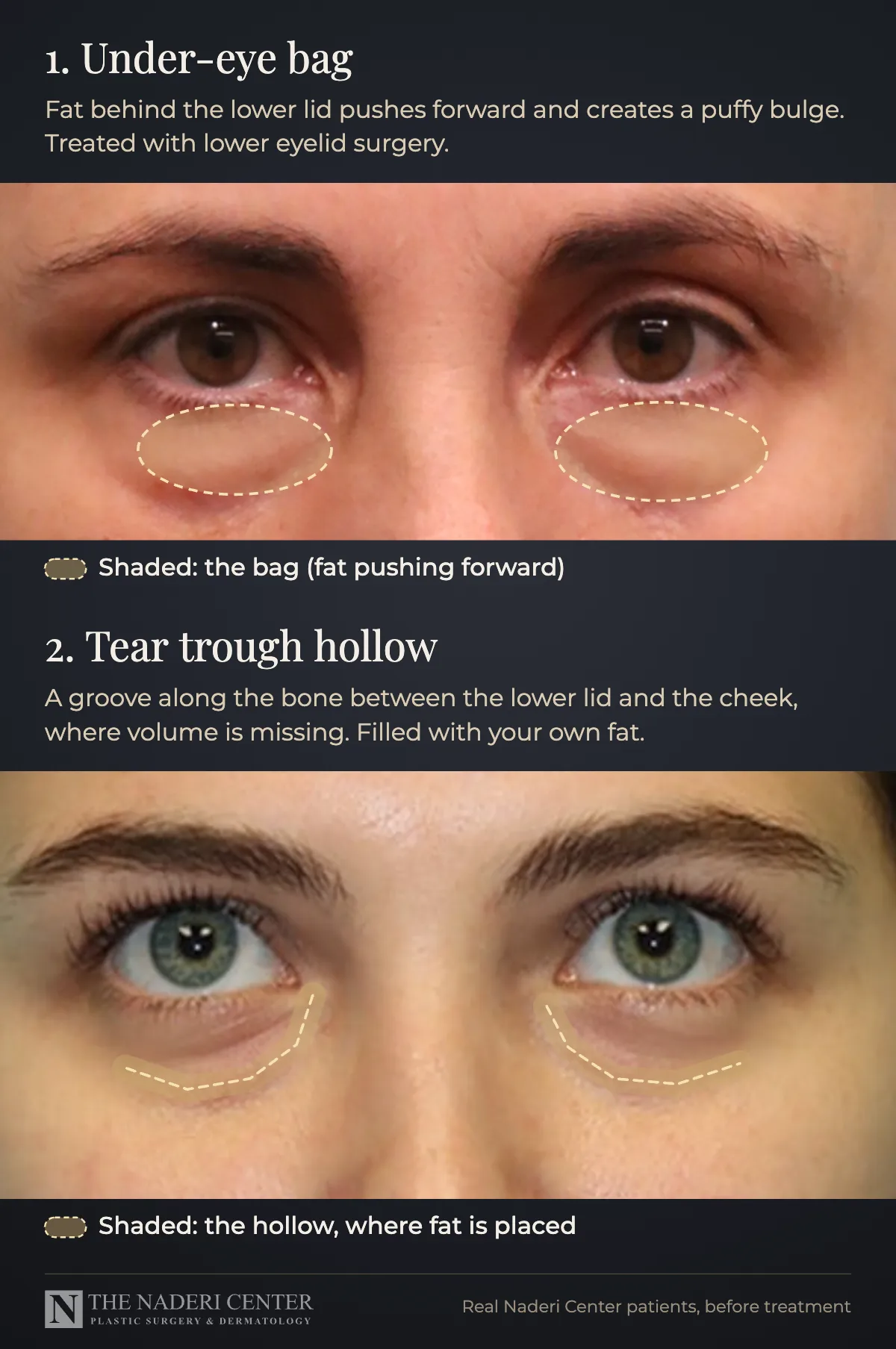
A bag is fat inside the lower eyelid that has pushed forward and casts a shadow below it. Adding more volume there would only make it bigger. Bags are treated with lower eyelid surgery, which removes or repositions that fat.
A hollow is the opposite: volume that is missing along the rim of the eye socket. That is where fat transfer helps. Many people have a little of both, which is why the plan always starts with an exam rather than a photo.
In his video on under-eye bags, dark circles and tear troughs, Dr. Naderi walks through how he tells them apart.
Why Fat Instead of Filler?
Filler can soften a tear trough, and in the right patient it is a good choice. It is quick, done in the office and can be dissolved. But the under-eye skin is so thin that filler can sometimes show through as a faint bluish tint, and it needs to be repeated over time.
Fat is your own tissue. For a true hollow under the eyes, it is the longest-lasting option Dr. Naderi offers. In his video on tear trough filler, he explains why he points many patients to PRF gel or to micro and nano fat instead.
“If you want something more permanent, it’s fat injections, micro and nano fat.”Dr. Shervin Naderi
Fat also does something filler does not. Dr. Naderi notes that fat has properties similar to PRF, PRP and exosomes, which is part of why he calls it the beauty of fat: it can improve the skin above it, not only fill beneath it.
Microfat and Nanofat
Under the eyes, fat is never placed in large amounts. Dr. Naderi refines it into very small particles so it sits smoothly in the thinnest skin of the face.
Microfat is fine enough to fill a hollow evenly. Nanofat is finer still and adds very little volume; it acts a little like PRF and PRP to improve the quality of the skin. He may use both in the same procedure, along the tear trough.
He also treats the mid-face at the same time in most patients. When the cheek loses fullness, the lower eyelid looks longer and the hollow looks deeper, so most people who need one need both.
How Dr. Naderi Performs It
Fat transfer is surgery. Dr. Naderi performs every one himself, in the operating room under general anesthesia, at one of the surgery centers where he operates. A board-certified anesthesiologist supervises a nurse anesthetist (CRNA), who stays with you the entire time.
There is a reason it is done asleep. Numbing medicine such as lidocaine can harm fat cells, and avoiding it helps more of the fat survive.
The fat is taken from an area where you have some to spare, then purified. Depending on its quality, he either spins it in a centrifuge or lets it settle so the fluid can be poured off, then refines it into microfat and sometimes nanofat. On its own, the procedure takes about 90 minutes to 2 hours.
Technique matters most under the eyes. Dr. Naderi injects fat perpendicular to the area being filled, because fat placed at the wrong angle can leave a lumpy, sausage-like ridge that is very hard to fix.
With Lower Eyelid Surgery
Fat transfer is often part of a larger plan. When Dr. Naderi removes the fat pads that cause under-eye bags, he often grafts fat below them to smooth the eyelid into the cheek, which can give an even better result than either step alone.
It can also be combined with a facelift or with laser resurfacing, which treats the skin itself while the fat restores volume beneath it.
Recovery
Your recovery, stage by stage
- 2 weeks beforeGetting readyStop all nicotine at least 2 weeks before, 4 weeks preferred, because nicotine keeps transferred fat from surviving. Follow the Naderi anti-bleeding, anti-bruising diet.
- Surgery dayAbout 90 minutes to 2 hoursIn the operating room under general anesthesia. You go home the same day with a responsible adult.
- Days 1 to 3Rest and cool compressesSleep with your upper body raised about 45 degrees. Cool compresses for 15 to 20 minutes about every hour while awake.
- Weeks 1 to 2Back to workMost patients return to work in 1 to 2 weeks. Avoid flying for 7 to 10 days.
- 1 monthBack to exercise, slowlyNo exercise or lifting over 20 pounds for the first month, then build back gradually.
- About 3 monthsYour final resultThe swelling has settled and the fat that stays has settled in.
Swelling and bruising are normal at first, and the area can look a little full while it settles. Not all of the transferred fat stays; roughly 50 percent may remain, which is why a touch-up is sometimes needed.
Who Is a Good Candidate?
Fat transfer under the eyes suits adults in good general health with a true hollow along the tear trough, who want the longest-lasting option rather than repeat filler and who are comfortable with a surgical procedure.
Some patients are better served by something else. Bags that cast a shadow call for lower eyelid surgery. Thin, crepey skin or dark circles from pigment respond better to PRF or to skin treatments from our cosmetic dermatology team. And patients who prefer an office visit to surgery may start with tear trough correction using filler or PRF.
Patients see Dr. Naderi from Reston, Herndon, McLean, Great Falls, Vienna and Arlington in Northern Virginia, from Bethesda, Potomac and Chevy Chase in Maryland, and from across Washington, DC.
Common Questions
Can fat be injected under the eyes?
Yes. For a true hollow under the eyes, fat is the longest-lasting option. Dr. Naderi places it as micro and nano fat along the tear trough and usually treats the mid-face at the same time.
Is under-eye fat transfer better than filler?
Fat lasts the longest and is your own tissue, so it avoids the bluish look filler can leave in thin under-eye skin. Filler is done in the office and can be dissolved. Dr. Naderi will tell you which suits your eyes.
How much of the fat stays?
Roughly 50 percent of the transferred fat may remain. One session is usually enough, though a touch-up is sometimes needed.
Can fat transfer fix under-eye bags?
No. Bags come from fat that bulges forward and are treated with lower eyelid surgery. During that surgery, Dr. Naderi often grafts fat below the bags to smooth the eyelid into the cheek.
How long is recovery?
Most patients return to work in 1 to 2 weeks. The final result is typically seen at about three months.
Begin with a Conversation
Bring us your questions. We will bring the experience. Meet Dr. Naderi in Reston, minutes from McLean and Tysons, in Chevy Chase, near Bethesda and Washington, DC, or virtually.
Reston (703) 481-0002 · Chevy Chase (301) 222-2020
Learn more on our facial fat transfer page, including before-and-after photos, cost and every area fat can restore.
Medically reviewed by Dr. Shervin Naderi, MD, FACS, double board-certified facial plastic surgeon. The Naderi Center for Plastic Surgery and Dermatology, Reston, VA and Chevy Chase, MD. Last reviewed November 13, 2026.

Patient Financing
Pay Over Time with Cherry
Monthly payment plans for surgery and treatments, including 0% APR options for qualifying patients. Checking whether you qualify won’t affect your credit score.